
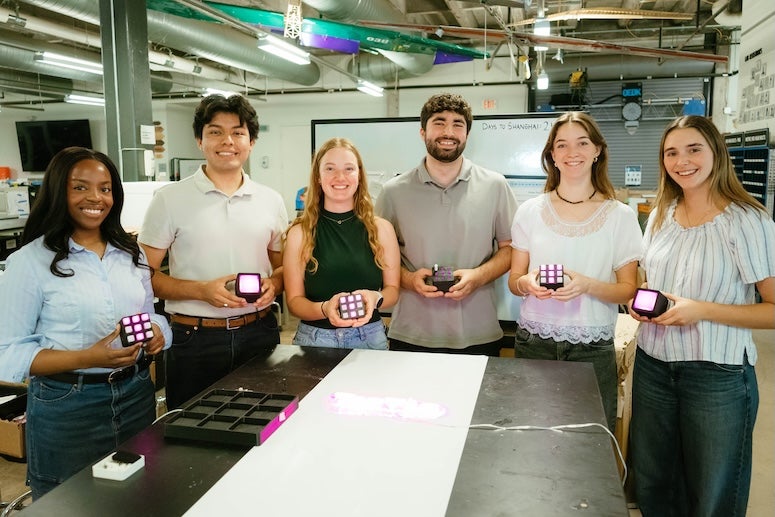
A team of Rice University mechanical and electrical engineering students has developed an interactive, modular rehabilitation system designed to make stroke recovery more engaging, adaptable and effective for patients at home.
The project, called TacTile, was created in Rice’s Oshman Engineering Design Kitchen (OEDK) and earned top honors at the HUFF OEDK Engineering Design Showcase, where it won first place in the Willy Revolution Award for Outstanding Innovation. The team was also selected as the sole North American representative for the international IEEE Circuits and Systems Society Student Design Competition in Shanghai and won first place at the event.
Comprised of graduating seniors Amelia Pillar, Avery Janenda, Brian Mercado, Hannah Wixom, Mina Schepmann and Tomi Kuye, the team set out to address a persistent challenge in stroke recovery: how to keep patients motivated and consistent with therapy once they leave the clinic.
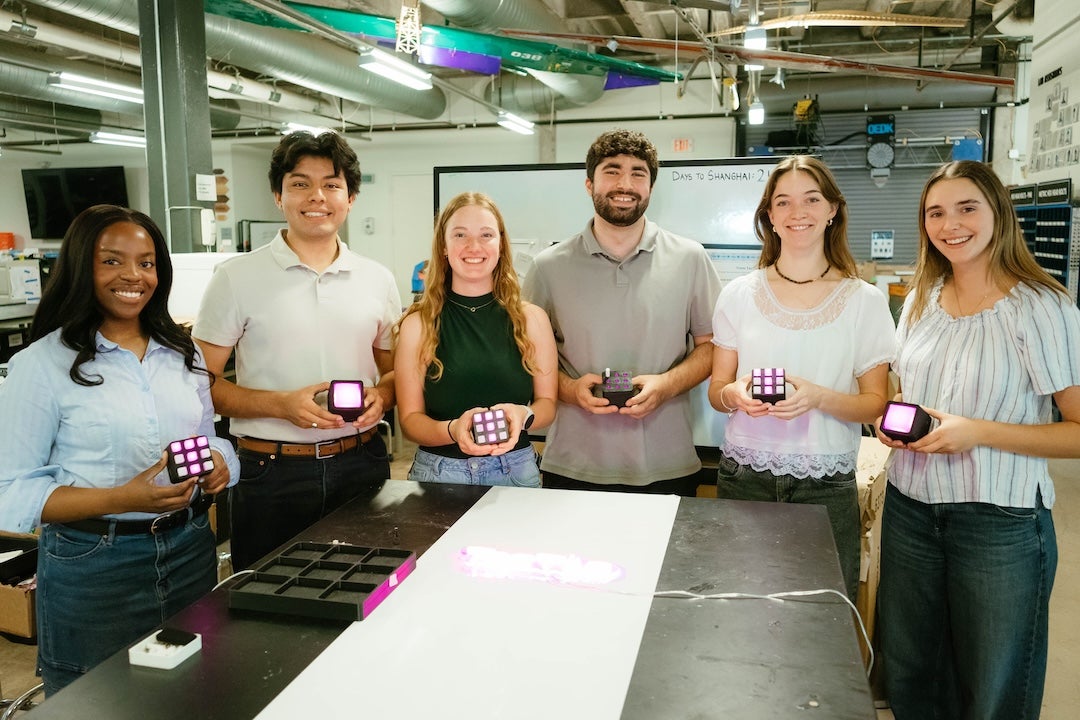
“After a stroke, patients might spend an hour a day in clinical rehab, but they’re expected to continue hundreds of repetitive exercises at home,” Pillar said. “That can be incredibly monotonous. We wanted to create something that makes the rehab process more engaging while also helping patients actually see their progress over time.”
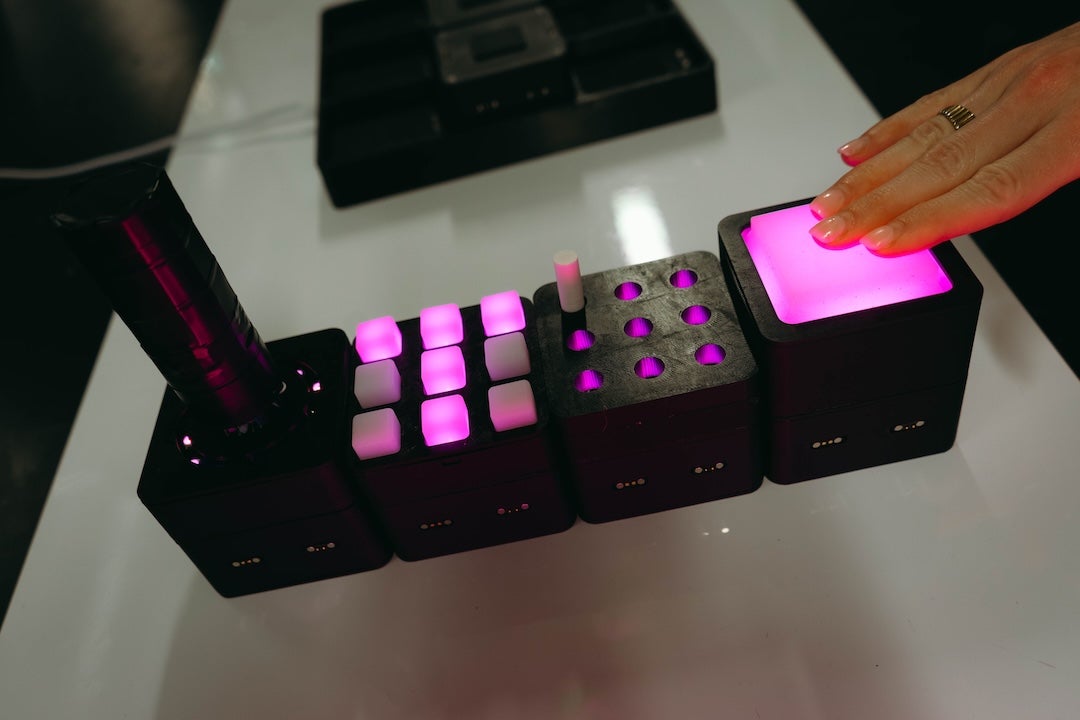
TacTile transforms upper-extremity rehabilitation into an interactive gaming experience. The system consists of modular “tiles,” each with interchangeable sensor tops that target different movements of the wrist, fingers and elbow. These tiles function as game controllers, allowing users to complete therapy exercises while playing digital games.
“Essentially, the user is playing games on a screen while interacting with the tiles,” Kuye said. “Behind the scenes, we’re tracking metrics like speed, accuracy and how often they hit targets. That data helps paint a picture of their progress.”
The system includes interchangeable components tailored to different stages of recovery, from gross motor movement to fine motor control.
“We designed four different tile tops, each targeting a specific function,” Schepmann said. “There’s a large button for elbow and wrist movement, a pegboard for fine motor skills, a keypad for finger extension and a joystick for wrist rotation and grip strength. The idea is that therapy can evolve with the patient.”
From the outset, the team worked closely with rehabilitation specialists to ensure the device addressed real clinical needs.
“We collaborated with therapists throughout the design process, from early concept development to testing prototypes,” Wixom said. “One of the biggest advantages of our system is its modularity. If a therapist identifies a movement we haven’t covered, new tile tops can be developed to meet that need.”
That flexibility also allows TacTile to adapt to patients with varying levels of impairment, offering a more personalized rehabilitation experience.
While at-home rehabilitation devices exist, the team said TacTile stands out by combining physical therapy, cognitive engagement and real-time feedback in a single system.
“Many existing devices focus on a single motion, like pressing a button, and they can be expensive,” Mercado said. “Our design allows for multiple interchangeable components and an expandable game library, which makes it more versatile and engaging.”
The system also addresses a key gap in at-home therapy: feedback. The tiles communicate with a user interface, which displays progress to motivate patients and also inform therapists.
“In the clinic, patients have a therapist guiding them, but at home, that feedback often disappears,” Pillar said. “We wanted to give patients a way to track their progress and stay motivated — whether that’s seeing improvement over time or trying to beat their own score.”
Sponsored by Harrell Huff and developed under the guidance of Marcia O’Malley, chair of the Department of Mechanical Engineering at Rice, TacTile reflects the program’s emphasis on hands-on, real-world problem solving.
“I’m so happy with the design solution that Team TacTile has come up with,” O’Malley said. “Their modular tiles and tops, along with their games and performance tracking system, create so many ways for stroke survivors to keep their rehabilitation exercises engaging. This team has been great to work with — they each learned new skills and demonstrated outstanding collaboration throughout the year.”
Although the students graduated this spring, they remain committed to the project and to their goal of improving recovery outcomes by making rehabilitation something patients want to do.
“If we can make therapy more engaging and help patients stay consistent, we believe we can make a real difference in their recovery,” Janenda said.