

Rice University welcomes US Navy research official on campus visit
Rice University welcomed Brett Seidle, deputy assistant secretary of the Navy for research, development, test and engineering, on a campus visit Oct.13.
Rice University welcomes US Navy research official on campus visit
Rice University welcomed Brett Seidle, deputy assistant secretary of the Navy for research, development, test and engineering, on a campus visit Oct.13.

Tunes on wheels: Rice Shepherd School bringing free music to community via The Concert Truck
Classical music from Rice University’s Shepherd School of Music is coming to several locations around Houston Oct. 24 and 26 thanks to a fully functioning mobile concert hall called The Concert Truck.

Rice, Houston Methodist showcase new Center for Human Performance at kickoff event
Rice and Houston Methodist unveiled the Houston Methodist-Rice University Center for Human Performance during a kickoff event Oct. 10.

Rice Shepherd School’s James McCarthy named 2024 San Francisco Opera Adler Fellow
James McCarthy, a graduate student in voice at Rice’s Shepherd School of Music , has been named a recipient of the 2024 San Francisco Opera (SFO) Adler Fellowship.
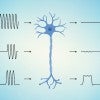
Rice-engineered material can reconnect severed nerves
Rice neuroengineers designed the first self-rectifying magnetoelectric material and showed it can not only precisely stimulate neurons remotely but also reconnect a broken sciatic nerve in a rat model.
Climate catastrophe produced instantaneous evolutionary change
A unique experiment by Rice University biologists in the wake of 2017’s Hurricane Harvey that revealed species can instantly evolve when they move in response to a climate catastrophe.

Rice, Houston Methodist to unveil state-of-the-art Center for Human Performance Oct. 10
Rice University and Houston Methodist will unveil the Houston Methodist-Rice University Center for Human Performance in an Oct. 10 kickoff event featuring demonstrations of the center’s state-of-the-art capabilities.
STaRTing the school year right
For the third year in a row, Rice’s School of Social Sciences held STaRT@Rice, an innovative program that provides a snapshot of the research process coupled with professionalization training.

A new National Science Foundation-funded study by Rice University will examine whether design strategies aimed at improving civic engagement in stormwater infrastructure could help reduce catastrophic flooding.
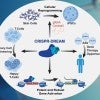
DREAM tool for gene therapies uses ‘locally sourced’ components
Rice bioengineers developed a tool that activates silent or insufficiently expressed genes using human-derived building blocks and a CRISPR-based genome-targeting platform.

Robotic cup helps wheelchair users stay hydrated
Rice undergraduate engineering students Thomas Kutcher and Rafe Neathery designed a robotic device that enables people with limited mobility to stay hydrated without caretaker help.

Interdisciplinary Rice team tackles the future of semiconductors
An interdisciplinary team of Rice University scientists has won a $1.9 million National Science Foundation grant for research on materials that could serve as the basis for next-generation energy-efficient computing devices.

Rice alum Louis Brus awarded Nobel Prize in chemistry
Rice alumnus Louis Brus (’65) has been awarded the Nobel Prize in Chemistry alongside Moungi Bawendi and Alexei Ekimov for the “discovery and development of quantum dots.”

Rice Biotech Launch Pad introduces external advisory board
Rice University today announced its external advisory board for the Rice Biotech Launch Pad, the new accelerator focused on expediting the translation of the university’s health and medical technology discoveries into cures.

Two Rice bioengineers win NIH Director’s New Innovator awards
Rice bioengineers Jerzy Szablowski and Julea Vlassakis received the NIH Director’s New Innovator Award for their respective research projects. Szablowski’s work seeks to develop a noninvasive method of mapping gene expression, while Vlassakis is studying complex, single-cell level processes and interactions in pediatric bone cancer.