HOUSTON – (Feb. 23, 2021) – Low-income livestock farmers in developing countries are often faced with a difficult dilemma: protect their animals from endangered predators, or spare the threatened species at the expense of their livestock and livelihood.
Rice engineer Yingyan Lin has won a National Science CAREER Award to help close the gap between fast “deep learning” algorithm advances and slow accelerator development.
Researchers receive funding for up to $1 million to develop a real-time electronic sensor able to detect minute amounts of the airborne virus that causes COVID-19 infection.
Tuberculosis bacteria have evolved to remember stressful encounters and react quickly to future stress, according to a study by computational bioengineers at Rice University and infectious disease experts at Rutgers New Jersey Medical School.
Rice's Ken Kennedy Institute is collaborating with the University of Texas MD Anderson Cancer Center on data science research into long-term outcomes and improved treatment methods for COVID-19.
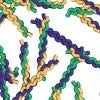
An algorithm by Rice University scientists predicts the structures and melting temperatures of collagen, the triple helix that accounts for about a third of the body’s proteins and forms the fibrous glue in skin, bones, muscles, tendons and ligaments.