
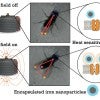
Wireless activation of targeted brain circuits in less than one second
Rice neuroengineers and collaborators have created wireless technology to remotely activate brain circuits.
Wireless activation of targeted brain circuits in less than one second
Rice neuroengineers and collaborators have created wireless technology to remotely activate brain circuits.
Strain-sensing smart skin ready to deploy
Carbon nanotubes’ natural fluorescence enables a method to detect high strain concentrations, which can lead to damage that threatens the integrity of critical infrastructure like aircraft, buildings, pipelines, bridges and ships.
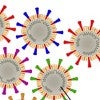
SARS-Arena reveals hidden hooks in virus
SARS-Arena will help to find conserved parts in proteins from SARS-CoV-2 that could be a key for the development of wide-spectrum vaccines.
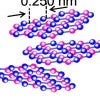
Flashing creates hard-to-get 2D boron nitride
Rice University chemists use their flash Joule heating process to synthesize 2D flakes of boron nitride and boron carbon nitride, highly valued for lending thermal and chemical stability to compounds.
Hidden genes may be tapped for new antibiotics
Rice University bioscientists learn to trigger “silent” gene clusters in bacteria that could be rich sources of new antibiotic candidates.

Padley named vice president for IT, chief information officer
Paul Padley, a professor of physics and astronomy and director of Rice’s Bonner Nuclear Laboratory, has been named the university’s vice president for information technology and chief information officer. Padley assumed the position on an interim basis last summer when Klara Jelinkova stepped down from the post.
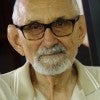
Nobel laureate, beloved Rice professor Robert Curl dead at 88
Nobel Prize-winning chemist and beloved Rice University Professor Robert Curl died July 3 at age 88.

On first day, President DesRoches thanks Rice community for support
Today marks my first day as president of Rice University and exactly five years since I first arrived at Rice. I am humbled and grateful for the opportunity to serve such a distinguished institution and have already received a tremendous amount of support.

Leebron expresses gratitude as he says goodbye
This is the final day of my service as president of Rice, and I face just one key but difficult task, namely to try to adequately express our gratitude to the Rice community. Ping and I came to Rice 18 years ago with only an inkling of what lay ahead. We were excited by what we had learned about Rice, including what the university had accomplished and what its ambitions were. We were hopeful about what we might contribute, and yet not sure what to expect.
Researchers discover new leukemia-killing compounds
Researchers from Rice and MD Anderson Cancer Center have discovered potential new drugs for treating leukemia.
New senior staff, structure announced for Rice’s Kinder Institute for Urban Research
As incoming director Ruth López Turley takes the helm of Rice University’s Kinder Institute for Urban Research July 1, the institute is announcing a new executive leadership team that will help implement a five-year expansion plan.

Emu stands tall at detecting bacteria species
Rice computer scientists develop Emu, which uses long reads of genomes to identify bacteria in a community.

Flooding exacerbates pollution exposure in at-risk urban communities
Increased flooding in the U.S. is exposing more people to industrial pollution, especially in racially marginalized urban communities, according to new research from Rice University, New York University and Brown University.

Landmark new engineering and science building on campus to bear Ralph S. O’Connor’s name
A self-made businessman who started out working in oilfields and ended up building an empire in energy and real estate investments will be memorialized at Rice University with a landmark new science and engineering building named in his honor.
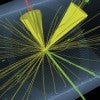
An Owl’s-eye view of the Higgs boson at 10
Anniversary finds Rice physicists pushing forward as Large Hadron Collider reboots