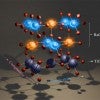
Rice's Ming Yi recently showed that the quantum material ruthenium dioxide potentially displays this new altermagnetism in its ultrathin film form in which the material is prepared as a very thin slice only a few atomic layers thick.
The 2026 Humans to Mars and the Moon Summit (H2M2), hosted by the nonprofit Explore Mars, was recently held at Rice’s BioScience Research Collaborative.
Rice professor Pernilla Wittung Stafshede recently served as a co-organizer of the 75th Lindau Nobel Laureate Meeting, where she co-represented the field of chemistry.
Hans Renata’s team recently developed a method that significantly reduces the cost of adding thiophosphate to chemical structures, opening up new pathways for drug design.
Two Rice research teams have received Phase I awards through the U.S. Department of Energy’s Genesis Mission, a national initiative harnessing artificial intelligence and advanced computing to accelerate scientific discovery.
LumiStrain, a Rice spinout commercializing a Strain Sensing Smart Skin (S4) for structural testing and health monitoring, has received a $1.55 million award through the National Science Foundation’s Small Business Innovation Research Fast-Track program.
Rice recently held a two-day Urban Sustainability Innovation Sprint and the opening reception for the Urban Sustainability Projects Portfolio at the Ion.
Rice and the Max Planck Society officially launched the Quantum Materials - Rice and Max Planck Partnership (Q-RaMP) June 19, aimed at supporting the identification and development of quantum materials that will support breakthroughs in sustainability, energy efficiency and quantum and classical information processing.