On the first day of Introduction to the Study of Women, Gender and Sexuality, Rice University’s Lora Wildenthal asks students to do something unusual. She invites them to write down anonymously what others have said about their decision to take the class.
The responses are revealing. Some students report encouragement. Others recount skepticism from parents or peers who question whether the subject is practical or even legitimate. The exercise, Wildenthal said, surfaces a reality many students must navigate before they even take their seats — a dynamic that remains especially visible during Women’s History Month.
“Feminism is always about challenging the status quo,” said Wildenthal, the John Antony Weir Professor of History and director of Rice’s Center for the Study of Women, Gender and Sexuality (CSWGS). “Taking a class that is avowedly feminist will arouse comment.”
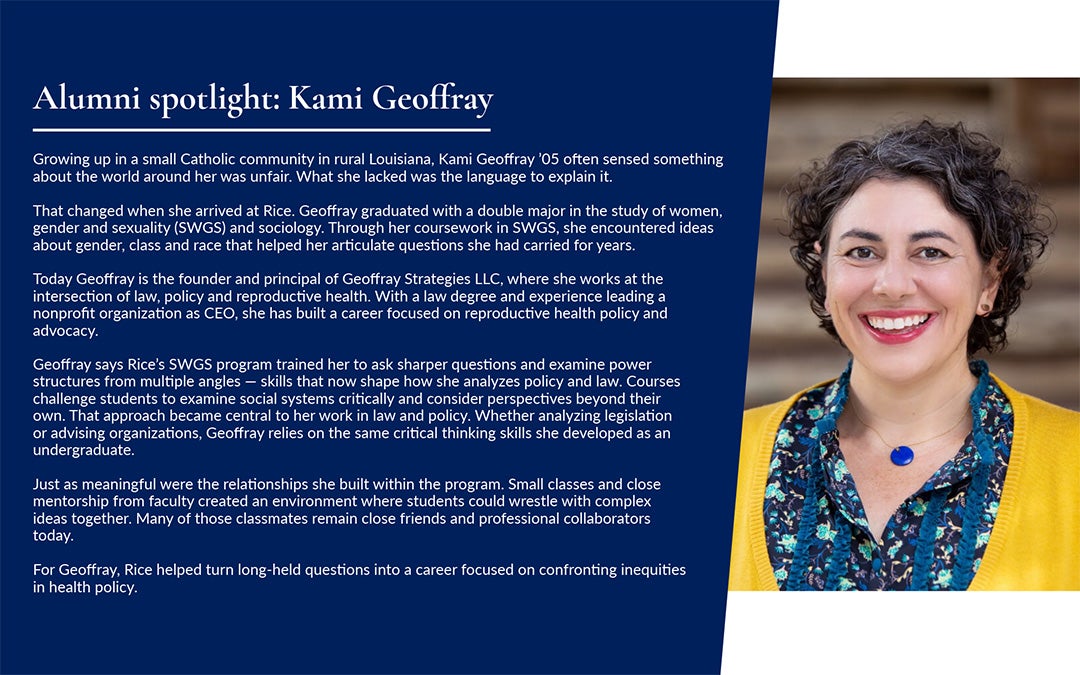
Rice faculty affiliated with CSWGS say those early assumptions often give way to something more concrete: preparation for workplaces where cultural fluency and interpersonal judgment can make or break a team. Wildenthal described the field as uniquely positioned to help students translate human complexity into professional strength.
“Gender and sexuality studies is social theory made accessible,” Wildenthal said. “Students walk into the classroom and suddenly realize it’s been right there in front of their faces all along. It’s theory you can actually use immediately.”
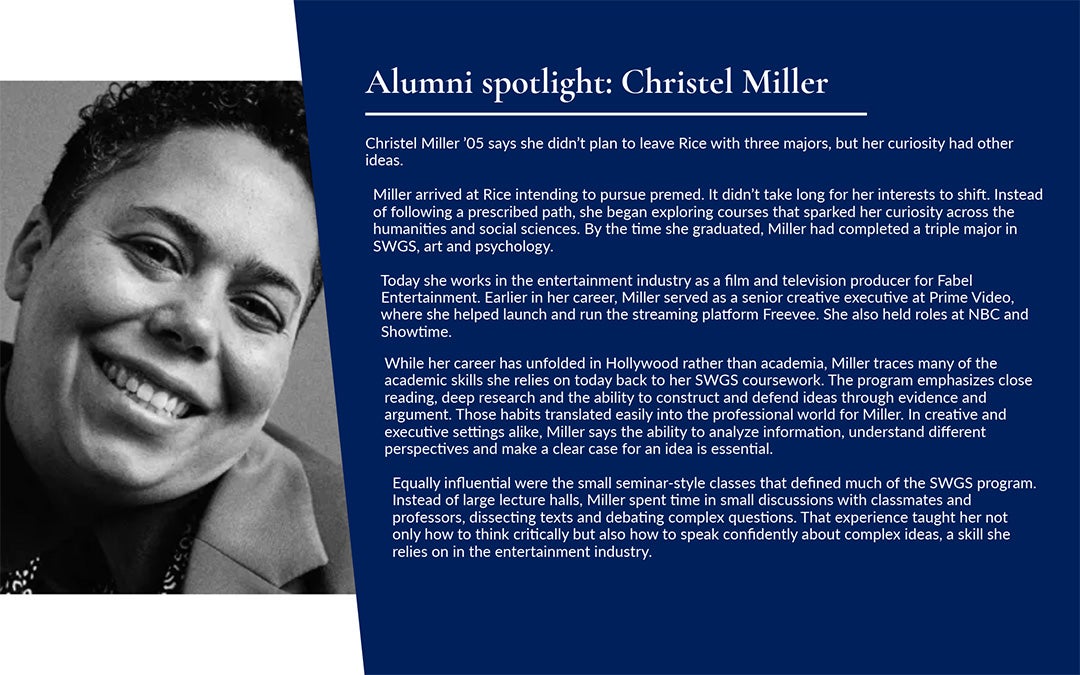
The CSWGS brings together 75 faculty affiliates across the schools of humanities and arts and social sciences, spanning disciplines from anthropology and history to economics and psychology. The program currently serves undergraduate majors and minors as well as doctoral students, who earn a graduate certificate. The curriculum is intentionally interdisciplinary. Questions of identity and difference shape nearly every professional field, Wildenthal said.
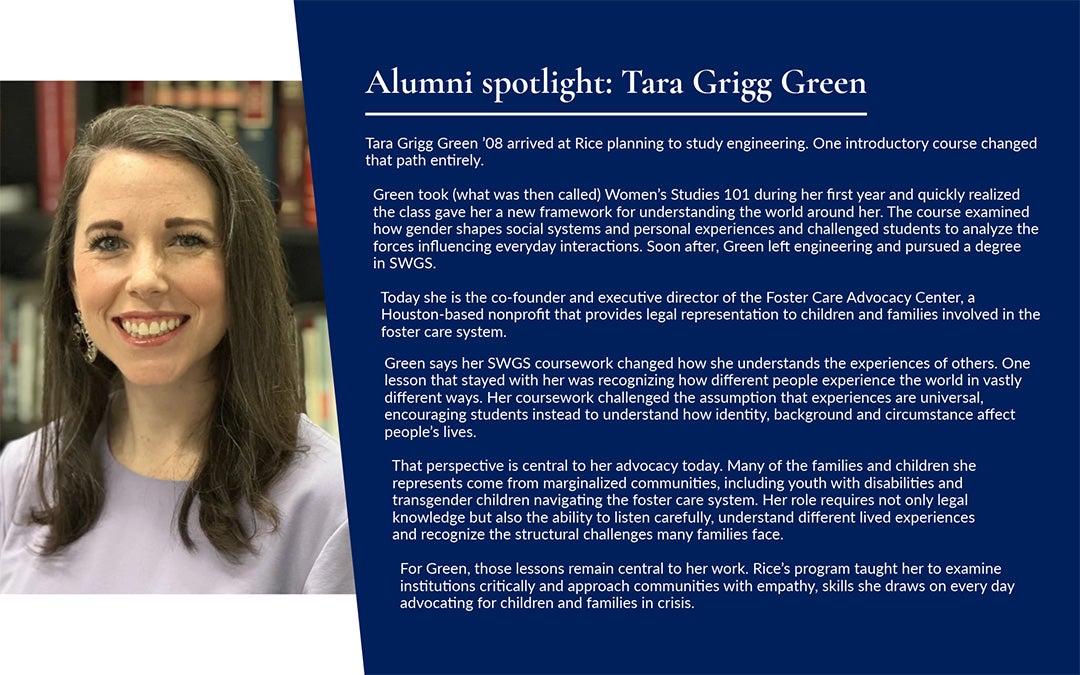
“A SWGS major helps students interpret their own experiences in a new light,” Wildenthal said. “It helps them realize who is in the room with them. Most young people assume others are basically like them, and that’s simply not true.”
That expanded awareness, Wildenthal said, is what gives graduates an edge in careers that depend on working effectively with people.
“Whatever job they take, they will be more sophisticated,” Wildenthal said. “They will be able to engage people better and have a stronger sense of what makes a team tick. They’re not going to be the ones who just don’t get it.”
While SWGS majors enter a wide range of professions, the center has observed notable representation in health-related fields, law, consulting, nonprofit leadership and business. Many graduates pursue double majors, pairing SWGS with disciplines such as biology, policy studies or economics, further broadening their career pathways. Wildenthal called the throughline across these outcomes “human literacy.”
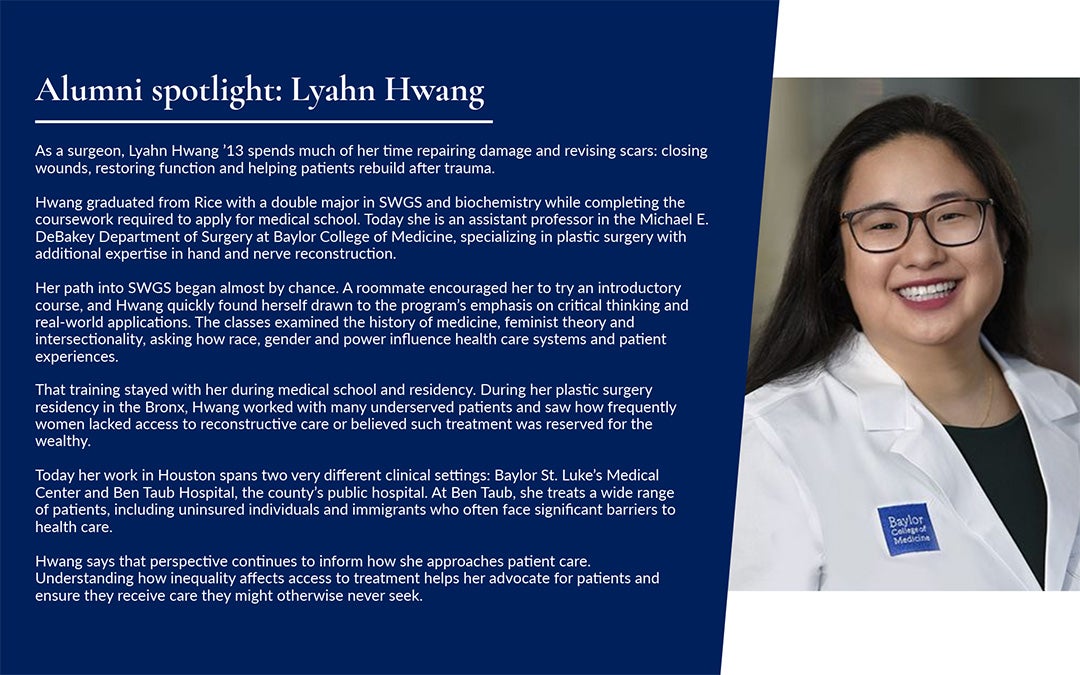
“This major is people, people, people all the time,” Wildenthal said. “It’s about identities, traditions, histories and anxieties. You could describe the entire history of feminism as being about understanding human experience at that level.”
Experiential assignments in introductory courses help students practice this analysis. One signature exercise asks students to keep a “gender diary,” reflecting on how their everyday interactions might have been different if they had a different gender, sexuality, race, etc. The goal, Wildenthal said, is to make abstract theory immediately tangible.
“SWGS majors will be the ones who can read the room and be inclusive in ways that aren’t just empty slogans,” Wildenthal said. “They understand why there might be silences in a meeting or why some people speak more than others. That awareness changes how teams function.”
In the end, Wildenthal said, the field responds to realities students already encounter in their daily lives.
“We are not the ones who decided gender and sexuality matter,” Wildenthal said. “Society talks about these issues all the time. What we do is show students there is deep scholarship behind the phenomena they see every day.”