
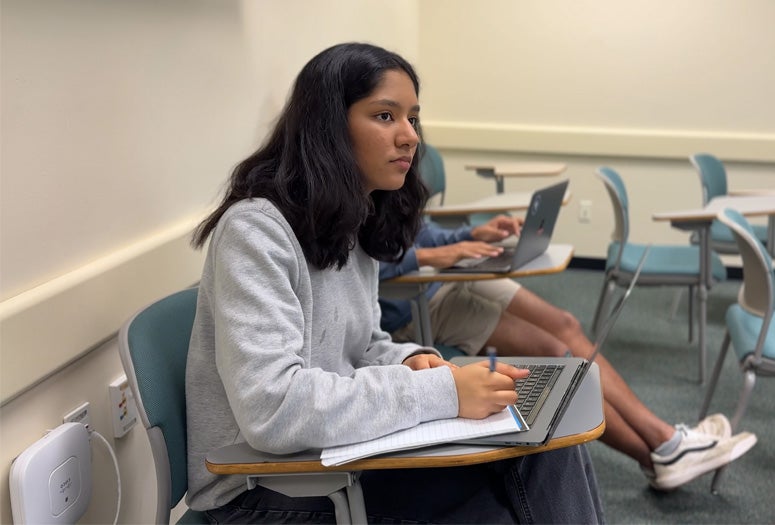
Antara Varma moves quickly across Rice University’s campus on a Wednesday morning, heading from one classroom to the next. It’s a stretch of hours that carries her through political theory, literary analysis, environmental science and global history — a cross-section of ideas that mirrors the way she approaches learning.
“Wednesdays are actually my busiest days out of the week,” said Varma, a sophomore double-majoring in environmental science and English and creative writing from Fulshear, Texas. “But it’s also probably my favorite day because it has the most things I love in one day.”
Her morning begins with Introduction to International Relations taught by lecturer Dogus Aktan. The course asks students to examine how nations interact and why political decisions unfold the way they do on the global stage.
“One of the main things we’ve been working on is how to think in an international relations way,” Varma said. “You’re holding politics and economics and sociology and human behavior together at the same time.”
An hour later, Varma pivots to an entirely different intellectual terrain. Practices of Literary Study: Reading Methods taught by assistant professor Ragini Tharoor Srinivasan asks students to interrogate the structures of language itself: how texts function, what they reveal and why they matter.
The shift from international politics to literary theory is dramatic, and for Varma, that contrast is precisely the point.
“I think it’s easy to see Rice as this four-year optimization problem,” Varma said. “You take the exact right classes, the exact right opportunities and just blaze your way through it. But so much development happens in boredom, in silence and in sitting with something your professor said.”
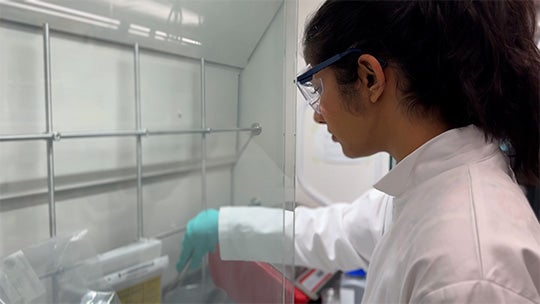
By early afternoon, Varma is in professor Pedro Alvarez’s lab, where she helps research biochar, a charcoal-like material made from plant matter that can improve soil quality. Working with doctoral student Johanna Bangala, she’s studying whether metals from reactor equipment can contaminate the material during production, a detail that could have implications for both agriculture and environmental safety.
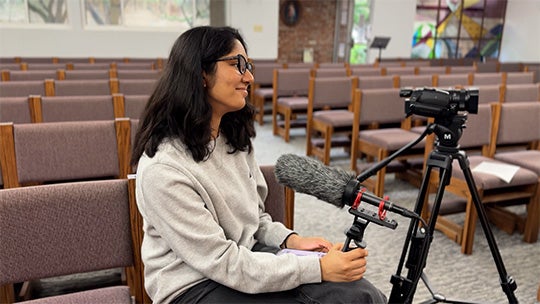
Later, she trades lab equipment for a camera. As part of her documentary filmmaking class, Varma and a classmate travel to the Rice Catholic Student Center to film an interview with the Rev. Tucker Redding for their final project, which explores how religion intersects with identity and politics in Texas.
In the early evening, she wraps up her academic day in Global Gandhi: Imperial Resistance and Global Politics with assistant professor Sourav Chatterjee. The class digs into Gandhi’s life and philosophy while examining the broader forces that shaped them such as colonialism, revolution and political resistance.
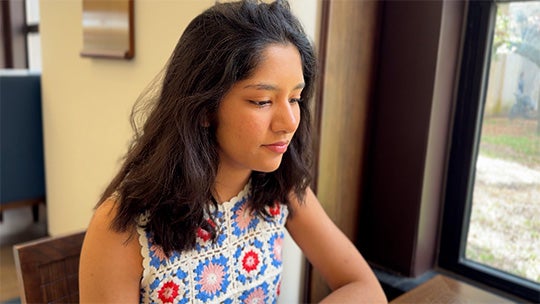
For Varma, moving between disciplines isn’t unusual; it’s part of how she thinks. That mindset has shaped the writing she’s now pursuing through the Elizabeth Lee Moody Undergraduate Research Fellowship in the Humanities and the Arts. Working with professor Lacy Johnson, she’s developing a creative nonfiction manuscript about her family’s migration story and how those journeys echo across generations.
The idea for the project came from an unexpected place: geology. In an introductory Earth science class, Varma learned how tectonic fault lines can build pressure for thousands of years before releasing it all at once in an earthquake. The image stuck with her. Soon she began thinking about history, and even family history, in much the same way.
“I think about those moments in life when everything shifts,” Varma said. “It could be getting into Rice. It could be my parents moving to the United States. These moments where years of tension and history suddenly move all at once.”
Her manuscript explores those “slips” in personal and global history, tracing how migration, memory and cultural inheritance shape families across time. The fellowship gives her the freedom to pursue that creative work while continuing to move between the humanities and sciences.
For Varma, the experience of being at Rice has been transformative in ways she says she did not anticipate when first arriving on campus.
“I think Rice takes whatever is good in you and amplifies it,” Varma said. “You spend a lot of time falling flat on your face while you figure out what works for you. But once you find it, you can push it to the absolute extent of your talent.”
Varma’s curiosity has also taken her well beyond Houston. In 2025, she joined the Rice Global Paris Summer Program, where she spent three weeks studying Romanticism: Race, Ruins and Revolution with professor Alexander Regier. The course examined the ideas that shaped the French Revolution, bringing students into conversation with writers such as Voltaire and Jean-Jacques Rousseau. Along the way, they wrestled with how revolutionary ideals about liberty and equality collided with questions of race, empire and gender.
“We were talking about these political philosophies while standing where the events actually happened,” Varma said. “That made the history feel immediate in a completely different way.”
Paris stretched Varma in smaller ways too. She had to learn the rhythm of the city including how to navigate the metro, follow conversations in another language and settle into a place that felt unfamiliar at first. In the end, those moments of uncertainty became part of what made the experience stick with her.
“It was some of the best weeks of my life,” Varma said.
Back in Houston, Varma has been trying to approach the city with the same openness. She’s been spending more time in museums, at performances and at live music shows, treating the city’s arts scene as another extension of her education.
Varma credits the classes, research, writing and places she’s explored for changing the way she thinks about her time at Rice. Instead of treating college as a checklist of accomplishments, she now sees it as a chance to imagine futures she hadn’t considered before.
“I didn’t know people could build a life doing what they love,” Varma said. “But seeing people who have spent their lives doing meaningful work makes you realize it’s possible.”
That shift in perspective, Varma said, may be the most important thing she’s gained during her time at Rice.
“I think Rice brings out the best in you,” Varma said. “And it helps you realize that being your best self is something that can actually exist.”