
Researchers at Rice University recently convened an international group of scientists to explore how artificial intelligence and machine learning could transform one of the world’s most ambitious physics experiments: the Deep Underground Neutrino Experiment (DUNE).
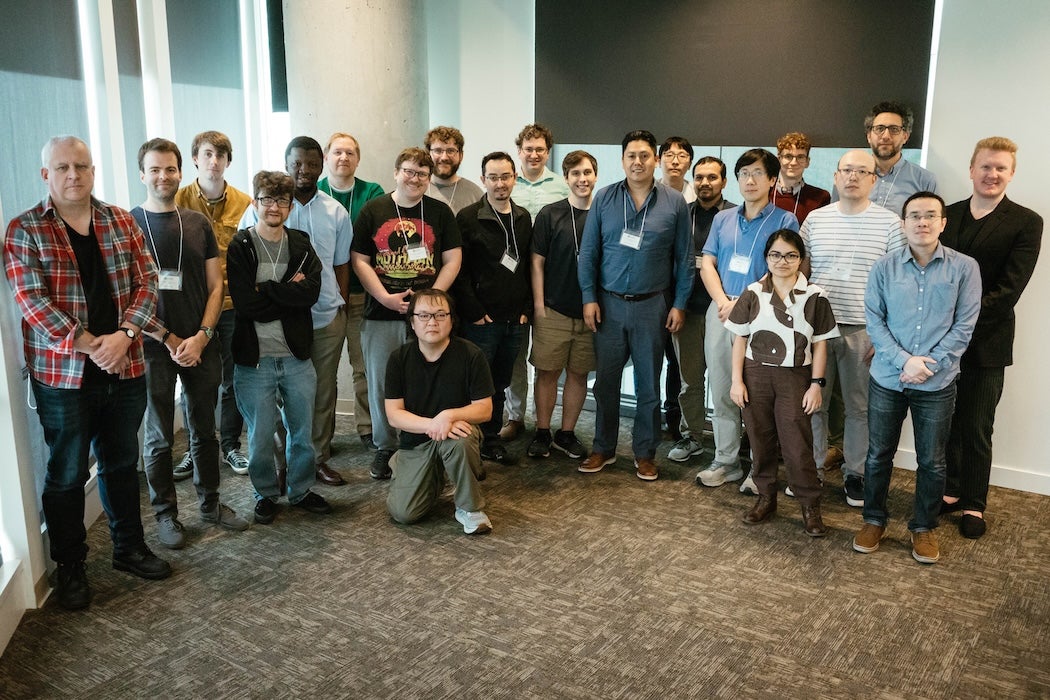
Held March 10-12 at Rice’s BioScience Research Collaborative, the three-day workshop brought together researchers from universities, national laboratories and international partners to discuss how the experiment’s software and computing infrastructure can better support the growing role of AI and machine learning. The event was organized by DUNE’s AI/ML Forum and Core Software and Computing Consortium and was partially supported by the Rice Creative Ventures Fund.
With 60 registered participants and 30 scheduled presentations, the meeting marked the first dedicated workshop focused specifically on integrating advanced AI techniques into the massive computing ecosystem that will power the DUNE experiment.
“The great thing about what we’re doing is we’re linking together the artificial intelligence machine learning world and the big science world with its huge amounts of data,” said Andrew McNab, academic researcher at the University of Manchester and global compute lead for DUNE.
“Experiments like DUNE are generating enormous amounts of data, and one of the biggest challenges is identifying the tiny signals hidden within that data,” added Aaron Higuera Pichardo, assistant research professor of physics and astronomy at Rice and one of the workshop organizers. “Machine learning gives us new tools to find patterns that traditional analysis methods often miss.”
DUNE is an international collaboration designed to study neutrinos — elusive subatomic particles that are the second most abundant particles in the universe but remain among the least understood.
The experiment will operate detectors separated by a 1,300-kilometer baseline. A high-intensity neutrino beam generated at Fermilab in Illinois will travel through Earth to a massive detector array located deep underground at the Sanford Underground Research Facility in South Dakota.
Together, the detectors will allow scientists to observe neutrino oscillations and explore fundamental questions about the universe, including why matter exists and how extreme cosmic phenomena such as supernova explosions work.
But the scientific promise of the experiment comes with a computational challenge: DUNE will produce enormous datasets that must be analyzed quickly and accurately.
“High-energy physics experiments have always pushed the limits of computing,” Higuera Pichardo said. “With DUNE, the scale of the data means we need smarter approaches to monitoring, simulation and analysis. AI and machine learning are becoming essential tools for that.”
Much of the promise of AI in DUNE lies in its ability to detect subtle signals buried within vast amounts of background noise.
“In many cases we are searching for extremely rare events — essentially the needle in a haystack,” Higuera Pichardo said. “Machine learning can identify small features in complex data that would be very difficult to detect using conventional techniques.”
Beyond data analysis, AI could also help automate key operational tasks within the experiment. Researchers are exploring ways to use machine learning to monitor detectors and sensors in real time, improving reliability while reducing the need for constant human oversight.
“AI can help us optimize how the detectors operate and how we monitor the experiment,” Higuera Pichardo said. “Automated systems can flag unusual patterns or potential issues early, which ultimately helps us collect better data.”
While machine learning opens new possibilities for discovery, integrating it into a collaboration as large as DUNE requires careful planning, which is one of the main goals of the Rice workshop.
“This workshop is an opportunity for people across the various efforts of this experiment to come together and determine the resources we need to do the physics that we are trying to do,” said Christopher Marshall, associate professor of physics at the University of Rochester and DUNE physics analysis coordinator. “A lot of these groups meet individually and plan individually, and this workshop is how we can exploit synergies among the different efforts.”
Sessions during the three-day workshop examined the physics goals of DUNE, the AI methods that could accelerate those goals and the computing resources required to implement them. During the workshop, Rice postdoctoral researcher Ilker Parmaksiz presented work on GPU-accelerated optical simulations designed to speed up complex physics simulations. Another Rice-led project, developed by computer science major Calvin Wong, focuses on an AI-driven system called the DUNE-Pro agent — a software platform designed to assist with complex data management tasks and computing resources.
The push to incorporate AI into large scientific experiments aligns with broader national initiatives to accelerate scientific discovery using advanced computing, including the U.S. Department of Energy’s Genesis Mission and its broader “discovery science” efforts to understand the universe from quarks to the cosmos.
“We’ve been using AI for quite a long time, but it has really taken off in the last few years, and this workshop is an opportunity for us to come together and see how it fits in with the DOE’s Genesis Mission as well as what resources we need,” said Leigh Whitehead, a research professor at the University of Cambridge and co-lead of the DUNE AI/ML Forum. “With those resources, we can hopefully revolutionize what we are doing.”
For Rice, the workshop underscores the university’s growing leadership at the intersection of AI and fundamental physics research. Rice is positioning itself not only as a key partner in one of the world’s largest neutrino experiments but as a hub for the kind of interdisciplinary collaboration bridging physics, computer science and AI that the next era of scientific discovery demands.