
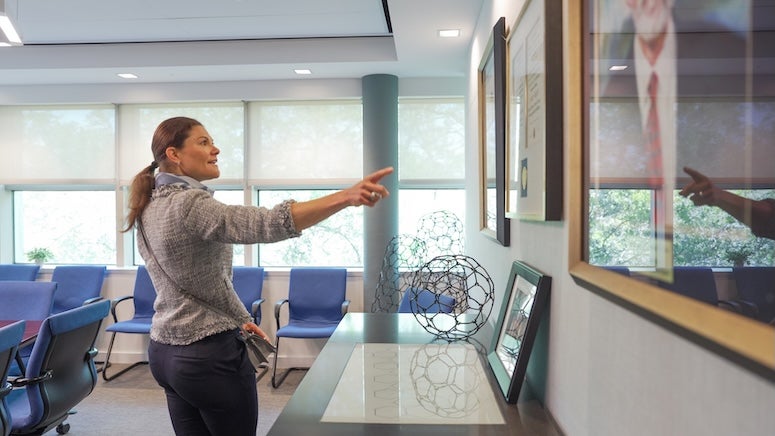
Rice University, represented by Swedish scientists Pernilla Wittung-Stafshede and Anna-Karin Gustavsson, welcomed Victoria Ingrid Alice Désirée, Crown Princess of Sweden, to campus March 16. Victoria, who was visiting Houston for the inauguration of Sweden’s newest embassy, was joined by Anna Hammarlund Blixt, the consul general of Sweden in Houston, as well as a number of Swedish dignitaries.
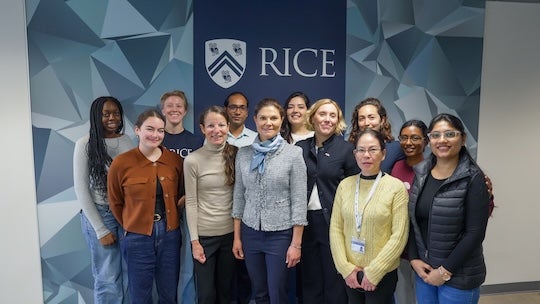
“It was an honor to share our work with the Crown Princess,” said Wittung-Stafshede, professor of chemistry and biosciences who served on the Nobel Prize committee for several years. “Sweden has a long history of supporting excellence in science, exemplified, of course, by our Nobel Prizes. So to have her visit my lab was incredibly exciting.”
Wittung-Stafshede studies amyloids, long strings of misfolded proteins present in diseases like dementia and cancer. She started the tour with a short explanation of her research, using 3D printed models of the proteins she studies to demonstrate how they aggregated before passing around a small desiccated protein sample amid a myriad of questions.
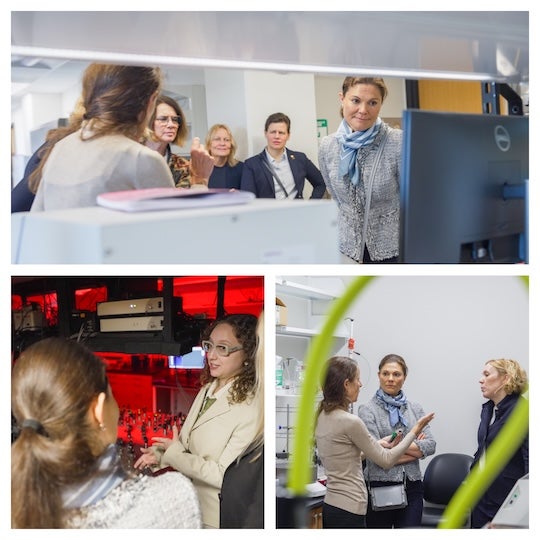
A lab tour followed, where the visiting dignitaries were able to watch students engage in their research work and learn about the machines used to grow, purify and characterize proteins. The group made a quick stop to view Rice’s Nobel Prize, on display in the Smalley-Curl Institute, before visiting Gustavsson’s lab, which develops and uses 3D super-resolution imaging, including custom-built light sheet microscopy, to study molecular mechanisms inside cells.
“We are in the heart of Texas with two Swedish women who are conducting groundbreaking research on diseases that affect all of us,” Hammarlund Blixt said. “These conversations are critical for the advancement of science and of women. It’s well worth listening to.”
Victoria, who was asking questions on the arrangement of optical lens in a large microscope setup, embodied the engagement Hammarlund Blixt advocated for. Smoothly switching between Swedish and English as she spoke to the professors and their students, she asked questions about microscopy images, about how radiation targeted and damaged some cells and not others, about how metal ions interacted with misfolded proteins … about nearly everything the researchers presented. “We could have spent so much more time here,” the Princess said as she stopped to take a final look at a spectrometer in Wittung-Stafshede’s lab. “Thank you.”
The visit ended with a short tour of Rice’s campus, a refreshing moment on a crisp, sunny spring day.
“I did my undergraduate and graduate training in Sweden before moving to the United States,” said Gustavsson, professor of chemistry. “Having the opportunity to welcome Crown Princess Victoria, as well as the consul general, into my lab and share my research with them was an incredible way to bridge my scientific journey from Sweden to the United States.”