
Ecology is often understood as a hyperlocal thing. The ecology of a pond, for instance, is vastly complex, even if the pond is tiny. But learning solely from local ecosystems is a slow and laborious approach that may not capture widely applicable findings. Rice University graduate student Annie Finneran, working in the lab of Matthew McCary, recently published a paper in Ecology Letters that took a big picture approach to studying food webs.

“We took mammal food webs across sub-Saharan Africa to see if we could combine multiple local observations into a highly generalizable analysis that could help us better understand both environmental drivers such as vegetation and human impact on a nearly continental-level scale,” said Finneran, first author on the paper. “That led to this work, the first published study to find that similarity in environmental conditions predicts local food web similarity across a continent.”
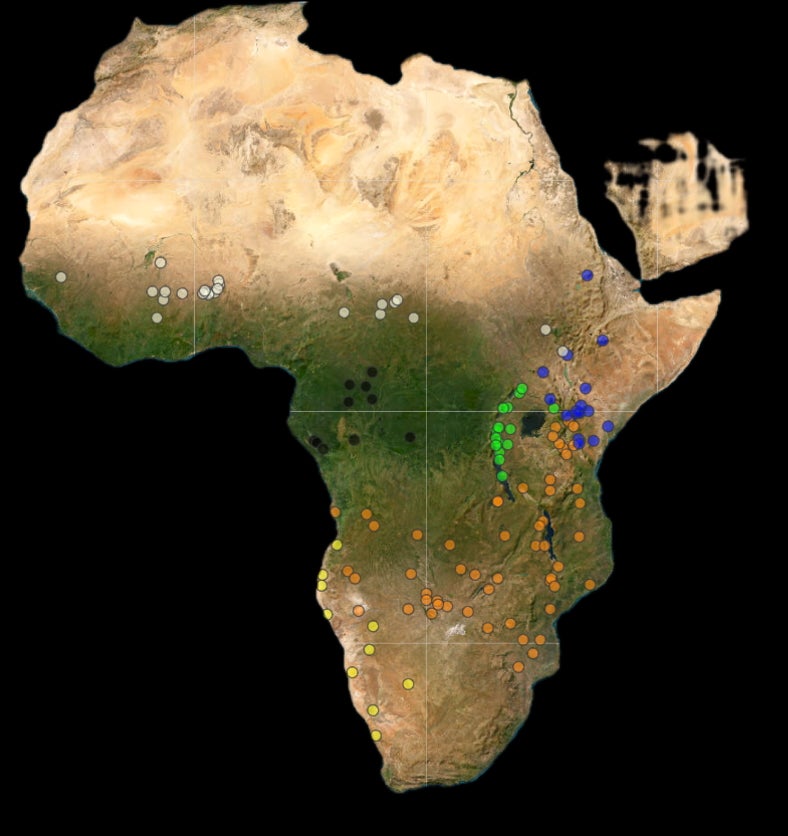
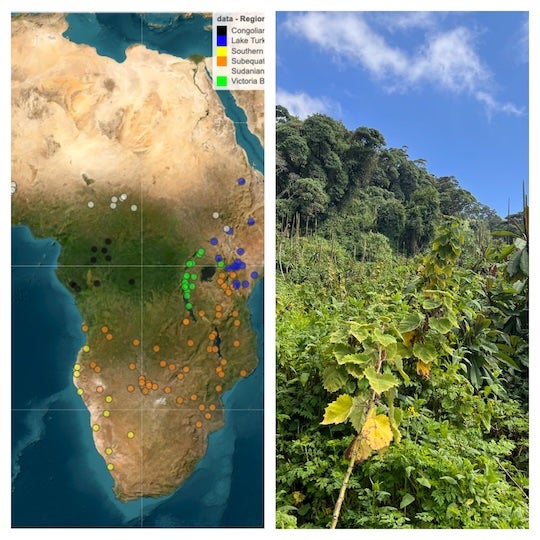
Finneran, working with researchers at Rice and Lydia Beaudrot, a professor at Michigan State University, used satellite images of 127 sites across sub-Saharan Africa to identify habitat fragmentation, or disruption caused by human activity, and vegetation amount in each site. These images, combined with mammalian species known to be at each site and mammalian predator-prey interactions, were used with a network analysis technique developed by César Uribe, the Louis Owen Assistant Professor of Electrical and Computer Engineering at Rice.
The network analysis showed that a major defining factor in the food webs was primary productivity, or how much vegetation an ecosystem had. Since the researchers were able to look across a wide variety of ecosystems — from savannahs to deserts to rainforests — they could see that the similarity in quantity of vegetation drove food web structure.
“The amount of energy available ultimately controls the amount of vegetation in a system,” Beaudrot said. “We found that similarity in the amount of vegetation strongly correlated with the similarity of food webs, regardless of the location or type of ecosystem.”
While the shaping forces of primary production were found across sub-Saharan Africa, their second finding was specific to the Congo Basin, a tropical forest region spanning approximately 3.7 million square kilometers. The Congo Basin, an area slightly larger than India, is one of the largest intact tropical forest regions in the world.
There, researchers found evidence that fragmentation, or disruption of habitat from agriculture or human development, shaped the food webs across the 10 Congo forest sites in the study.
“In the Congo Basin,” Finneran said, “we found that fragmentation was a driver of food web structure. Tropical forests with similar levels of fragmentation had more similar food webs. This may indicate that fragmentation predictably disrupts species with similar ecological roles.”
Though the sites Finneran examined were protected, the extent of the protection varies depending on the country and status of each individual site. Food webs in these systems can undergo further structural changes, or changes to predator-prey interactions, if fragmentation continues to happen.

“Implementing this network analysis has given us the ability to better understand food webs on a continental scale as well as the impact of human disruption on them,” said McCary, an author on the paper. “We can use this approach to study food webs across continents and then apply those findings to individual ecosystems to support preservation and restoration efforts.”
This project was funded by the National Science Foundation’s Division of Environmental Biology (2213568) and Division of Computing and Communication Foundations (2443064).