
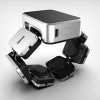
Hands-free tech adds realistic sense of touch in extended reality
Rice mechanical engineers and their collaborators have demonstrated a new hands-free approach to convey realistic haptic feedback in virtual reality.
Hands-free tech adds realistic sense of touch in extended reality
Rice mechanical engineers and their collaborators have demonstrated a new hands-free approach to convey realistic haptic feedback in virtual reality.

Lauren Stadler has won an NSF CAREER Award
Engineering’s Lauren Stadler has received a CAREER Award from the National Science Foundation to improve wastewater treatment by harnessing the power of microbiomes.
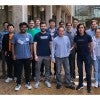
Rice team begins ambitious quantum entanglement research
A Rice research team has begun an ambitious three-year project to see quantum entanglement among billions of particles in a solid material thanks to a $1.2 million grant from the Keck Foundation.
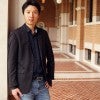
Rice U.’s Taiyun Chi wins NSF CAREER Award
Taiyun Chi, an assistant professor of electrical and computer engineering at Rice University, has won a prestigious National Science Foundation CAREER Award to research the development of a high-performance neural interface and a noninvasive deep-brain-stimulation system.
Rice joins neutrino megaproject. Engineering launches energy transition initiative. McHugh lands cancer research grant. Keck Foundation funds quantum research. West named Cottrell Scholar.
Tapia to discuss book on importance of improving STEM education for minorities
Rice University’s Multicultural Community Relations department will host a book presentation for Richard Tapia’s “Losing The Precious Few: How America Fails to Educate Its Minorities in Science and Engineering” Feb. 22 at 4 p.m. in Anne and Charles Duncan Hall’s McMurtry Auditorium.
Potential for profits gives Rice lab’s plastic waste project promise
Rice University scientists create carbon nanotubes and other hybrid nanomaterials out of plastic waste using an energy-efficient, low-cost, low-emissions process that could also be profitable.
Engineered wood grows stronger while trapping carbon dioxide
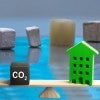
Rice University scientists have figured out a way to engineer wood to trap carbon dioxide through a potentially scalable, energy-efficient process that also makes the material stronger for use in construction.

Rice scientists reengineer cancer drugs to be more versatile
Rice University scientists enlist widely used cancer therapy systems to control gene expression in mammalian cells, a feat of synthetic biology that could change how diseases are treated.
Black girls benefit most when STEM teachers train up
When middle and high school teachers in science, technology, engineering and mathematics pursue continuing professional development, their students benefit, and a new study from Rice University shows the payoff can be dramatic.
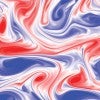
Scientific AI’s ‘black box’ is no match for 200-year-old method
Rice engineers discovered a 200-year-old technique called Fourier analysis can reveal crucial information about how a form of artificial intelligence called a deep neural network learns to perform tasks involving complex physics.
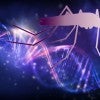
Mosquito’s DNA could provide clues on gene expression, regulation
Rice University researchers discover that the Aedes aegypti mosquito’s DNA has the physical properties of a liquid crystal, a unique feature not found in any other species that could provide new clues on the factors that govern gene expression and regulation.
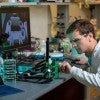
Bite this! Mosquito feeding chamber uses fake skin, real blood
Rice bioengineers teamed up with tropical medicine experts from Tulane to invent a high-tech way to study the feeding behavior of mosquitoes. To eliminate the need for live volunteers, the system uses patches of "synthetic skin" made with a 3D bioprinter.
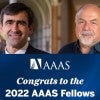
Two Rice University professors elected AAAS fellows
Rice University professors Thomas Killian and Marek Kimmel are elected fellows of the American Association for the Advancement of Science, a distinction that honors scientists, engineers and innovators whose efforts on behalf of science and its applications are scientifically or socially distinguished.
STAT’s Hopkins co-authors National Academies report. CAREER Awards keep coming. DOE funds NEWT desalination research.