
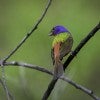
Bird-in at Owl Deck raises over $3,000 for Houston Audubon
Rice's first annual bird-in, which supports the Houston Audubon, was hosted at the Owl Pavilion this Earth Day.
Bird-in at Owl Deck raises over $3,000 for Houston Audubon
Rice's first annual bird-in, which supports the Houston Audubon, was hosted at the Owl Pavilion this Earth Day.
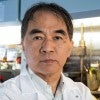
Pengcheng Dai elected to American Academy of Arts and Sciences
Rice professor Pengcheng Dai has been elected to the American Academy of Arts and Sciences, one of the oldest and most prestigious learned societies in the nation.

New model helps understand why most human pregnancies are singletons
Rice researchers develop new model of follicle selection that suggests its chance, not size, that selects a follicle during the menstrual cycle.
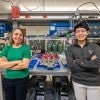
Engineered dual-bacterial sensors turn chemical signals into electricity
Rice professor Caroline Ajo-Franklin’s group, working in collaboration with researchers from Tufts University and Baylor College of Medicine, recently developed a flexible bioelectrical sensor system called electroactive co-culture sensing system (e-COSENS).
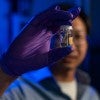
Rice researchers find sulfur-rich Mercury magmas behave differently than Earth’s
Rice researchers recreate Mercury rocks, showing that sulfur replaces oxygen in key rock structures.
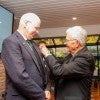
Rice professor receives French Order of Merit
Rice’s David Alexander recently received the Ordre national du Mérite (National Order of Merit), an honor awarded by the French president for, among other things, innovation and contributions to the renown of France.
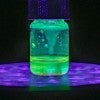
Rice study resolves decades-old mystery in organic light-emitting crystals
Researchers at Rice have now solved a long-standing mystery in a widely used organic semiconductor, revealing how tiny structural imperfections can actually improve how these materials work.
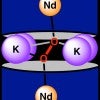
Rice scientists discover new way metals bind oxygen, possibly starting ‘new chapter’ in chemistry
Rice researchers develop a way to create new interaction between dioxygen and a lanthanide metal called neodymium, enabling the creation of lanthanide-oxos.
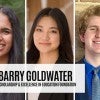
3 Rice students receive Barry Goldwater Scholarship
Rice juniors Prasi Desai, Ellena Jeon and Eitan Feldman have all been awarded the Barry Goldwater Scholarship, an annual award that recognizes pioneering science, technology, engineering and mathematics (STEM) undergraduates in the United States.
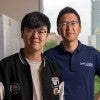
Scientists uncover new method to generate protein datasets for training AI
Rice researchers develop an method to quickly produce protein activity data needed to train predictive AI models for improved protein function.
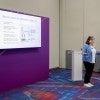
Rice experts spotlight energy solutions shaping a lower-carbon future at CERAWeek
Rice researchers presented at the recent CERAWeek conference, focusing on alternative energy sources that pointed toward a world less dependent on oil and gas and more conscious of its carbon consumption and impacts.
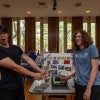
Students learn how to help from campus groups, external partners at Earth Month Festival
Rice kicked off Earth Month with its third annual Earth Month Festival, a celebration hosted by the Office of Sustainability.
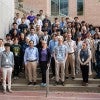
Rice spring school brings together emerging and established leaders in quantum materials
More than 80 scientists and students from around the world gathered at Rice for the third annual Spring School on Electron Correlations and Topology.
Rice researchers use network analysis to understand mammal food web drivers across Africa
Rice researchers took a big picture approach to studying food webs across sub-Saharan Africa

5 Rice researchers elected AAAS fellows
Five Rice professors, Pernilla Wittung-Stafshede, Volker Rudolf, Edward Knightly, Marcia O’Malley and Ed Billups, have been elected as fellows of the American Association for the Advancement of Science.