
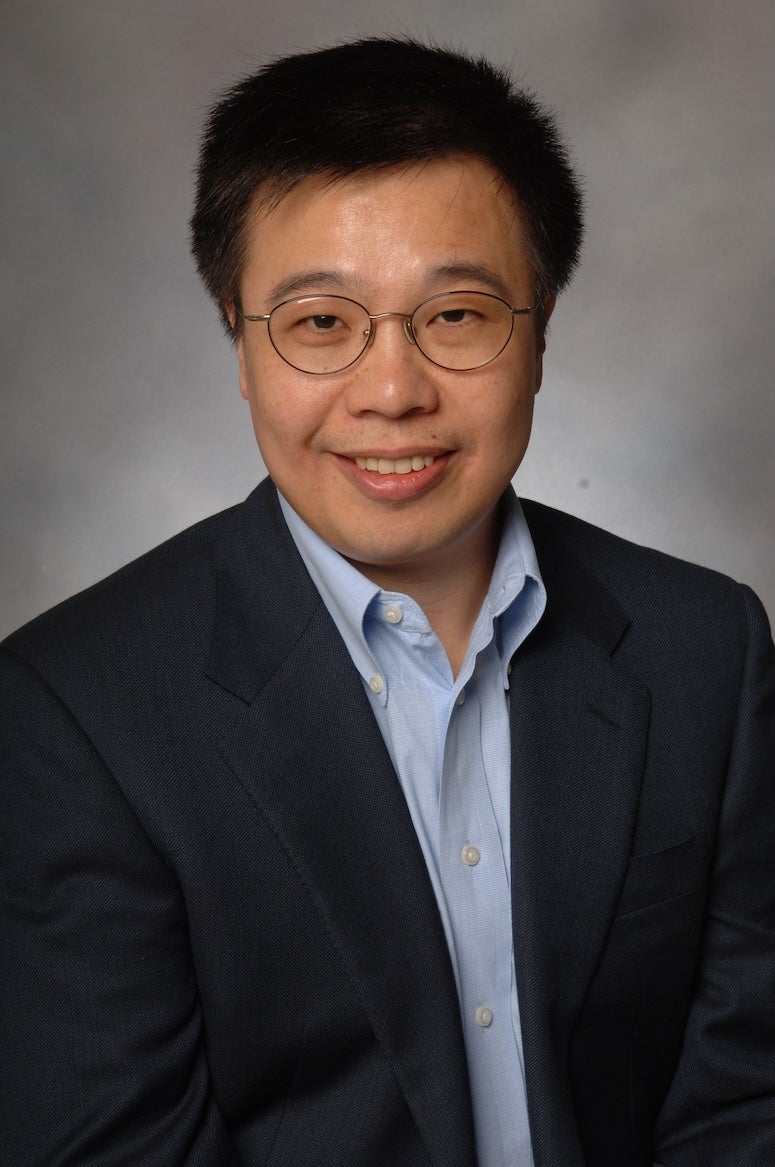
Qimiao Si, the Harry C. and Olga K. Wiess Professor of Physics and Astronomy at Rice University, has been awarded a Harvard Radcliffe Fellowship for the 2026-27 academic year. He joins a class of 50 fellows, including scholars, creatives and public intellectuals, who will take residence at Harvard University in order to pursue an academic or creative project supported by the diverse fellowship community and full breadth of Harvard’s resources.
“I am incredibly excited to spend a year in fellowship with such exceptional artists, researchers and intellectuals,” Si said. “I hope to further advance my research on quantum entanglement and bring back to Rice the full breadth of what I gain, both scientifically and through the rich intellectual community that the Radcliffe Fellowship offers.”
Si, who is the director of the Extreme Quantum Materials Alliance, studies how vast numbers of electrons collectively organize in solids to produce new forms of matter with emergent properties. During his fellowship, he will be seeking new ways of understanding this collective behavior, focusing on quantum entanglement, or as Albert Einstein put it, “spooky action at a distance.”
“Radcliffe recognizing and supporting Qimiao’s work on quantum entanglement demonstrates the impact of his research well beyond our campus,” said Christopher Johns-Krull, chair of physics and astronomy. “We are excited to support his fellowship year and look forward to the insights he will bring to Rice upon his return.”
While quantum entanglement has until recently been observed mainly in small systems of a few isolated particles, Si has taken the leap to bring the application and understanding of this phenomenon to far more complex quantum systems.
“My group’s recent work has initiated the use of measurable quantum entanglement as a new approach to better understand the behavior of vast numbers of electrons in highly collective quantum materials, including strange metals,” Si said. “I look forward to a year of advancing this research, collaborating both at Harvard and across the greater Boston area and engaging with Radcliffe Fellows from diverse disciplines on its broader significance.”
The Radcliffe Fellowship Program annually selects and supports artists, scholars and public intellectuals who bring both a record of achievement and exceptional promise. This competitive program receives approximately 1,700 applications each year with only 50 applicants selected for each class.
“I’m inspired by the wisdom, creativity, and passion of our incoming fellows,” says Tomiko Brown-Nagin, dean of Harvard Radcliffe Institute, the Daniel P.S. Paul Professor of Constitutional Law at Harvard Law School and a professor of history in the Harvard Faculty of Arts and Sciences. “At a time when higher education has been under heightened scrutiny, our new fellowship class offers hope and purpose—a reminder of the vital importance of scholarly exploration and advanced study. Their work signals a promising future.”
Fellows are at different stages of their careers who come to the institute from across the United States and around the world and represent a broad range of academic, professional and artistic fields. Fellows work on an individual project while mining and deepening the knowledge, ingenuity and talent of the Harvard community.