
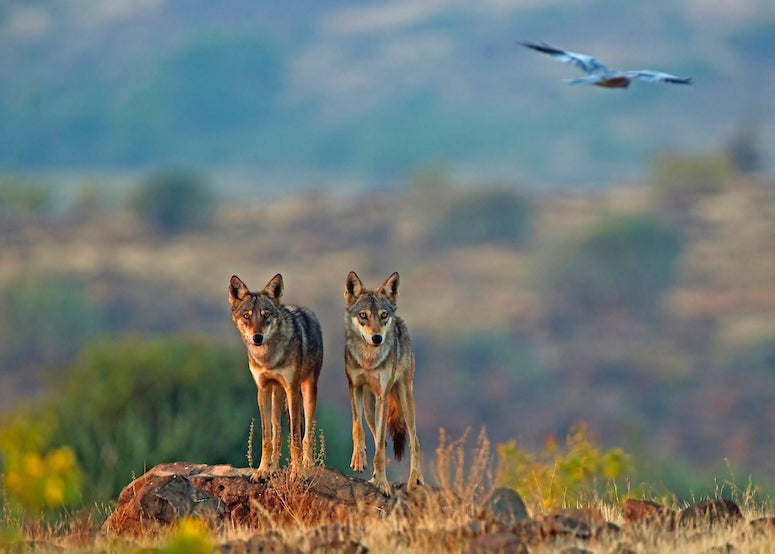
Wolves in India, like the pack that raised Mowgli in “The Jungle Book,” can often feel disconnected from both the research and storytelling of wolves. Rice University professor Lauren Hennelly is working to change that. Her research uncovers the stories that these grey wolves, along with the nearby Tibetan wolves, carry in their DNA.

“I had previously led work showing that Indian and Tibetan wolves were the two oldest evolutionary lineages of the grey wolf,” said Hennelly, an assistant professor of biosciences. “When we expanded our work to sequence wolves from across Asia, we found even more hidden stories in their DNA.”
Hennelly and her team, which includes scientists from 11 countries, collected and analyzed DNA from wolves across Asia. They discovered that the DNA of wolves in southern regions of Asia contained an unexpectedly large amount of unique genetic variation, making them an important reservoir of global wolf genetic diversity. This work, published in Communications Biology, establishes southern Asia as a hotbed for grey wolf diversity –— an evolutionarily important location that contains information about wolves’ past and hope for their future.
Unusually distinct lineages
Wolves are traveling animals with reported journeys reaching over 500 miles. These travels often result in genetic mixing, making it easy to find traces of one wolf population mixed into the DNA of other populations. For example, wolf populations across the vast areas of northern Asia and North America are genetically very similar due to this genetic mixing, or gene flow. However, that was not the case for wolves in southern Asia. Hennelly’s data showed sharply defined geographical boundaries between the three main lineages, or populations, that split long ago with little gene flow between the different populations.
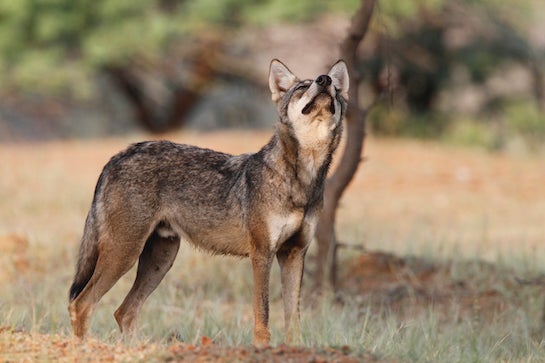
In fact, Hennelly’s team found that the ancient Indian and Tibetan wolf lineages were isolated from other wolves for over 100,000 years. There likely were past climatic factors such as habitat changes due to previous glacial cycles that led to this separation, but the distinction has remained through to current days, when the breaks between the populations have disappeared.
“We found that Pakistan is the global hotspot of gray wolf diversity. That is because this location is where all three major lineages of wolves — Indian, Tibetan and Holarctic — come together,” Hennelly said. “How and why these different types of wolves remain genetically distinct despite living so close to each other is a question that could help us understand fundamental questions in evolutionary biology, like the early stages of speciation.”
Conservation implications
Conservationists have classified the grey wolf species as stable overall, but this dive into the genetics of Indian wolves made it clear that they needed to be considered separately from the wolves living in Europe and North America. Hennelly co-led a working group that estimates the Indian wolf population contains around 3,000 individuals with a high risk of extinction in the foreseeable future. Under the International Union for the Conservation of Nature, the Indian wolf, like the Tibetan wolf, is now classified as threatened.
“Only through genetics could we understand that these are unique wolves found nowhere else,” Hennelly said. “These hotspots of wolf diversity in southern Asia are where grey wolves are most threatened, with wolves in the Indian subcontinent facing immense pressures. Our work not only informs the conservation status and taxonomy of these wolves but highlights the importance of conserving these two evolutionarily distinct populations, and preserving the full spectrum of wolf genetic diversity, before it’s too late.”
This work was funded by the National Science Foundation Postdoctoral Research Fellowship (2208950), the Norwegian Environment Agency (18088069), Fondation Segré and the Sigrid Rausing Trust.