
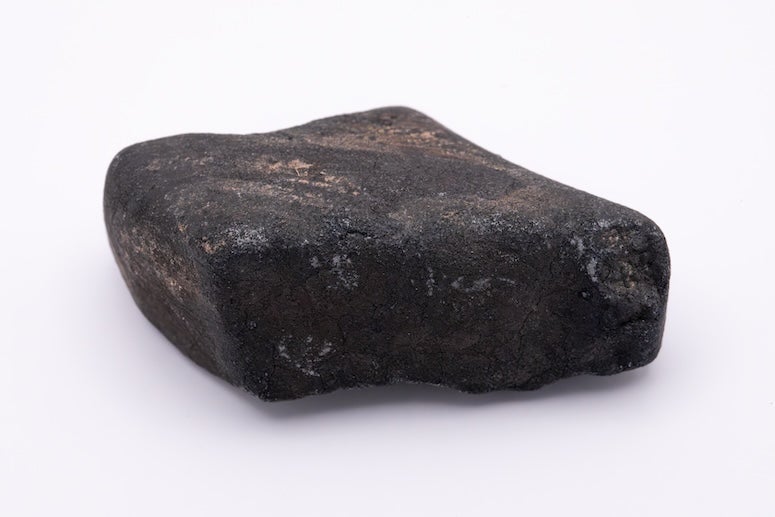
It’s not often that a meteorite lands in a major metropolis. It’s even rarer that meteorite samples are able to be collected almost immediately after landing. And yet on March 21, both things happened. A meteorite landed in north Houston, and within 24 hours, experts and enthusiasts were finding small chunks that had landed on public property.
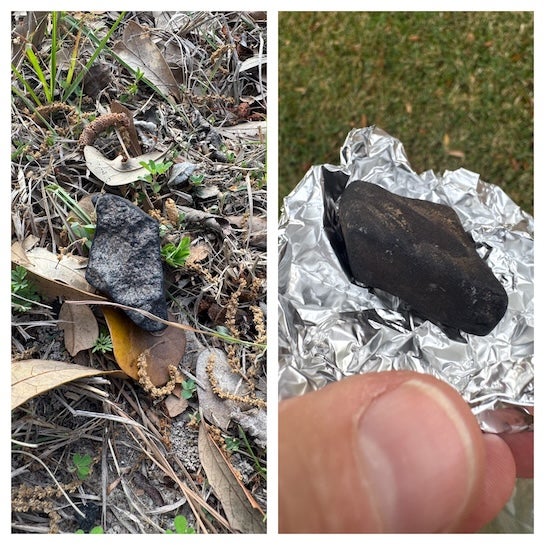
Rice University’s Bidong Zhang was one of those experts out hunting. Though his 23,000 steps didn’t lead him to any samples, fellow searchers David Gonzales and Marc Fries found several and donated them to Rice.
These pieces became part of Zhang’s recently established Rice Astromaterials Research and Exploration (RARE) lab, an analytical laboratory and collection of astromaterials. Linda Fries, a science writer who has worked extensively with meteorites, supported the coordination, analysis and classification of the meteorite samples.
“These samples mark the first meteorite tested and catalogued by RARE,” said Zhang, an assistant professor of Earth, environmental and planetary sciences. “It was beyond exciting when I realized that RARE’s first piece to be analyzed and categorized could be a meteorite that had not only landed in Houston but provided a rare opportunity to analyze freshly landed samples.”
Once the samples arrived at Rice, the scientists, collaborating across multiple labs, went to work. Gelu Costin, a research scientist, analyzed the samples using an electron microprobe that could take hundreds of chemical measurements and images of each sample.
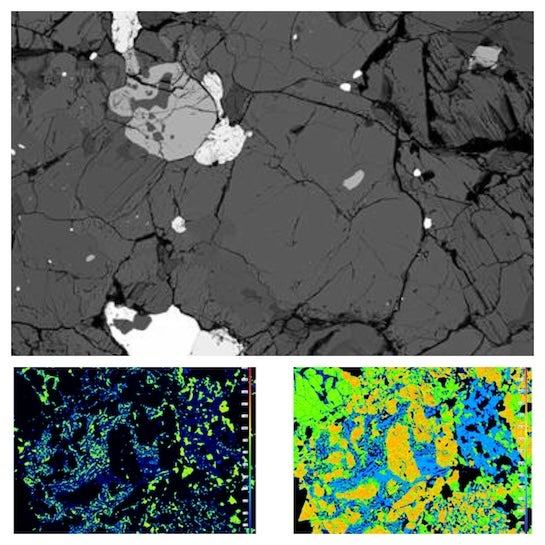
“My analysis also showed that this was a type of meteorite known as a chondrite, which we can estimate to be roughly 4.5 billion years old,” Costin said. “But it was a chondrite with an unusual past, one that we could only see through careful microscopic imaging and chemical analysis.”
The imaging provided a mystery for the researchers. Chondrites typically have little round grains called chondrules, but the Houston meteorite had none.
“The first thing I noticed was that the rock appeared to be fragmented and melted. We could see metal grains and glassy crystals but no chondrules,” Fries said.
To understand why, the researchers had to dig into the chemical analysis and microstructure. A mineral in the rock called feldspar provided some clues. Feldspar is commonly found in meteorites, but in the Houston meteorite, it was unusually in a sodium-rich crystalized form.
This suggested that the meteorite went through a high-heat event, reaching temperatures of nearly 1,100 degrees Celsius while it was still a part of its parent asteroid. This temperature would melt the chondrules, the little round grains most chondrites have. As the melted minerals in the chondrules slowly cooled, they would become glass and eventually the sodium-rich glassy crystals observed in the lab. At some point after this, a high-speed impact would have broken up the asteroid, releasing the meteorite from its parent rock and potentially sending it on its way toward Earth.
“We think this meteorite was impacted in space,” Zhang said. “It truly is a unique specimen.”
Like any good scientists, the research team sought to confirm their findings. Tao Sun, a research scientist, ran a triple oxygen isotope composition analysis on the samples as another way of classifying them.
Oxygen has three different stable variations or isotopes. The amounts and ratios of these isotopes, called 16O, 17O and 18O, can be used to identify different types of asteroids and planetary bodies. By comparing the measurements taken from the Houston meteorite to other samples, Sun confirmed that this was indeed a chondrite. The data also showed that the rock had undergone the heating process described above while it was still part of its parent asteroid.
“We found that the 18O and 17O values were very consistent with chondrites. Specifically, it was consistent with what we call high grade H type chondrites,” Sun said. “But there were also some unusual results. The 17O levels were quite varied within the samples, when we would normally expect them to be pretty consistent. There is more work to be done to understand that.”
With every level of analysis, the Houston meteorite reveals more surprises. It seems this meteorite is truly an exceptional fit for the new RARE lab.