
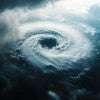
A new Rice study published in the Journal of Geophysical Research: Atmospheres provides a comprehensive evaluation of how AI-based global weather models simulate tropical cyclones.
A new Rice study published in the Journal of Geophysical Research: Atmospheres provides a comprehensive evaluation of how AI-based global weather models simulate tropical cyclones.
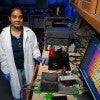
Carbon nanotube fiber ‘textile’ heaters could help industry electrify high-temperature gas heating
A cross-disciplinary team at Rice has developed a new type of electric heating element — one that looks less like a traditional metal coil and more like a high-performance thread.

Rice’s Wong breaks down facts about PFAS
Michael S. Wong, the Tina and Sunit Patel Professor in Molecular Nanotechnology at Rice University, is available to speak with media about emerging strategies to address PFAS (per- and polyfluoroalkyl substances), widely known as “forever chemicals.”

On Feb. 17, the SSPEED Center welcomed Jed Anderson, founder and CEO of EnviroAI, for a lecture on environmental AI permitting.

Rice and Lehigh partner with global industry leaders to revolutionize catastrophe modeling
The Consortium for Enhancing Resilience and Catastrophe Modeling (CERCat) convened at Rice Feb. 5-6 for its semiannual meeting.
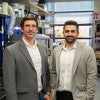
A new study from mechanical engineers at Rice describes a surprisingly straightforward fix for superhydrophobic surfaces: Instead of just engineering the surface’s chemistry and texture, they focused on engineering its heat flow.
New Rice-led perspective charts path to next-generation water and energy membranes
A new invited perspective in Nature Water, led by Rice researchers and international collaborators, discusses the future of membrane science.
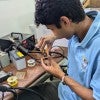
Rice360 and African universities inspiring new generation of inventors and global health innovators
When the Rice360 Institute for Global Health Technologies launched the first design studios in partner universities across Africa during Phase 1 of the NEST360 initiative, the vision was clear: create sustainable, university-based ecosystems that empower students to design, prototype and commercialize lifesaving technologies inspired by real needs in their own communities.

A coast, a calling and the search for common ground
A new documentary tells two interwoven stories: the evolution of environmentalism in the United States and the evolution of Jim Blackburn, whose career has unfolded alongside the rise of environmental law.
Rice introduces new graduate certificate in global health technologies
Rice is expanding its commitment to health innovation with the launch of a new graduate certificate in global health technologies, now open to all Rice graduate students regardless of discipline.

From Honduras to Houston: Rice student engineering care, access and belonging
Graduate student Sofia Urbina is working to advance wearable rehabilitation technologies while ensuring they reach communities like those in Honduras, where she grew up.

She came to Rice to run. She stayed to ask bigger questions
Johanna Bangala learned early what it meant for effort to yield results, a lesson that has carried her across continents and disciplines, from elite track competitions to environmental engineering research at Rice.
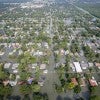
A new paper published in Proceedings of the National Academy of Sciences argues that trustworthiness of climate-risk scores depends not just on the sophistication of the models used to produce the scores but also on whether the science behind them is open, reusable and transparent enough for others to examine, test and improve.

Statistics experts at Rice University available for interviews, background, media opportunities
Rice’s Department of Statistics houses internationally recognized experts whose work spans infectious disease modeling, artificial intelligence and machine learning, climate and environmental analytics, quantitative finance, genomics, neuroimaging, applied probability and more.
Incoming winter storm: Rice experts available to discuss forecast and impacts
As a major winter storm is expected to move into Texas beginning Friday night, Rice experts are available to provide insight into the storm’s impact on transportation.