


A Houston-based energy technology startup with roots at Rice University has secured a major funding milestone, underscoring the growing impact of Rice-driven innovation in the clean energy industry.
Helix Earth, a spinoff from the lab of mechanical engineer Daniel J. Preston, announced it has raised $12 million in an oversubscribed Seed 2 funding round. The company was founded by Rice alumni Rawand Rasheed and Brad Husick and continues to build on research developed at Rice and inspired by technology co-invented at NASA.
The funding round was led by Veriten, founded by Rice alumnus Maynard Holt, and drew participation from a global network of investors spanning Silicon Valley, Boston, New York, Houston and Saudi Arabia. The breadth of backing reflects growing interest in practical, scalable solutions for energy efficiency, particularly in the built environment.
Founded in 2022 and incubated at Greentown Labs Houston near the Ion District, Helix Earth is focused on rethinking how commercial HVAC systems manage temperature and humidity — a long-standing challenge for building owners facing rising energy costs, aging infrastructure and stricter performance expectations.
At the core of the company’s approach is a novel system that separates temperature control from moisture management, allowing each to be optimized independently. Traditional air conditioning systems handle both simultaneously, often leading to inefficiencies, excess energy use and inconsistent indoor air quality. By decoupling these processes, Helix Earth aims to deliver lower energy bills, improved comfort and reduced wear on existing equipment.
“This investment will empower the Helix Earth team to scale manufacturing and accelerate deployment of our first hardware product, a retrofit system designed to disrupt a significant portion of the $150 billion commercial air conditioning market,” said Rasheed in the company’s announcement. “Building owners are dealing with rising energy costs, uncontrolled humidity and aging infrastructure with no viable, cost-effective path forward. We are in the field today solving these problems for commercial customers, and this capital puts us on an aggressive path to scale.”
For Preston, whose lab helped originate the underlying science, the milestone represents the successful translation of fundamental research into real-world impact.
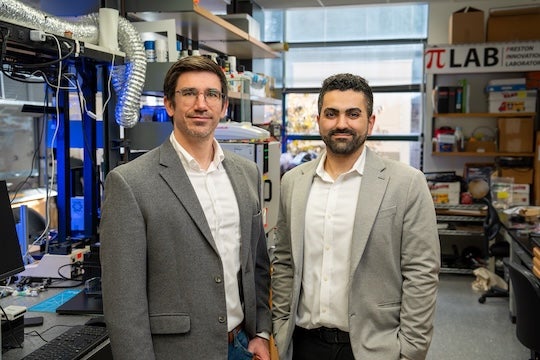
“This is exactly the kind of outcome we hope for when we pursue research at Rice,” Preston said. “Our goal is to develop technologies that, in addition to advancing scientific understanding, can also be deployed at scale to solve meaningful problems. Seeing Helix Earth take that work out of the lab and into commercial buildings is incredibly rewarding.”
Helix Earth has already garnered significant recognition, including placement on the Cleantech 50 to Watch list, first place in the 2025 South by Southwest Pitch competition and selection as one of Pepperdine Business School’s “Most Fundable Companies.” The company has also received a Phase II Small Business Innovation Research grant from the National Science Foundation and additional support from the U.S. Department of Energy. While at Rice, Rawand participated in the Liu Idea Lab for Innovation and Entrepreneurship’s Innovation Fellows program and won first place in the 2022 Napier Rice Launch Challenge.
Investors say the company’s potential extends beyond HVAC. The same underlying liquid-gas chemistry platform could have applications in industrial filtration, rare earth extraction and pollution scrubbing, opening pathways to broader impact across multiple sectors.
“We are tripling our investment in Helix Earth,” Holt said in the announcement. “The team has built breakthrough technology with real applicability across multiple industries. Their first product will have an immediate and measurable impact on our energy system, and they are already pursuing adjacent innovations to help heavy industries operate more efficiently and with less waste. This is a well-rounded team with a proven track record of strong execution and disciplined capital management.”
With fresh capital in hand, Helix Earth is now focused on scaling manufacturing and accelerating deployment, positioning itself at the intersection of energy efficiency, climate technology and the future of the built environment.
As the company grows, it also highlights Rice’s role as a catalyst for innovation — where interdisciplinary research, entrepreneurship and industry partnerships converge to bring new technologies from the lab to the marketplace.