
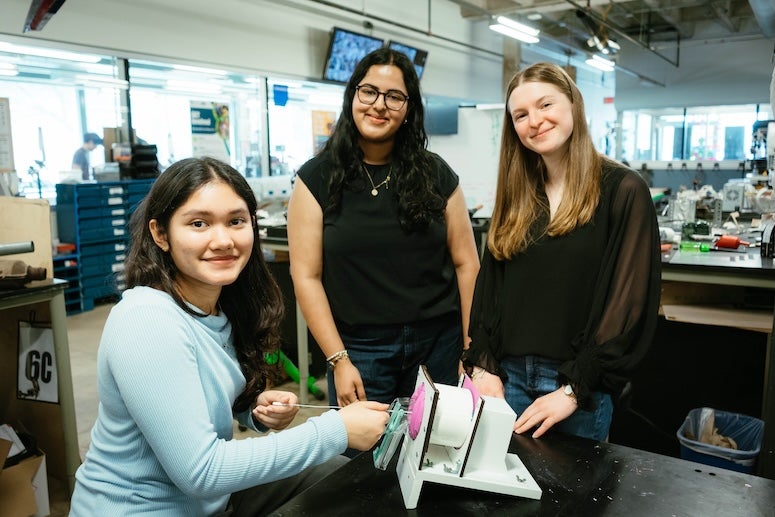
For an interdisciplinary team of Rice University undergraduates, improving global women’s health started with a pressing question: What does it take to make an essential cancer diagnostic procedure available worldwide?
Their answer is AGILE — Accessible Gynecology Innovation & Learning Equipment, a low-cost training model designed to help physicians and health workers learn how to perform uterine biopsies safely and effectively. The device aims to expand access to early uterine cancer diagnosis in low-resource settings where specialized training is often unavailable.
The project, supported by Rice360 Institute for Global Health Technologies and developed in the Oshman Engineering Design Kitchen, was created by students Lauren Walcott, Saumya Chauhan and Valerie Valentin under the mentorship of Meaghan Bond and Jenny Carns Plante. Clinical mentors Mila Salcedo and Parisa Fallah, obstetrician-gynecologists at The University of Texas MD Anderson Cancer Center, helped guide the project’s medical design.
The project will compete in the annual Harrell and Carolyn Huff OEDK Engineering Design Showcase, which will take place 4:30-7 p.m. April 16 at the Ion.
Uterine cancer is highly treatable when detected early. However, diagnosing it requires an endometrial biopsy, a specialized procedure that requires training not always available in low-resource settings.
“In many places, physician trainees don’t have the opportunity to practice this procedure before performing it on a patient,” Chauhan said. “If more providers had a realistic training tool, they could become comfortable taking biopsies and help diagnose uterine cancer sooner.”
Rice360 had previously developed the LUCIA, a training model used worldwide to teach cervical cancer biopsy techniques. However, the model did not include a uterine component or the ability to simulate the tactile experience of an endometrial biopsy. Over the past year, the team designed and built a uterine model that attaches to the existing LUCIA platform. Using the same medical tool physicians use in clinics — a small syringe-like device called a Pipelle — trainees can insert the instrument through the simulated vaginal canal and cervix to collect a biopsy sample from the uterus. The model is carefully designed to provide resistance and anatomical feedback that mimics the feel of the real procedure.
“One of the biggest challenges was understanding what the procedure actually feels like,” Valentin said. “Our clinical mentors spent a lot of time walking us through the textures and sensations physicians experience during a biopsy, so we could recreate that as accurately as possible.”
In an effort to replicate the full procedure, the model also allows trainees to collect a realistic tissue sample. The students experimented with a surprising range of household materials for the tissue, including mixtures of soap, floral foam and even strawberry jam. Eventually they developed a simple but effective solution: a mixture of hair gel and chia seeds that mimics the texture and appearance of a real biopsy specimen.
“When physicians collect a sample, they need to see and feel that they’ve obtained tissue,” Chauhan said. “That feedback is essential for learning the procedure correctly.”
The mixture also had to be practical for global use. During field testing, the team discovered that humid climates could cause organic materials to mold. As a result, they created multiple formulations — including a seed-free version — so trainers can adapt the model to local conditions.
“We wanted something that could be made almost anywhere using inexpensive materials,” Walcott said. “Hair gel is widely available, and the rest of the components are easy to source and bring abroad.”
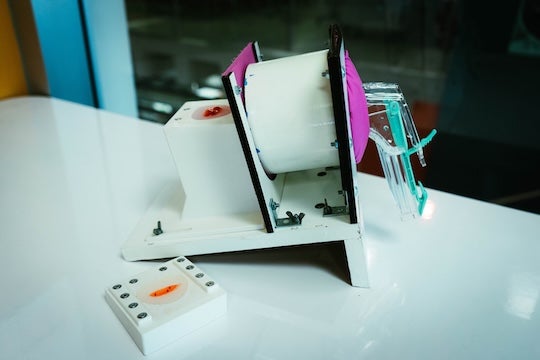
The uterus itself is molded from silicone using 3D printed molds designed by the students. Even that process required extensive engineering work and iteration. Because measurements of reproductive anatomy vary widely in medical literature, the team refined the dimensions based on clinician feedback and testing.
“There’s a surprising lack of standardized data on reproductive measurements,” Walcott said. “Working with clinicians helped us refine the anatomy, so it better reflects what doctors encounter in real patients.”
Last summer, the students tested early versions of their prototype with clinicians in Nairobi, Kenya, and Santo Domingo, Dominican Republic, collecting feedback through structured surveys. Across both locations, the response was overwhelmingly positive.
“One nurse told us she wished she had a device like this when she first learned how to perform endometrial biopsies,” Valentin said. “That was incredibly meaningful for our team.”
The project began in the Rice course GLHT 360: Appropriate Design for Global Health, where students collaborate with clinicians and partners to address real health challenges. After the class ended, Walcott, Chauhan and Valentin chose to continue developing the idea as an independent design project. The experience has also shaped their career aspirations.
Chauhan, a health sciences major who originally planned to pursue medicine, said the project introduced her to the world of engineering design.
“I absolutely fell in love with the engineering process through this project,” she said. “It reshaped the way I see my future as an innovator. Rice360 really brings together students from different backgrounds to design solutions for global health, and that interdisciplinary collaboration is what makes it so impactful.”
Valentin, a bioengineering major who has long dreamed of becoming an OB-GYN, said the project has helped her see how closely engineering and medicine goes hand in hand.
“I’ve wanted to work in obstetrics and gynecology since I was in sixth grade as someone very close to me struggled with gynecologic health conditions,” she said. “This project helped me realize that there are so many different ways to impact health care, which is what I’m truly passionate about. Seeing how engineering problem-solving can improve the tools or techniques doctors use made me appreciate how engineering and medicine can advance patient care.”
For Walcott, a mechanical engineering student interested in medical technology, the project offered a chance to tackle a real clinical challenge through hands-on design.
“What I loved most was getting to deeply understand the clinical problem before designing a solution. Collaborating with medical professionals and turning their insight into physical prototypes made the engineering process feel incredibly rewarding,” Walcott said.
The team is planning to conduct additional field testing abroad to prepare the work for publication, while also collaborating with Rice360’s global manufacturing partners to explore scalable production.
“If providers can learn this procedure earlier by practicing it with a realistic model like AGILE, they can help detect uterine cancer sooner and improve survival rates for women around the world,” Chauhan said.