

Rice researchers develop new way to quickly recycle electronic waste
Rice’s James Tour recently published an improved method to recover antimony from this electronic waste stream.
Rice researchers develop new way to quickly recycle electronic waste
Rice’s James Tour recently published an improved method to recover antimony from this electronic waste stream.

‘An investment in people’: Rice physics professor earns Packard Fellowship
Rice’s Yonglong Xie is one of 20 early-career scientists, mathematicians and engineers to receive a 2026 Packard Fellowship.
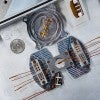
New monolithic ion trap developed for accessible quantum simulations
Rice’s Guido Pagano, along with collaborators at Duke University and Translume Inc., has developed a new kind of trapped-ion simulator, called a monolithic segmented 3D ion trap.
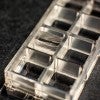
Improved precision microscopy method developed by Rice professor
Rice’s Anna-Karin Gustavsson published a method in Nano Letters expanding the use of light sheet microscopy to include a single objective in commercially available sample chambers.

Catalytic confessions and a quest for Matt Damon: PodCAT puts science on mic
PodCAT, hosted by researchers from Rice, the University of Rochester and Penn State University, is a podcast devoted to the science of catalysis, academic careers and the surprisingly personal stories of the researchers themselves.

A softer porous material could help improve solid-state batteries
Rice researchers have developed a relatively soft, flexible material that can selectively transport lithium ions — offering a new approach to porous solid electrolytes that combine efficient ion movement with better mechanical adaptability inside a battery.

The secret to a perfect crystal may be an extra turn
Rice researchers have developed a theoretical strategy for eliminating an unintended directional bias that can arise when magnetic particles are assembled using rotating magnetic fields.
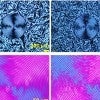
Liquid crystal takes page from steel in surprising phase transition
Rice researchers have shown that an organic semiconductor can transform from a liquid crystal into a solid crystal through a rapid, highly coordinated process resembling a Martensitic transformation.

Securing tomorrow: Rice hosts key leaders for inaugural summit on quantum and national security
Rice’s Defense Research Advancement initiative and the Smalley-Curl Institute recently hosted the inaugural Quantum Frontiers Summit, a first-of-its-kind gathering that brought together leaders from industry, academia and government to build a collaborative future vision for the rapid evolution of cutting-edge quantum technologies.

Smalley-Curl hosts 40th annual colloquium to ‘encapsulate Rice’s interdisciplinary drive’
Rice’s Smalley-Curl Institute recently hosted its 40th annual summer colloquium.

Rice researchers discover new way to tune electron flow in altermagnet material
Rice’s Pengcheng Dai recently published a paper in Physical Review X describing the first successful efforts to put a proposed altermagnet material into a single magnetic domain state, allowing the research team to characterize the material’s intrinsic magnetic structure.
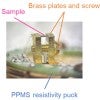
A small squeeze reveals new clues about an unusual kind of magnet
Researchers at Rice have found that gently squeezing a crystal of iron sulfide can change two of its unusual properties at the same time: its tiny magnetic signal and the way electricity moves through it.
Rice lab develops new technique for rapid production of advanced materials
Rice professor James Tour developed an ultrafast method for producing MXenes.

New controls allow researchers to incorporate thermal effects in quantum simulation
Rice physicist Guido Pagano unveiled a new, two-knob control for a trapped-ion quantum simulator that allows individual control of temperature and dissipation.
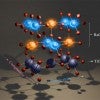
Shedding light on new type of magnetism in quantum materials
Rice's Ming Yi recently showed that the quantum material ruthenium dioxide potentially displays this new altermagnetism in its ultrathin film form in which the material is prepared as a very thin slice only a few atomic layers thick.