
By Jorge Vidal,
Special to Rice News
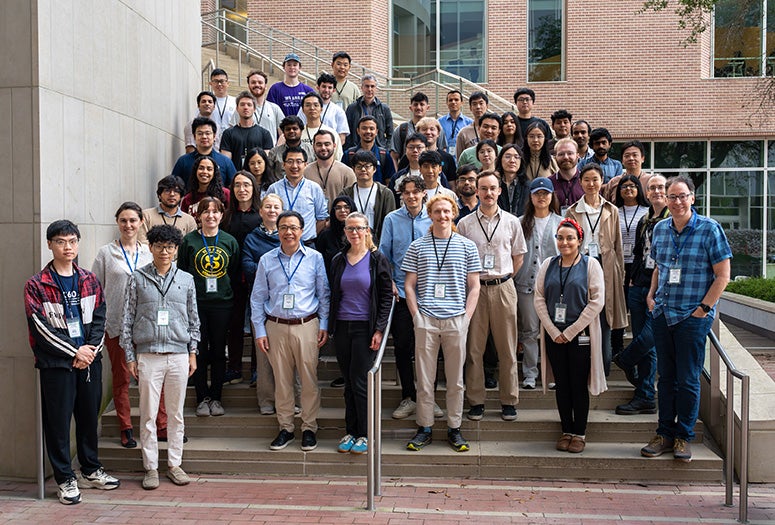
More than 80 scientists and students from around the world gathered at Rice University for the third annual Spring School on Electron Correlations and Topology, a program focused on advancing research at the intersection of two rapidly converging fields in quantum materials science.
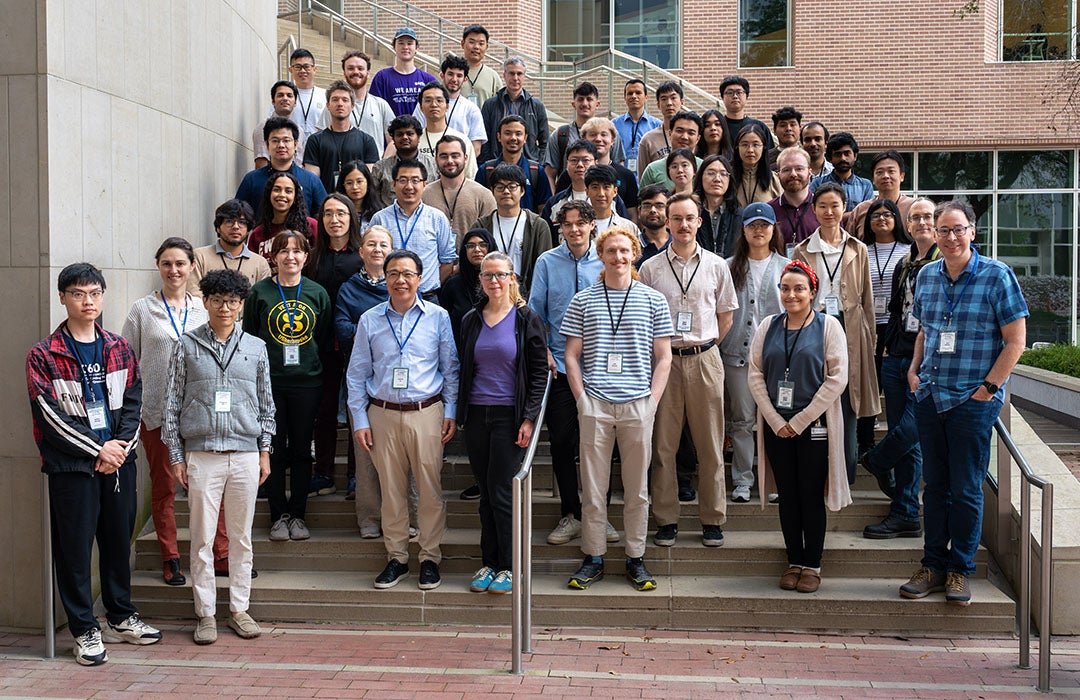
Hosted by Rice’s Extreme Quantum Materials Alliance (eQMA) in collaboration with the Smalley-Curl Institute, the four-day school featured lectures, discussions and collaborative exchanges among leading theorists, experimentalists and early career researchers. The event took place at the Bioscience Research Collaborative.
Designed with an emphasis on education and cross-disciplinary engagement, the program aimed to introduce foundational concepts while highlighting emerging frontiers where strong electron correlations and topology intersect, an area increasingly recognized as central to the discovery of new quantum phases and materials.
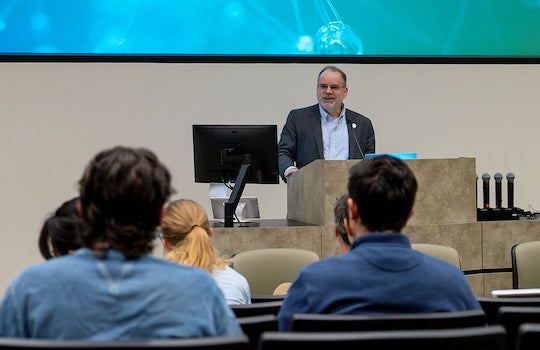
“Bringing together early career researchers and leading experts, Rice University’s Spring School on Electron Correlations and Topology is designed to connect two historically distinct physics communities working on shared challenges,” said David Sholl, Rice’s executive vice president for research, who delivered opening remarks. “The goal is to give young scientists a common foundation in this rapidly converging field while advancing some of the most pressing questions in quantum materials.”
Exploring convergence in quantum matter
The school reflected a broader shift in condensed matter physics, where the study of strongly interacting electrons and topological properties of materials is increasingly intertwined. Recent advances in platforms such as moiré materials, kagome metals and topological semimetals have revealed unexpected electronic behaviors and raised new theoretical and experimental challenges.
“What makes this moment particularly exciting is that the boundaries between correlation physics and topology are rapidly dissolving,” said Qimiao Si, director of eQMA and a scientific adviser for the program. “By bringing these communities together, we are not only deepening our understanding of quantum matter but also opening pathways to entirely new phases and functionalities that were not previously accessible.”
Sessions throughout the week covered a wide range of topics, including correlated systems from foundational principles to advanced studies, theoretical modeling of correlated topology, quantum entanglement in strongly interacting matter and out-of-equilibrium dynamics of many-body systems.
Lectures were delivered by an international group of experts, including Peter Armitage of Johns Hopkins University; Erez Berg of the Weizmann Institute of Science; Joel E. Moore of the University of California, Berkeley; Fiona Burnell of the University of Minnesota; Cécile Repellin of Université Grenoble Alpes; Dmitri Efetov of Ludwig Maximilian University of Munich; Philipp Werner of the University of Fribourg; and Brian Zhou of Boston College.
Training the next generation of researchers
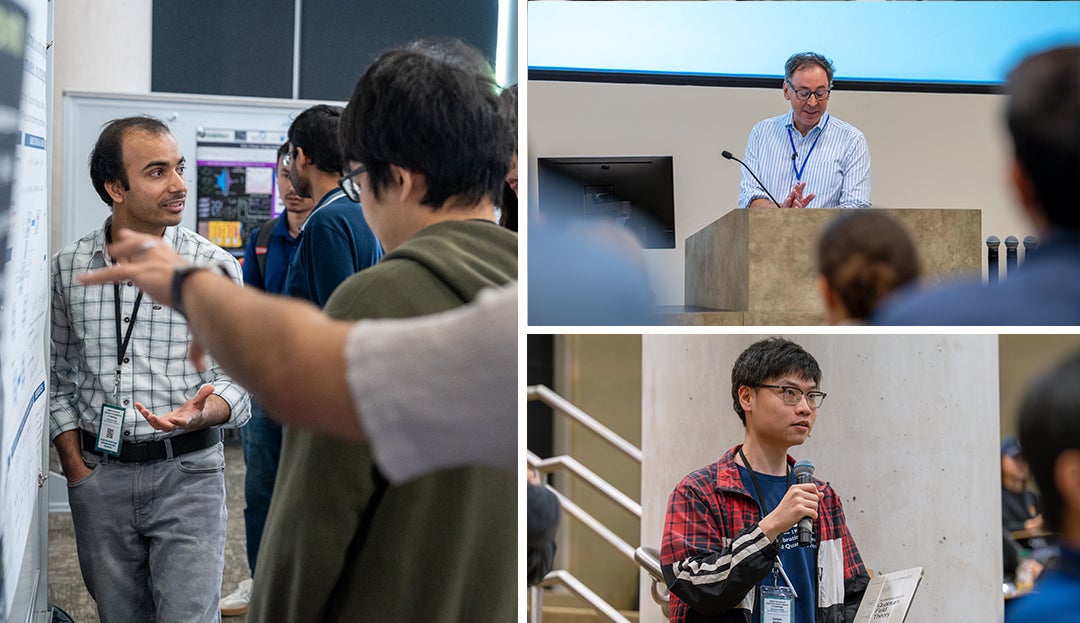
A central goal of the spring school was to provide junior researchers with the tools needed to navigate this evolving field. In addition to formal lectures, the program included poster sessions, participant talks and informal discussions designed to foster collaboration and mentorship.
“The school was designed to give young researchers a shared language across these two fields,” said Yonglong Xie, assistant professor of physics and astronomy at Rice and a co-organizer of the event. “By combining foundational lectures with discussions on emerging platforms like moiré materials and kagome systems, we aimed to equip participants with both the tools and perspective needed to tackle the next generation of challenges in quantum materials.”
By encouraging interaction across experience levels and research specialties, the program created opportunities for students and postdoctoral researchers from many institutions to engage directly with leaders in the field and build lasting professional connections.
The 2026 Spring School on Electron Correlations and Topology was organized by Rice’s Yonglong Xie, Kuan-Sen Lin and Fang Xie; Alex Thomson of the University of California, Davis; and Maia G. Vergniory of the Université de Sherbrooke.
The event was supported by the Gordon and Betty Moore Foundation, Rice, the Smalley-Curl Institute, Rice Global, Rice’s Department of Physics and Astronomy and Office of Research’s Creative Ventures program and the Institute for Complex Adaptive Matter (ICAM-I2CAM).