
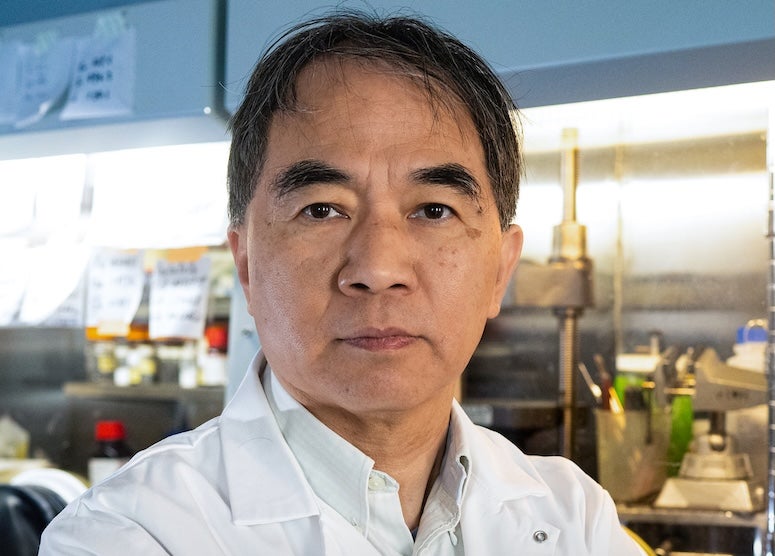
Rice University professor Pengcheng Dai has been elected to the American Academy of Arts and Sciences, one of the oldest and most prestigious learned societies in the nation.
“Professor Dai’s election to the American Academy of Arts and Sciences recognizes the profound impact of his work in condensed matter physics,” said Amy Dittmar, the Howard R. Hughes Provost and executive vice president for academic affairs. “His contributions are advancing understanding in his field and exemplify the kind of rigorous, high-impact scholarship that defines Rice. This honor highlights both his leadership as a researcher and the global reach of our faculty’s work.”
Dai, the Sam and Helen Worden Professor in Physics and Astronomy, will be formally inducted into the academy Oct. 10 alongside more than 250 other outstanding individuals.
“Pengcheng is a prime example of the exceptional faculty here in the Wiess School of Natural Sciences,” Dean Thomas Killian said. “His work has fundamentally advanced the field of unconventional superconductivity, and I am delighted the AAAS has recognized his seminal contributions.”
Dai is being recognized for establishing spin excitations as the unifying experimental signature linking magnetism and superconductivity across unconventional superconductors. His neutron scattering experiments provided decisive evidence connecting magnetic correlations to superconducting pairing in both cuprates and iron-based superconductors.
“I am honored to be joining the American Academy of Arts and Sciences,” said Dai, who is also a fellow of the American Physical Society and the American Association for the Advancement of Science. “This recognition, which has distinguished an incredible community of past and present visionaries, is both humbling and exciting. It reflects not only my work but the contributions of the amazing students and researchers who I have been fortunate enough to have in my lab over the years.”
Founded in 1780, the AAAS is dedicated to the recognition of exceptional “accomplishments in artistic, scholarly or scientific pursuits and leadership in the public, nonprofit and private sectors.” An independent policy organization with a wide-ranging, multidisciplinary agenda, the academy counts among its ranks luminaries such as Benjamin Franklin, Alexander Hamilton, George Washington, Ralph Waldo Emerson, Albert Einstein, John F. Kennedy and Martin Luther King Jr.