

Rice University scientists and collaborators have created a new type of two-dimensional semiconductor that comes closer than ever to a “perfect” crystal. The findings, reported in the journal Nature Synthesis, could open new possibilities for solar cells and other optoelectronic devices.
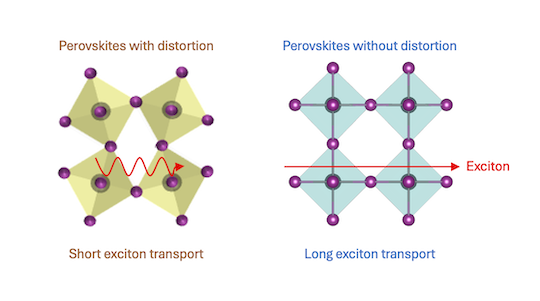
The new semiconductor belongs to a class of materials known as 2D metal halide perovskites, which consist of both organic and inorganic components. While semiconductors made from inorganic materials tend to form highly ordered, symmetrical crystal structures, the same is typically not the case for perovskites, whose softer lattices are more prone to distortions that can limit performance.

A team of researchers led by Aditya Mohite engineered a multilayered 2D perovskite that exhibits no such distortions, which means that energy can move through the material without getting trapped.
“It is as close to perfectly symmetrical as you can find in a crystal, and, to the best of our knowledge, it is the first time this has been demonstrated in a multilayered 2D perovskite system at room temperature,” said Mohite, Rice’s William M. Rice Trustee Professor, a professor of chemical and biomolecular engineering, and faculty director of the Rice Engineering Initiative for Energy Transition and Sustainability. “All the light that gets absorbed forms these material excitations called excitons, which can then propagate through the material for more than two micrometers without losing energy. That’s a big deal, because not many materials can really do this.”
In terms of exciton transport, the performance of the new 2D perovskite is an order of magnitude better than that of previously reported perovskites and on par with that of monolayer transition metal dichalcogenides, a new generation of 2D materials used in a range of applications, including ultrasensitive sensors and integrated electronic circuits.
The advance relied in part on a different way of making the material. Instead of allowing crystals to form as a solution cools, the researchers removed them at higher temperatures, locking in the desired structure before it could transform. Moreover, earlier efforts had been limited to thinner versions of these materials, but the new approach enabled thicker, multilayered forms.
“In two directions, it looks like a perovskite, and in the third direction, three perovskite layers are connected together,” said Isaac Metcalf, a Rice Ph.D. alum and postdoctoral researcher in the Mohite research group who is a co-first author on the study. “Before, people had only been able to connect two perovskite layers using this chemically stable formamidinium cation inside those layers. This is the first time that someone has connected three or more layers in this configuration.”
That added thickness matters because it changes how the material interacts with light. As more layers are stacked, the energy threshold needed to absorb light — known as the band gap — becomes smaller, allowing the material to capture a broader portion of the solar spectrum.

“The more sunlight it can absorb, the better a solar cell it can be, which is why people are excited about this,” Metcalf said.
The material was tested in proof-of-concept self-powered photodetectors, devices that convert light into electrical signals. Devices made from the new perovskite were more sensitive and responded faster than ones made from a different 2D perovskite, particularly in thicker films.
The findings could also have implications for next-generation optoelectronic and quantum devices, as well as for tandem solar cells, where two or more materials are layered to capture different parts of the light spectrum more efficiently.
“One of the big challenges with tandems right now is the wide band gap material,” said Faiz Mandani, a Rice Ph.D. alum and study co-author. “The 2D perovskites we are developing have enhanced stability. And this specific 2D perovskite has a near ideal band gap to pair with silicon or any other perovskite or semiconductor”
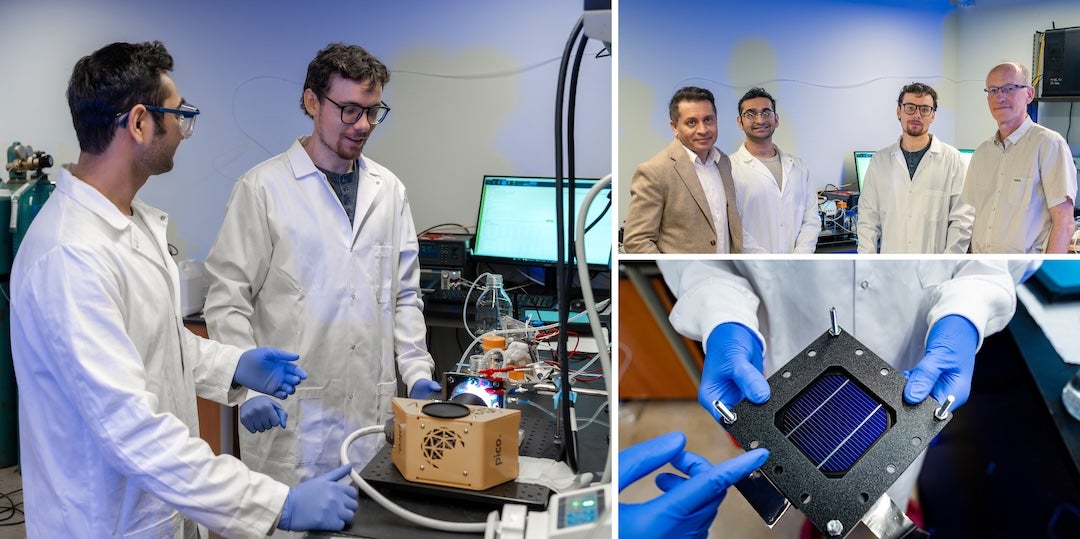
Jin Hou, a materials science and nanoengineering Ph.D. student at Rice, was the first author on the study along with Jared Fletcher, a graduate student at Northwestern University working in the research group of Mercouri Kanatzidis, a co-corresponding author alongside Mohite. In addition to Rice and Northwestern, collaborators include researchers at City University of New York, University of Rennes, University of Lille and University of Nebraska-Lincoln.

The research was supported by the U.S. National Science Foundation (2019444, 2112550, 2044049, 2339721), the China Scholarships Council (202107990007), the European Union’s Horizon 2020 research and innovation program (899546, 795091), the French National Research Agency (ANR-23-CE09-0001), the American Chemical Society Petroleum Research Fund (65743-ND6), France’s National Center for Scientific Research and the Academic Institute of France. The content in this press release is solely the responsibility of the authors and does not necessarily represent the official views of funding entities.
- Peer-reviewed paper:
-
Two-dimensional perovskites with maximum symmetry enables exciton diffusion length exceeding 2 micrometers | Nature Synthesis | DOI: 10.1038/s44160-026-01041-4
Authors: Jin Hou, Jared Fletcher, Siedah J. Hall, Hao Zhang, Marios Zacharias, George Volonakis, Claire Welton, Stefan Zeiske, Isaiah W. Gilley, Donghoon Shin2, Faiz Mandani, Isaac Metcalf, Shuo Sun, Bo Zhang, Yinsheng Guo, Bin Chen, G. N. Manjunatha Reddy, Claudine Katan, Jacky Even, Matthew Y. Sfeir, Mercouri G. Kanatzidis and Aditya D. Mohite
https://www.nature.com/articles/s44160-026-01041-4 - Access associated media files:
-
Video: https://www.youtube.com/watch?v=ii10bdQhwVo
Photos: https://rice.app.box.com/s/mozg3g7e21hk6hyu8df2xi04wnq5jnc8/folder/374800528245
(Photos and video by Jorge Vidal/Rice University)