

Magnetic materials in a quantum spin liquid phase are of great interest in the pursuit of exotic state of matter and quantum computation. But in the quantum realm, things are not always what they seem. A recent study, published in Science Advances and co-led by Rice University’s Pengcheng Dai, found that the material cerium magnesium hexalluminate (CeMgAl11O19) was not actually in a quantum spin liquid phase despite evidence suggesting it was.
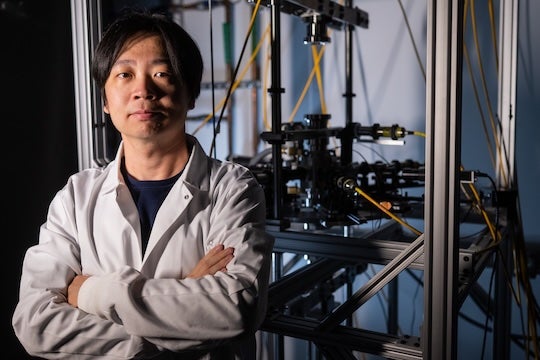
“The material had been classified as a quantum spin liquid due to two properties: observation of a continuum of states and lack of magnetic ordering,” said Bin Gao, co-first author and a research scientist at Rice. “But closer observation of the material showed that the underlying cause of these observations wasn’t a quantum spin liquid phase.”
Insulating materials like CeMgAl11O19 can have their magnetic ions, like cerium, take on one of two magnetic states: ferromagnetic or anti-ferromagnetic. Typically, once an ion is in a ferromagnetic state, it will influence nearby ions to also enter that state, resulting in all the ions in a structure aligning in a ferromagnetic state. Similarly, if it’s in an anti-ferromagnetic state, it will result in an alignment of ions in anti-ferromagnetic states. This magnetic alignment can be viewed when the researchers bring the material down to near-absolute zero temperatures.
At these low temperatures, nonquantum materials with their ions aligned into one state will settle into a low energy configuration. Because the materials will have their ions either all in a ferromagnetic or anti-ferromagnetic state, researchers will see only one low energy configuration.
For a quantum spin liquid material, the behavior at near-absolute zero is different. The quantum materials transition to and from different low energy states via quantum mechanics. This results in the researchers observing a continuum of different states instead of just one. The transitions also give a lack of magnetic ordering, meaning both ferromagnetic and anti-ferromagnetic states will be seen, rather than just one or the other as in conventional magnetically ordered materials.
CeMgAl11O19 presented with both a lack of magnetic ordering and a continuum of different states. But careful analysis of the continuum of states indicates that it does not arise from a quantum spin liquid but instead from degeneration of states from the competition of ferromagnetic and antiferromagnetic interactions.
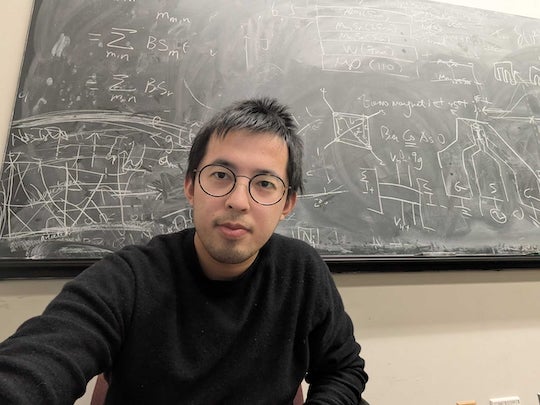
“We were interested in this material, which had a collection of characteristics we hadn’t seen before,” said Tong Chen, co-first author and a research scientist at Rice. “It was not a quantum spin liquid, yet we were observing what we thought were quantum spin liquid-associated behaviors.”
By bombarding the material with neutrons and taking careful other measurements, the researchers came to the answer. In CeMgAl11O19, the boundary between the ferromagnetic and anti-ferromagnetic state was weaker than it was in most materials. The magnetic ions, with more flexibility to go between the two states, didn’t align into a single ordered state — instead, in the same structure, some were ferromagnetic and some were anti-ferromagnetic, producing a lack of magnetic ordering. This lack of ordering opened up a greater array of possible low energy states. As the material was brought to near-absolute zero, it could select from a number of different low energy states, resulting in a mix of observable states that resembled the continuum of different states found in quantum spin liquids. However, since the material was not in a quantum spin liquid state, once it entered a low energy state, it could not shift to another state.
“The material’s unique ability to ‘choose’ between different low energy states produced observational data very similar to a quantum spin liquid state,” said Dai, corresponding author on this study. “This is a new state of matter that, to our knowledge, we are the first to describe.”
This unique material, Dai added, is a good reminder of how much we don’t know about the quantum realm. “It underscores the importance of careful observation and thorough investigation of your data.”
The neutron scattering and AC magnetic susceptibility work at Rice was supported by the U.S. Department of Energy’s Basic Energy Sciences (DE-SC0012311, DE-SC0026179). The single crystal growth work was supported by the Robert A. Welch Foundation (C-1839). Crystal growth by BG, XX, and SWC at Rutgers University was supported by the visitor program at the Center for Quantum Materials Synthesis, funded by the Gordon and Betty Moore Foundation’s EPiQS initiative (GBMF6402) and by Rutgers. The theoretical work done by CL and LB was supported by the DOE, Office of Science, BES (DE-FG02-08ER46524) and the Simons Collaboration on Ultra-Quantum Matter. Researchers received individual support from the Gordon and Betty Moore Foundation through the Emergent Phenomena in Quantum Systems program; the National Natural Science Foundation of China (12204160); the National Research Foundation of Korea, Ministry of Science and ICT (2022M3H4A1A04074153); and the Welch Foundation (AA-2056-20240404). The neutron scattering experiment at the MLF of J-PARC was performed under proposal No. 2022B0242. This research used resources at the Spallation Neutron Source, a DOE Office of Science User Facility operated by Oak Ridge National Laboratory.