

A recently arrived Rice University professor preparing to study quantum systems assembled from the ground up with individual atoms has two significant papers on which to build his reputation.
A recently arrived Rice University professor preparing to study quantum systems assembled from the ground up with individual atoms has two significant papers on which to build his reputation.

People, papers and presentations Jul 7, 2021
Physics and astronomy graduate student Asa Stahl is gaining international attention for his children’s book, “The Big Bang,” illustrated by his collaborator in England, Carly Allen-Fletcher. The book was nominated for the Ezra Jack Keats Award, is a finalist for Japan’s Sakura Medal, won an honor in the 2021 International Literacy Association's Children's and Young Adults' Book Awards and was named an Outstanding Science Trade Book for Students by the National Science Teachers Association and Children's Book Council.

Biologists construct a ‘periodic table’ for cell nuclei
A team of biologists studying the tree of life has unveiled a new classification system for cell nuclei, and discovered a method for transmuting one type of cell nucleus into another.
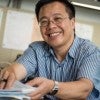
Pristine quantum criticality found
U.S. and Austrian physicists searching for evidence of quantum criticality in topological materials have found one of the most pristine examples yet observed.
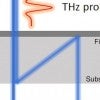
Thin is now in to turn terahertz polarization
Rice lab’s discovery of ‘magic angle’ builds on its ultrathin, highly aligned nanotube films

Rice physicist Stanislav Sazykin dies at 49
Stanislav Sazykin, an associate research professor of physics and astronomy who was highly respected in his field of space science, died suddenly on May 3 at 49. The cause of his death has not yet been determined.

Students’ model could help avoid costly natural gas compressor shutdowns
A student project to predict the need for maintenance in natural gas compressors and avoid unexpected shutdowns has won this year’s Data to Knowledge Lab Showcase.

Rice names architect for new engineering and science building
With the imminent demolition of Rice University’s Abercrombie Engineering Laboratory, the space will soon be cleared for a new engineering and science building, according to Rice administrators. International architecture firm Skidmore, Owings & Merrill (SOM) has been selected as lead architect for the new building. Houston’s Scientia Architects will consult on laboratory design.
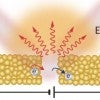
Teamwork makes light shine ever brighter
If you’re looking for one technique to maximize photon output from plasmons, stop. It takes two to wrangle.
Seven research teams win Carbon Hub funding
Carbon Hub, Rice University's zero-emissions research initiative, has awarded seed grants for seven projects that will rapidly advance its vision for transforming the oil and gas sector into a leading provider of both clean hydrogen energy and solid carbon products that can be used in place of materials with large carbon footprints.
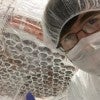
Christopher Tunnell wins NSF CAREER Award
Rice University computational astroparticle physicist Christopher Tunnell is getting help in his search for the nature of the universe through a National Science Foundation (NSF) CAREER Award.
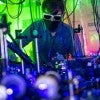
Bottling the world's coldest plasma
Rice University physicists have discovered a way to trap the world's coldest plasma in a magnetic bottle, a technological achievement that could advance research into clean energy, space weather and astrophysics.
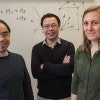
Quantum quirk yields giant magnetic effect, where none should exist
In a twist befitting the strange nature of quantum mechanics, physicists have discovered the Hall effect — a characteristic change in the way electricity is conducted in the presence of a magnetic field — in a nonmagnetic quantum material to which no magnetic field was applied.
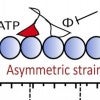
Study shows why anesthetic stops cell’s walkers in their tracks
Researchers detail the mechanism that allows propofol, a common anesthetic, to halt the movement of kinesin proteins that deliver cargoes to the far reaches of cells.
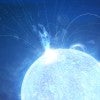
Fermi space telescope offers 'best look ever' at giant flare
Intense light from the April 2020 eruption of a neutron star in a nearby galaxy has given astronomers their first clear look at a type of gamma-ray burst known as a magnetar giant flare.