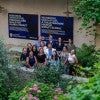
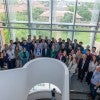
Rice’s Smalley-Curl Institute held its 38th annual Summer Research Colloquium Aug. 2 at Rice’s Duncan Hall, where undergraduate and graduate students and postdoctoral researchers gave presentations covering topics in nanoscience, quantum materials and quantum information science and technology to a multidisciplinary audience.
Rice neural engineer Chong Xie and his team have won a $2.9 million R01 grant from the NIH to develop a state-of-the-art implantable neural electrode system that is highly biocompatible, untethered and capable of stable, long-term and large-scale neural recording and stimulation.
The Rice Global Paris Center hosted the BioElectronic Therapeutics (BETx) conference and workshop June 27-28, the first formal event dedicated to the field of bioelectronics to be held at Rice’s Paris campus.
An international team of researchers from Rice and Hanyang University have developed a new material that moves like skin while preserving signal strength in electronics. The technology could enable the development of next-generation wearable devices with continuous, consistent wireless and battery-free functionality.
The Ken Kennedy Institute, in collaboration with the Rice Synthetic Biology Institute, Smalley-Curl Institute and the Rice Advanced Materials Institute, awarded $175,000 in support of seven innovative research projects looking to establish new paradigms in AI, data and computing.
The Rice Center for Quantum Materials recently hosted the second edition of the Workshop on Quantum Materials Synthesis, an event dedicated to communicating recent developments in the field, identifying new research areas and providing a platform for theorists and experimentalists to come together for discussion and knowledge exchange.
Rice physicists have discovered a phase-changing quantum material — and a method for finding more like it — that could potentially be used to create flashlike memory capable of storing quantum bits of information, or qubits, even when a quantum computer is powered down.
A team of researchers from Rice University and the University of Illinois Urbana-Champaign has shown that molecules can be as formidable at scrambling quantum information as black holes by combining mathematical tools from black hole physics and chemical physics and testing their theory in chemical reactions.
A team of Rice researchers led by Angel Martí, professor and chair of chemistry and professor of bioengineering, materials science and nanoengineering, was awarded a $1.875 million grant by the National Institutes of Health to support its groundbreaking research in biological fibrillar nanostructures with potential implications for the treatment and diagnosis of diseases including Alzheimer’s and Parkinson’s.
Rice University’s Junichiro Kono has assumed leadership of the Smalley-Curl Institute, named for Nobel Laureates Richard Smalley and Robert Curl ’54 and home to some of the world’s most accomplished researchers in nanoscience, quantum science and materials science.
Rice engineers have demonstrated a way to control the optical properties of an atomic imperfection in silicon material known as a T center by embedding it in a photonic integrated circuit and exploiting the Purcell effect to strengthen light-matter interaction and increase the rate of spontaneous emission.
Rice University’s Naomi Halas has been selected as the 2024 recipient of the C.E.K. Mees Medal by Optica for her “original use of optics across multiple fields.”