Rice Athletics celebrated longtime supporters and champions of its student-athletes Sept. 30 at the 21st An Evening for Rice’s Honour gala at River Oa...
Rice parents, siblings, grandparents and other family members joined their Owls for meals, performances, conversations, campus activities and athletic...
Houston’s population boom masks other trends that have been unfolding for more than two decades: Women here are having fewer children and having them ...
Rice and First Community Credit Union have signed a 20-year football stadium naming rights and campus collaboration agreement as announced Thursday by...
Rice’s George R. Brown School of Engineering and Computing has named Karen Lozano as the director of the Tapia Center for Empowerment through STEM Edu...
Rice continues its upward momentum in global higher education, rising two spots to No. 101 worldwide in the 2027 Times Higher Education World Universi...
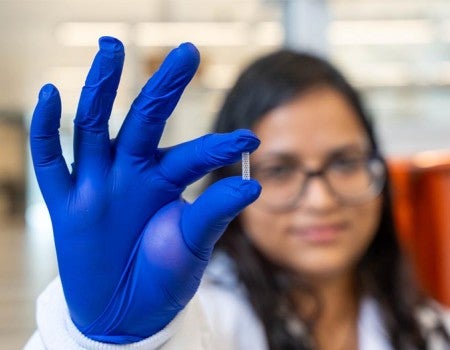
Researchers at Rice, with the support of the Rice Biotech Launch Pad, have developed an implantable “living pharmacy” using engineered protein produce...
New research explores how perceptions of immunity can shape vaccine decisions and how personalized feedback may help people better understand their pr...
Kirsten Ostherr, the Gladys Louise Fox Professor of English and director of the new Medical Humanities Research Institute at Rice, received a grant from the National Endowment for the Humanities (NEH) to advance her work on the role of visual representation in the history of computational health.
Rice U. engineers developed a lightweight, wearable textile-based device that can deliver complex haptic cues, enabling a user to perform open-world navigation tasks. The device is resilient to regular daily use, withstanding multiple cycles of washing and other damage and repair without loss of function.
While university life promises adventure, growth and new connections, the rigor of academia can sometimes become intimidating and even overwhelming. That’s why fostering our mental, physical and emotional well-being is paramount for our sustained success.
Rice University’s efforts to support mental health and wellness go beyond advocating for individual self-care. The university fosters a culture of community care that enhances mental wellness in classrooms, offices and social settings.
Michelle “Mikki” Hebl , the Martha and Henry Malcolm Lovett Professor of Psychological Sciences and professor in the Jones Graduate School of Business, is the 2023 recipient of the Advancing Women in Leadership Award from the Academy of Management (AOM).
Rice’s incoming class received a crash course in Rice athletics on the third day of O-Week as they flocked to Tudor Fieldhouse for Rice Rally, a pep rally to introduce new Owls to the teams they’ll be rooting for in the coming years.