
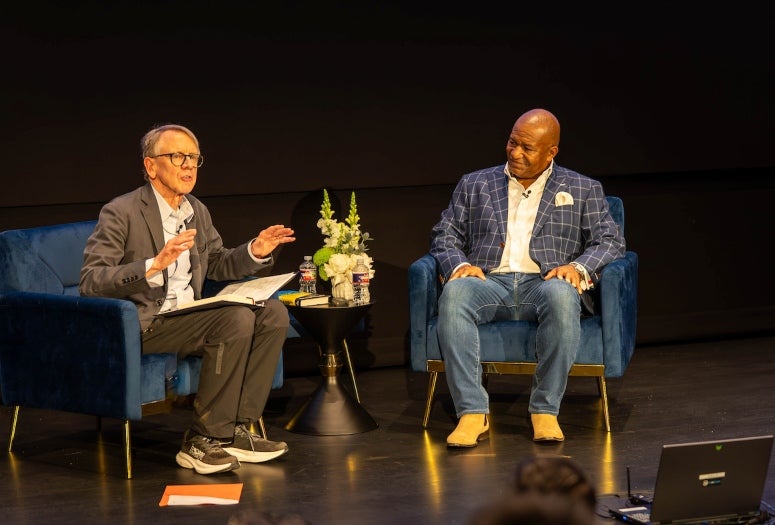
Venture capitalist John Doerr joined Doerr Institute for New Leaders’ director Bernie Banks at Rice University March 26 for a wide-ranging conversation on leadership, technology and the future of work. The discussion brought together students, employees and leaders to explore a central challenge of our time: how to lead with purpose in an era of rapid and uncertain change.
From the outset, Doerr emphasized that leadership is not about status or authority but about meaning. Reflecting on his own life and career, the namesake of the Doerr Institute shared a guiding principle: “Make meaning in life out of your relationship with others.”
This human-centered view shaped much of the conversation. For Doerr, leadership is deeply relational; it is about building trust, fostering collaboration and inspiring people to act. Citing leadership expert Jim Collins, he described leadership as “the art of getting people to want to do what must be done,” a definition that highlights influence over control.
The power of mentorship and values
A recurring theme in Doerr’s remarks was the importance of mentorship. He credited much of his success to influential figures like former Intel CEO Andy Grove and former Intuit chairman and CEO Bill Campbell. These mentors not only shaped his thinking but also reinforced a critical leadership lesson: people come first.
“People are the most important thing we do,” Doerr said, recalling Campbell’s philosophy of leadership rooted in care, trust and personal growth.
This perspective aligns with the mission of the Doerr Institute at Rice, where leadership development is grounded in coaching, reflection and experiential learning. Students who spoke during the event described how the program helped them grow as both leaders and as individuals — becoming more self-aware, present and connected to others.
Mission-driven leadership
Doerr also introduced a powerful distinction between “missionary” and “mercenary” leadership. Missionaries, he explained, are driven by purpose, long-term vision and impact, while mercenaries focus on short-term gains and opportunism.
“Mercenaries are sprinting for the short run, whereas missionaries know they’re in a marathon for the long run,” he said.
Mission-driven organizations, he argued, foster stronger cultures, better teamwork and more sustainable innovation. They prioritize values, mentorship and collaboration over individual success or financial outcomes. In contrast, mercenary environments often emphasize competition, hierarchy and short-term metrics.
This framework is particularly relevant in today’s startup and tech ecosystems, where companies must balance rapid growth with long-term purpose.
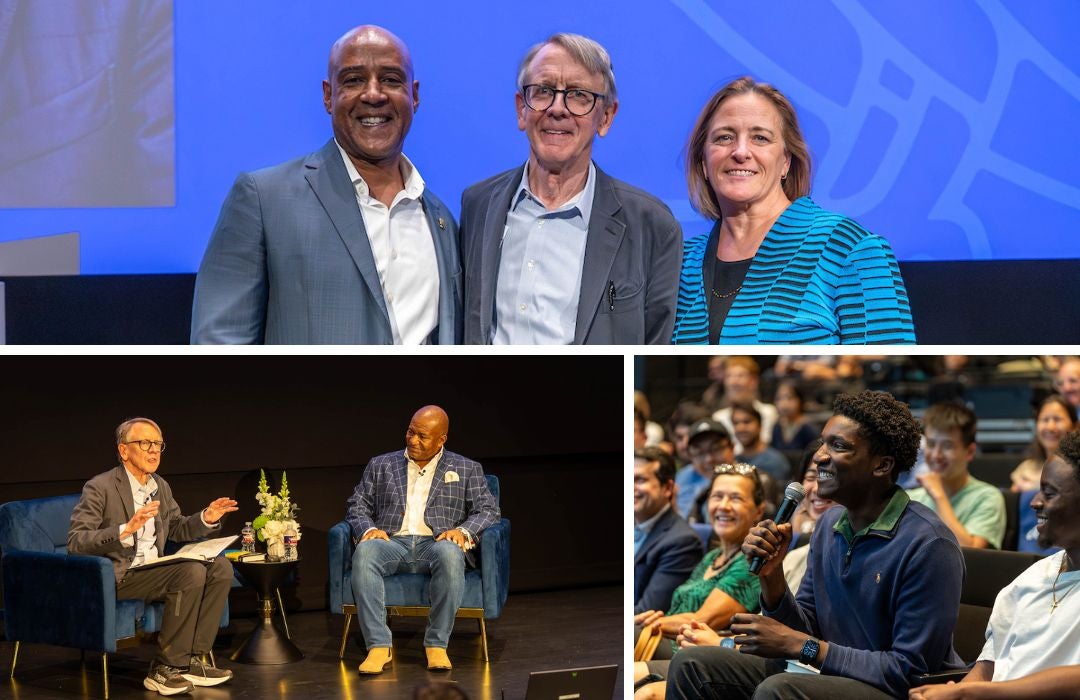
Navigating technological tsunamis
Doerr described technological progress as a series of “tsunamis” — waves of innovation that reshape industries and society. He pointed to four major waves over the past several decades:
- The rise of personal computing
- The emergence of the internet
- The smartphone and cloud revolution
- The current surge in artificial intelligence
Each wave builds on the last, accelerating change and creating new opportunities. But Doerr said the latest wave — AI — stands apart in both scale and uncertainty.
“We’re just at the beginning,” Doerr said, noting that even the most experienced leaders cannot fully predict what lies ahead.
This uncertainty, he suggested, is both a challenge and an opportunity. It demands adaptability, curiosity and a willingness to learn continuously.
The role of education and society
As technology advances, Doerr warned that it can also deepen inequality if left unchecked. He emphasized the importance of education as a counterbalance — a force that creates opportunity and upward mobility.
“Technology widens the gap between the rich and the poor,” he said, “and the offsetting force is education.”
He expressed concern about declining support for higher education and stressed the need for strong institutions to guide society through periods of disruption. Universities like Rice, he argued, play a critical role not just in advancing knowledge but in preparing leaders to tackle global challenges.
Advice for the next generation
When asked what advice he would give students entering this uncertain future, Doerr was direct: The nature of work is changing, and no one can assume stability.
“A profound shift in employment is underway,” he said.
To navigate this shift, he encouraged students to focus on building essential skills and relationships:
- Learn to communicate and lead teams
- Develop strong networks
- Seek out high-growth opportunities
- Embrace and leverage AI
He also challenged the popular advice to simply “follow your passion.” Instead, he argued, passion must be paired with excellence and practicality. Success comes from finding work that you are both great at and that can sustain your life.
Humanity at the center of innovation
A particularly important theme was the role of the humanities in a technology-driven world. Both Doerr and Banks stressed that technical progress must remain grounded in human values.
Technology, they argued, should enhance the human experience, not replace or diminish it. Leaders who understand culture, ethics and human behavior will be better equipped to build meaningful innovations.
This holistic approach that combines science, technology and the humanities may be essential for navigating the complexities of the AI era.
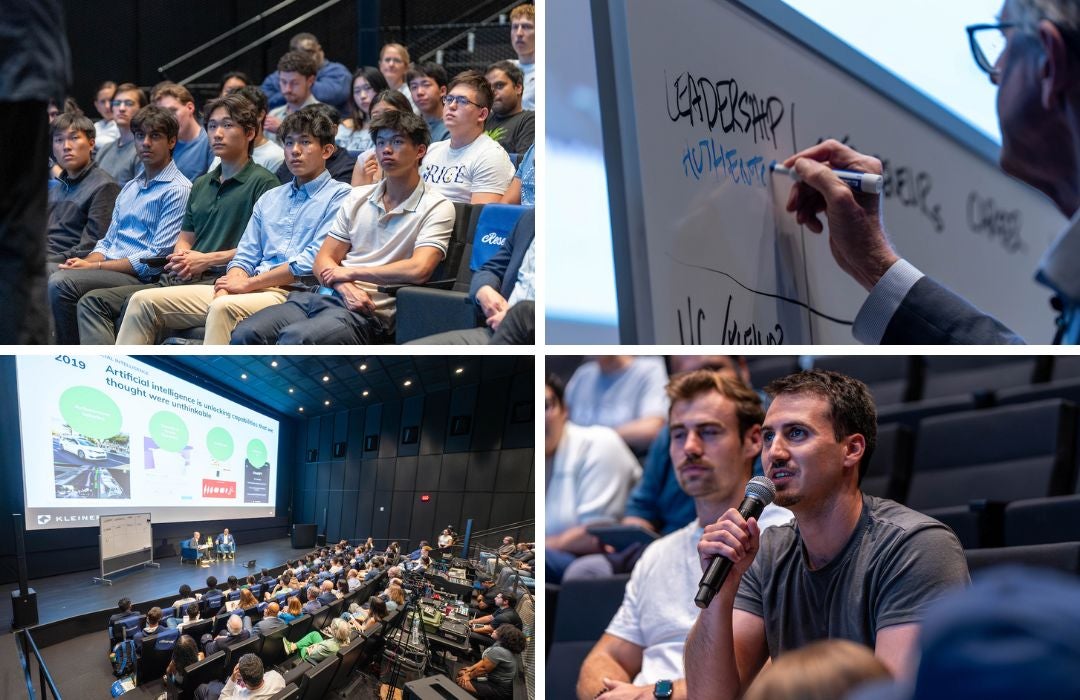
Leading with authenticity
Doerr closed with a reflection on authentic leadership. To lead effectively, he said individuals must stay true to their values while prioritizing the success of their teams.
Authentic leaders are not self-centered. Instead, they are service oriented. They understand that leadership is about enabling others to succeed.
In a world defined by rapid change, this kind of leadership — one that is grounded in purpose, relationships and integrity — may be the most important skill of all.
As the conversation made clear, the future will not be easy to predict, but for those willing to embrace uncertainty, invest in others and lead with purpose, it will be full of possibility.