

In Houston and other parts of the country, some public school districts are seeing declining enrollment, but the story is more complex than fewer students.
A new report from the Houston Education Research Consortium (HERC) at Rice University’s Kinder Institute for Urban Research offers a clearer answer to a question many district leaders and families are asking: Where are all the students?

They haven’t disappeared. They are simply attending school somewhere else.
“Many school districts outside the urban core are experiencing rapid population growth that has huge implications for them,” HERC researcher Courtney Thrash said. “Building schools and adding services takes significant time and financial investment. On the other side, many districts in the urban core are experiencing enrollment decline and facing really difficult decisions about how to best serve the students that remain.”
The study, “Preparing for Future Enrollment in Public School Districts: Population Change, Births and Mobility in the Houston MSA,” finds that shifting population patterns and expanding school options are redistributing students across the region, leaving some districts with fewer classrooms to fill and others working to keep up with growth.
The Houston metropolitan area has added more than 2 million residents since 2005, but that growth has not translated evenly into public school enrollment.
Instead, students are increasingly concentrated in districts outside the urban core, particularly in fast-growing suburban and exurban communities. At the same time, several large urban districts are experiencing stagnant or declining enrollment, forcing difficult decisions about school closures, staffing and long-term planning.
What the data shows
Researchers analyzed population trends, birth records and enrollment data across 68 public school districts in the greater Houston area.
“I think this analysis demonstrates how thinking about births alone when making predictions about future enrollment is insufficient,” Thrash said. “Births, mobility and other educational options can all affect enrollment in public school districts. Gathering all this information is the tricky part.”
Key findings include:
- Population growth is not being driven by birth rate
While the region’s population has surged, births have remained relatively flat. - Migration is the dominant force shaping enrollment
Most growth in the region comes from people moving in, not from natural population increase. - Fastest-growing districts are outside the urban core
Smaller districts on the region’s edges are seeing the largest gains in both population and school-age children. - Some districts enroll more students than births alone would predict
High-growth districts are attracting families with school-age children, leading to kindergarten enrollment that exceeds expectations based on local births alone. - Charter schools are influencing enrollment patterns
Districts with more charter schools in their area tend to enroll fewer kindergarten students than expected, pointing to the role of school choice.
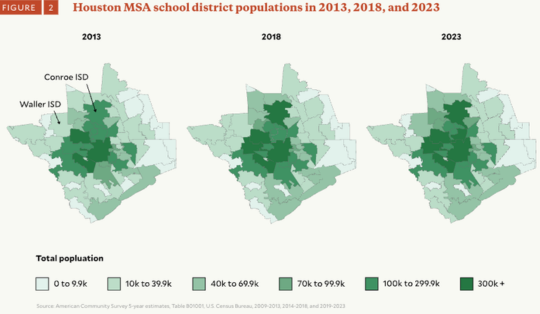
The findings help explain a growing disconnect across the region.
Even as the Houston area continues to grow, enrollment declines in some districts are triggering school closures and funding challenges, while others are grappling with increased demand. Because public school funding is closely tied to enrollment, even small shifts in student population can have major financial consequences.
The report suggests that traditional forecasting methods, especially those that rely heavily on birth rates, no longer capture the full picture.
Instead, districts must account for a more complex mix of factors, including mobility, housing patterns and the expanding landscape of school choice.
Researchers say better access to localized demographic data could help districts make more informed decisions without relying on costly outside studies.
"Ideally, the state of Texas could somehow provide more district- and regional-level demographic information for school districts to use when planning for the future,” Thrash said. “This type of data is imperative for districts but can be cost-prohibitive for districts already struggling with tight budgets."
The study also points to the importance of understanding how broader trends, including where families choose to live, are shaping school enrollment.
Enrollment changes, the study shows, are not just about schools. They reflect how and where families are making decisions about their lives.
The report was authored by Thrash, Autumn Horne, Erin Baumgartner and Annie Pham through HERC.
The full report and interactive data are currently available.
For more information or to schedule an interview, contact Kat Cosley Trigg, media relations specialist, at kat.cosley.trigg@rice.edu.