
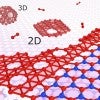
Weak bonds a strength in making borophene
Rice University researchers show how borophene, the 2D form of boron, can be grown to simplify its use for applications.
Weak bonds a strength in making borophene
Rice University researchers show how borophene, the 2D form of boron, can be grown to simplify its use for applications.

American Chemical Society honors Gustavo Scuseria
Rice University’s Gustavo Scuseria wins the American Chemical Society Award in Theoretical Chemistry.
Message from provost on launch of Rice Quantum Initiative
For more than four decades, Rice University scientists and engineers have explored and expanded the boundaries of quantum science and created revolutionary computation, sensing and communication technologies based on the principles of quantum mechanics.

Rice physicists find 'magnon' origins in 2D magnet
Rice physicists have confirmed the topological origins of magnons, magnetic features they discovered three years ago in a 2D material that could prove useful for spintronics.
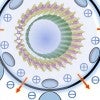
Double-walled nanotubes have electro-optical advantages
Rice theorists find that flexoelectric effects in double-walled carbon nanotubes could be highly useful for photovoltaic applications.
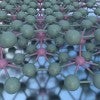
Scientists make bilayer borophene for the first time. The versatile 2D material shows promise for quantum electronics, energy storage and sensors.
Physicists find room-temperature, 2D-to-1D topological transition
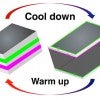
Physicists have discovered a room-temperature transition between 1D and 2D electrical conduction states in the topological insulator bismuth iodide.

The Way I See It: The state of quantum computing
Ken Kennedy Institute Executive Director Angela Wilkins discusses the development and future of quantum computing.
Odds are good for unique 2D compound
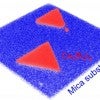
Rice University engineers make 2D materials for valleytronics, a platform for information processing and storage that relies on the manipulation of electrons’ positions in energetic “valleys.”

Solar energy collectors grown from seeds
Rice University engineers have created microscopic seeds for growing remarkably uniform 2D perovskite crystals that are both stable and highly efficient at harvesting electricity from sunlight.

Odd angles make for strong spin-spin coupling
HOUSTON – (May 25, 2021) – Sometimes things are a little out of whack, and it turns out to be exactly what you need.

A recently arrived Rice University professor preparing to study quantum systems assembled from the ground up with individual atoms has two significant papers on which to build his reputation.

Pristine quantum criticality found
U.S. and Austrian physicists searching for evidence of quantum criticality in topological materials have found one of the most pristine examples yet observed.

Thin is now in to turn terahertz polarization
Rice lab’s discovery of ‘magic angle’ builds on its ultrathin, highly aligned nanotube films
Teamwork makes light shine ever brighter
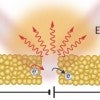
If you’re looking for one technique to maximize photon output from plasmons, stop. It takes two to wrangle.