

A number of Rice graduate programs are rated among the nation’s best in the latest edition of U.S. News and World Report’s “Best Graduate Schools” rankings.
A number of Rice graduate programs are rated among the nation’s best in the latest edition of U.S. News and World Report’s “Best Graduate Schools” rankings.

A team from Rice participated in the NASA Spacesuit User Interface Technologies for Students program.

European Academy of Sciences honors Rice’s Pol Spanos with prestigious award
Rice’s Pol Spanos, the Lewis B. Ryon Professor of Mechanical and Civil Engineering, has been awarded the 2024 Blaise Pascal Medal in Engineering by the European Academy of Sciences.
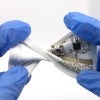
Wearable devices get signal boost from innovative material
An international team of researchers from Rice and Hanyang University have developed a new material that moves like skin while preserving signal strength in electronics. The technology could enable the development of next-generation wearable devices with continuous, consistent wireless and battery-free functionality.

Heartbeat HERoes win Rice’s 2024 Engineering Design Showcase
Team Heartbeat HERoes claimed victory at Rice University’s Oshman Engineering Design Kitchen’s (OEDK) annual Huff OEDK Engineering Design Showcase last month. The team secured the 2024 Woods-Leazar Innovation Award along with a $5,000 cash prize for its project in medical engineering.
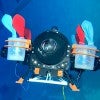
Underwater robot pioneers new energy-efficient buoyancy control
A remotely operated underwater robot built by a team of Rice University engineering students pioneers a new way to control buoyancy via water-splitting fuel cells.

Rice students build low-cost cold spray metal 3D printer prototype
A team of Rice University students has developed a cold spray metal 3D printing device that relies on pressure and velocity rather than temperature to create a metal part.
Rice engineering students’ device could make intubation safer for young babies
TinyTrach, a team of interdisciplinary engineering students from Rice, created an innovative pediatric endotracheal tube integrated with a camera and anchoring system that could make intubation procedures safer for babies 1 month and older by ensuring precise placement, stable anchoring and visibility access for up to 14 days.

Rice engineering students convert old truck into an electrical vehicle
Four teams of Rice engineering students converted a 1997 Chevy P30 delivery van into a fully electric vehicle in less than a year, using a combination of parts scavenged from out-of-use vehicles, custom-built elements and off-the-shelf items.

Rice team brings home top prize in 2024 Ethics in Engineering Case Competition
A team of Rice engineering students have won this year’s national Ethics in Engineering Case Competition hosted by Lockheed Martin.

Rice research could advance soft robotics manufacturing, design
Rice engineers propose a new quantitative framework to account for and predict the impact of temperature on the curing speed of platinum-catalyzed silicone elastomers. The findings could maximize throughput and minimize waste in the manufacturing of components for soft robotics and wearables.

Faster and simpler point-of-care malaria test developed by Rice researchers
Rice University researchers have developed a rapid, accurate test for diagnosing malaria that is significantly faster and easier to use than traditional tests. The advancement has the potential to improve patient outcomes, especially in rural regions with limited health care resources.

Houston Methodist, Rice launch Center for Neural Systems Restoration
Houston Methodist and Rice recently launched the Center for Neural Systems Restoration, a joint interdisciplinary center for neuroscience research and treatment innovation that aims to advance care for neurological conditions by bringing together scientists, clinicians, engineers and surgeons to tackle medical challenges like stroke recovery and spinal cord injury.

Rice study shows coal-based product could replace sand in concrete
A new study by Rice researchers found that graphene derived from metallurgical coke, a coal-based product, through flash Joule heating could serve not only as a reinforcing additive in cement but also as a replacement for sand in concrete.

Rice announces partnership with Tecnológico de Monterrey
Rice University has announced an agreement with Tecnológico de Monterrey, which will include concurrent doctoral degrees, dual master’s programs and a partnership to expand access to continuing and professional education.