
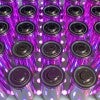
New priming method improves battery life, efficiency
Rice University engineers have developed a readily scalable method to optimize a silicon anode priming method that increases lithium-ion battery performance by 22% to 44%.
New priming method improves battery life, efficiency
Rice University engineers have developed a readily scalable method to optimize a silicon anode priming method that increases lithium-ion battery performance by 22% to 44%.

Physicists discover ‘stacked pancakes of liquid magnetism’
Physicists from Rice and Ames National Laboratory have discovered “stacked pancakes of liquid magnetism” in layered helical magnetic materials.

Business leaders, strategists and technologists from the energy industry attended the first International Workshop on AI-Powered Renewable Energy April 17-18 at the Ion innovation hub.
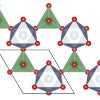
Physicists find unusual waves in nickel-based magnet
Rice physicists and collaborators have discovered “spin exciton” excitations can ripple through a nickel-based magnet as a coherent wave.
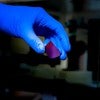
Strong ultralight material could aid energy storage, carbon capture
Rice U. materials scientists and collaborators at the University of Maryland showed that fine-tuning interlayer interactions in a class of 2D polymers can determine the materials’ loss or retention of desirable mechanical properties in multilayer or bulk form.

James Chappell wins NSF CAREER Award
Rice bioscientist James Chappell has won a National Science Foundation CAREER Award to develop RNA programming methods that can improve human health and the environment.

Rice Alliance Clean Energy Accelerator opens Class 3 applications for energy transition ventures
The Rice Alliance for Technology and Entrepreneurship is accepting applications for Class 3 of its Clean Energy Accelerator, the premier energy transition accelerator in Houston, through April 14.

Rice joins neutrino megaproject. Engineering launches energy transition initiative. McHugh lands cancer research grant. Keck Foundation funds quantum research. West named Cottrell Scholar.

Texas in position to lead hydrogen energy economy, new report says
Texas’ legacy energy economy and geology are ideal for developing a robust hydrogen market, which will play an important role in sustainability, but a successful energy transition also requires a shift in policy and market structure, according to a new report from Rice University’s Baker Institute for Public Policy.

Researchers can ‘see’ crystals perform their dance moves
Rice University researchers already knew the atoms in perovskites react favorably to light. Now they’ve seen precisely how the atoms move when the 2D materials are excited with light. Their study this week in Nature Physics details the first direct measurement of structural dynamics under light-induced excitation in 2D perovskites.
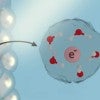
Nanoparticles make it easier to turn light into solvated electrons
Chemists from Rice, UT Austin and Stanford have uncovered the long-sought mechanism of a light-driven process that creates solvated electrons, inherently clean chemical reactants that are attractive for green chemistry.

Rice flashes new life into lithium-ion anodes
Rice chemists use flash Joule heating to recover graphite anodes from spent lithium-ion batteries.

Texas power grid debate should focus on reliability and economics, says Baker Institute expert
Building new ties between the Texas electrical grid and the major grids in North America should be explored with strict regard to economics and reliability — leaving politics aside — according to a new report from Rice University’s Baker Institute for Public Policy.
A crystal shape conundrum is finally solved
Rice researchers learn to predict how crystals take shape from their internal chemistry, even when the crystal lacks symmetry.

Rice lab’s catalyst could be key for hydrogen economy
A light-activated catalyst efficiently converts ammonia into clean-burning hydrogen using only inexpensive raw materials.