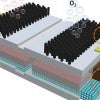
Water-splitting module a source of perpetual energy
Rice University researchers have integrated high-efficiency solar cells and electrode catalysts into an efficient, low-cost device that splits water to produce hydrogen fuel.
“I feel really grateful for the opportunities that I’ve had now that I am here," said senior Michael Garcia....

The Center for Philanthropy and Nonprofit Leadership at Rice’s Susanne M. Glasscock School of Continuing Studies welcomed nonprofit leaders from acros...

The Olivier Award-nominated play traces the rise and fall of the Houston-based energy trading giant, translating complex financial systems into a fast...

New consumable hemp rules from the Texas Department of State Health Services are officially in effect, and the biggest change comes down to how THC is...
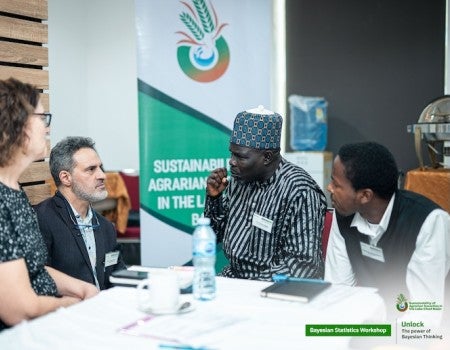
For more than a decade, Rice’s Frederi Viens has been studying Lake Chad, a vast freshwater lake in west-central Africa that borders Nigeria, Niger, C...

The Center for Energy Studies at Rice’s Baker Institute for Public Policy and the University of Houston Energy Transition Institute are launching a st...
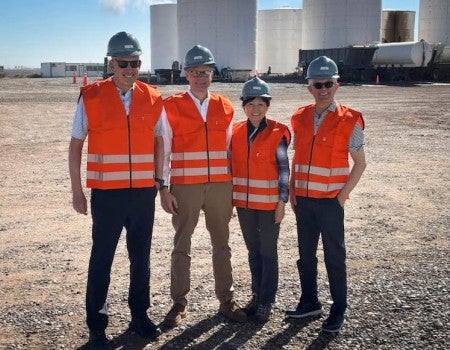
A delegation of researchers from Rice’s WaTER Institute traveled to Argentina’s Neuquén province this month to help address a pressing question facing...
Rice’s open enrollment period for employee benefit plans will run from April 3-17. To give employees a way to better explore their benefits options, t...
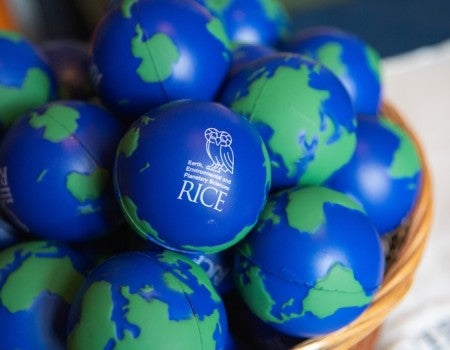
Rice's Office of Sustainability invites the campus community to join the third annual Earth Month Kick-Off Festival from 12:30-3:30 p.m. April 1 at th...

Rice continues to strengthen its position as a leader in innovation, rising to No. 66 in the 2025 Top 100 U.S. Universities List for utility patents, ...

Rice once again found itself at the center of the college basketball world, serving as the official host institution for the NCAA Men’s Basketball Sou...

For Rice senior Leo Marek, engineering is about finding the small changes that make big systems run better....
Water-splitting module a source of perpetual energy
Rice University researchers have integrated high-efficiency solar cells and electrode catalysts into an efficient, low-cost device that splits water to produce hydrogen fuel.

Rice to offer minor in entrepreneurship
Rice, which has the No. 1 graduate entrepreneurship program in the U.S., will now offer an undergraduate minor in entrepreneurship.

Regulatory hurdles make HIV research less effective, Baker Institute experts say
Quianta Moore, a fellow in child health policy at the Baker Institute, and Zeinab Bakhiet, a research associate for the Baker Institute's Center for Health and Biosciences, outline their insights in a new paper, “Navigating the Regulatory Framework for HIV Prevention Research in Adolescents.”

‘Quaranteens’ across the world star in podcast launched by Rice students
A new podcast from Rice students features interviews with other undergraduates tackling college during the coronavirus.

Humanities courses for summer 2020 help make sense of changing world
Nearly 50 online courses are available at significant discount for Rice students and the general public.

Rice graduate student wins Department of Energy fellowship
Justin Porter, a Rice mechanical engineering graduate student, has won a Department of Energy Computational Science Graduate Fellowship.

COVID-19 has unveiled shortcomings of US health policy, Baker Institute expert says
HOUSTON – (April 30, 2020) – When it comes to keeping the nation healthy, "medical care is actually a pretty small piece,” according to an expert in health policy at Rice University’s Baker Institute for Public Policy.

Hidden symmetry found in chemical kinetic equations
Rice University researchers have discovered a hidden symmetry in the chemical kinetic equations scientists have long used to model and study many of the chemical processes essential for life.