


Underwater robot pioneers new energy-efficient buoyancy control
A remotely operated underwater robot built by a team of Rice University engineering students pioneers a new way to control buoyancy via water-splitting fuel cells.
Rice Athletics celebrated longtime supporters and champions of its student-athletes Sept. 30 at the 21st An Evening for Rice’s Honour gala at River Oa...

Rice parents, siblings, grandparents and other family members joined their Owls for meals, performances, conversations, campus activities and athletic...

Houston’s population boom masks other trends that have been unfolding for more than two decades: Women here are having fewer children and having them ...

Rice and First Community Credit Union have signed a 20-year football stadium naming rights and campus collaboration agreement as announced Thursday by...
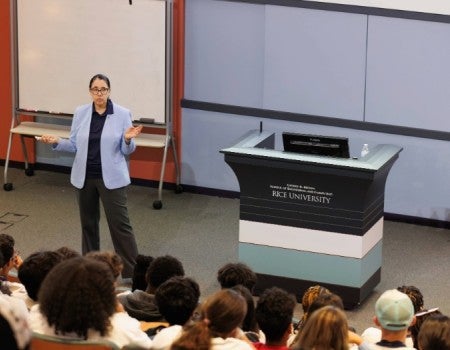
Rice’s George R. Brown School of Engineering and Computing has named Karen Lozano as the director of the Tapia Center for Empowerment through STEM Edu...
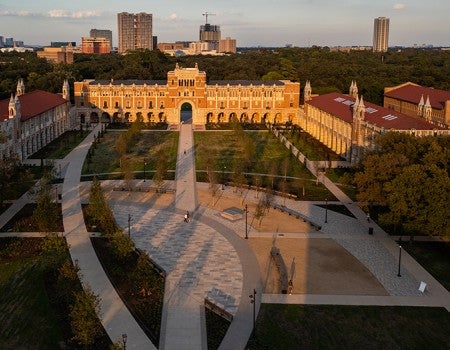
Rice continues its upward momentum in global higher education, rising two spots to No. 101 worldwide in the 2027 Times Higher Education World Universi...
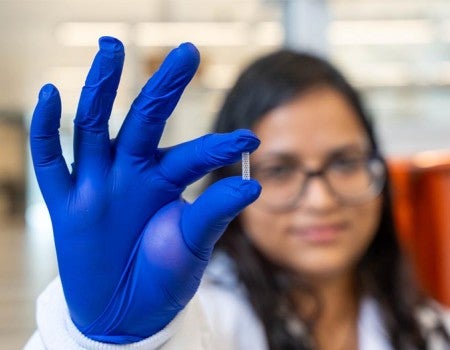
Researchers at Rice, with the support of the Rice Biotech Launch Pad, have developed an implantable “living pharmacy” using engineered protein produce...

New research explores how perceptions of immunity can shape vaccine decisions and how personalized feedback may help people better understand their pr...
Underwater robot pioneers new energy-efficient buoyancy control
A remotely operated underwater robot built by a team of Rice University engineering students pioneers a new way to control buoyancy via water-splitting fuel cells.

OpenStax at Rice University was awarded $90 million from the National Science Foundation to build and lead SafeInsights, a groundbreaking research and development (R&D) hub for inclusive learning and education research to benefit tens of millions of students and their instructors across all educational levels.

‘Music for New Bodies’ makes world premiere at Rice’s Shepherd School
Lauded by the New York Times for “the ferocity of the music” and “the layered depths of the text,” “Music for New Bodies” made its world premiere at the Shepherd School of Music at Rice University April 20.

Great teaching cannot be accomplished without first taking great responsibility in the classroom, said Betul Orcan-Ekmekci, an associate teaching professor in mathematics and Rice’s 2024 recipient of the George R. Brown Prize for Excellence in Teaching.

Faculty recognized with award for superior teaching
Nine Rice University faculty members received the 2024 George R. Brown Award for Superior Teaching, which honors top Rice instructors based on votes from alumni who graduated within the past two, three and five years.

Rice honors staff during 2024 appreciation gathering
President Reginald DesRoches welcomed hundreds of Rice University staff members to a morning breakfast and recognition ceremony April 18 at Tudor Fieldhouse. Themed “Because of You,” the gathering highlighted the university’s successes and growth during the previous year and a glimpse into what the future holds for Rice.

Rice and LSC celebrated the renewal of a memorandum of understanding and the signing of an articulation agreement to allow transfer students in LSC’s Take Flight Program to receive Rice credit for core science, technology, engineering and mathematics courses completed at LSC.

Rice engineering student builds Rice campus out of Lego pieces
Rice engineering student Andrew Linhart built a full scale model of the Rice campus using over 8,000 Lego pieces and help from his friends.

Rice University, in collaboration with the University of Houston, IPTalons and the Society of Research Administrators International, will host a first-of-its-kind national workshop to examine the burgeoning field of research on research security to inform future laws, policies and guidelines aimed at enhancing research security around the world.

Special issue of Rice Magazine explores university’s world-renowned research
The spring 2024 issue of Rice Magazine highlights a sample of the dynamic, complex and ambitious scholarship underway in academic disciplines across campus.