
When it’s time for another vaccine, many people may ask themselves a familiar question: Do I really need another one?
The answer may depend, at least in part, on how protected they think they already are.
Allie Sinclair, an assistant professor of psychological sciences and director of Rice University’s Learning & Behavior Change Lab, and her collaborators at Duke University found that people often misjudged their level of immunity to COVID-19. Many believed they were more protected than their vaccination and infection histories suggested, while others underestimated their protection and may have been more concerned about their risk than necessary.
Those perceptions matter because what people believe about their immunity can influence whether they get vaccinated, take a diagnostic test when symptoms appear or take other steps to protect their health.
The study, published in PNAS Nexus, sought to better understand why people were not staying up to date on recommended COVID-19 vaccines.
Their earlier research pointed to a potential blind spot: People may know another vaccine is available but believe they are already sufficiently protected. If someone feels overconfident in their protection, they might believe that a vaccine dose doesn’t offer much benefit.
“We expected that factors like inconvenience and concern about side effects would be important, but to our surprise, we found that some of the most common reasons were related to overconfidence in immunity,” Sinclair said. “People believed that they were still protected and so didn’t stand to benefit from a vaccine dose.”
That led the researchers to develop an interactive “Immunity Estimator” tool that gives users personalized feedback about their likely protection against COVID-19.
Users enter the approximate month and year of previous COVID-19 vaccinations and infections. The tool then estimates their likely protection against infection and severe disease based on factors including the number and timing of those events, changes in the virus and the rate at which antibodies decline.
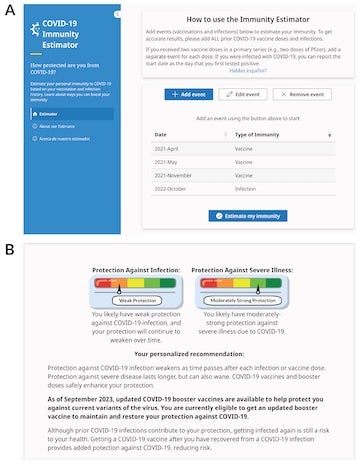
Researchers tested the approach with 882 U.S. adults, ages 18 to 93. Participants received either personalized feedback from the Immunity Estimator, an informational flyer produced by the Centers for Disease Control and Prevention or a modified version of the flyer that included information about waning immunity. The researchers aimed to test whether the personalized feedback about immunity was more effective than these existing, impersonal methods of encouraging vaccination.
The personalized approach was the most effective at bringing participants’ perceptions of their risk more closely in line with actual risk (estimated based on each person’s history of vaccines and infections). It worked in both directions, increasing perceived risk among people who underestimated it and decreasing perceived risk among those who overestimated it. The effect was particularly strong among older adults, who are more vulnerable to severe disease and can most benefit from maintaining protection.
Sinclair said the Immunity Estimator was designed to tap into two processes involved in how people learn and make decisions.
“First, we used corrective feedback because surprising information, or prediction error, engages brain systems that support learning and belief updating,” she said. “Second, we gave participants personalized information because self-relevance is a key part of the brain’s value calculation system, used to guide choices.”
Simply put, general information about vaccines or waning immunity may not resonate in the same way as information that shows someone what it could mean for them personally.
And the effect lasted.
When researchers followed up two months later, participants’ perceptions of risk remained more closely aligned with the researchers’ estimates. Among those who were eligible for an updated vaccine but had not received one when the study began, participants who received information about waning immunity also reported higher vaccine uptake than the national increase during the same period.
The researchers caution that the study was not large enough to establish significant differences in vaccine uptake among the three intervention groups. Still, the results suggest that addressing what people believe about their existing immunity could be an important part of vaccine communication.
“Prior studies have shown that interventions that focus on just providing information or increasing knowledge tend to have very weak downstream effects on beliefs, intentions and behaviors,” Sinclair said. “Giving people personalized information that targets specific beliefs related to a behavior can be more effective.”
Although the research focused on COVID-19, Sinclair sees broader potential for the approach. It could be adapted for recurring vaccines such as the annual flu shot, though researchers would need to develop disease-specific ways of estimating immunity.
The implications could extend beyond vaccines. Misjudging personal risk can shape other health decisions, from whether someone takes a diagnostic test when symptoms appear to choices about preventive care and healthy behaviors.

“Our beliefs about personal risk and protection are foundational for many preventative health behaviors, like getting an annual checkup or living a healthy lifestyle,” Sinclair said. “Providing personalized feedback could help people make more informed decisions in many areas of life to help them stay healthy.”
Sinclair, who joined Rice’s faculty this summer, is continuing to study how health beliefs and perceptions of risk can influence behavior. One current focus in her Learning & Behavior Change Lab is exploring ways to motivate everyday behaviors that support long-term brain health.
That work draws on the Brain Care Score to provide personalized feedback about brain health, an approach Sinclair said is conceptually similar to the personalized protection estimates used in the Immunity Estimator.