




Researchers at NASA and Rice have launched the the world’s first open-source dynamic simulation environment to develop robots used in space vehicles a...
Taylor Schultz, who graduated this spring with a degree in chemical and biomolecular engineering and served as president of Duncan College, was select...
Published in the journal Information Systems Research and co-authored by Jing Zhou, the Mary Gibbs Jones Professor of Management at Rice Business, the...
An estimated 141,000 Houston-area residents experienced temporary homelessness in the past year, according to a new survey by Rice’s Kinder Institute ...
Rice and the Max Planck Society officially launched the Quantum Materials - Rice and Max Planck Partnership (Q-RaMP) June 19, aimed at supporting the ...
Researchers from Rice and North Carolina State University have created a nontoxic, stretchable battery that operates by extracting moisture from the a...
Rice's Office of Public Affairs earned four honors at the 41st Public Relations Society of America Houston Excalibur Awards, including Communicat...
Rice's Rebecca Richards-Kortum has been elected to the National Academy of Medicine (NAM), one of the nation’s highest honors in health and medicine. She is one of two Rice faculty who are the only Texas researchers to share membership across the national academies of medicine, science and engineering — an honor held by fewer than 35 researchers nationwide.
The inaugural semester of student programming at the Rice Global Paris Center is a collaboration between the Wiess School of Natural Sciences and Rice Global with support from the School of Social Sciences and School of Humanities and Arts.
Rice President Reginald DesRoches emphasized the university’s ambitious, collaborative approach to transforming health and medicine during a panel discussion hosted by the Greater Houston Partnership. Joined by leaders from the Cancer Prevention and Research Institute of Texas and Harris Health, DesRoches outlined Rice’s vision for becoming a world leader in health innovation — a key component of the university’s strategic plan.
LLMs and the Brain, a symposium featuring researchers from Rice, Baylor College of Medicine, the University of Texas, the Georgia Institute of Technology, the University of Montreal and other institutions explored the intersection between neuroscience and AI. The conversation around brain research extends beyond the university and is unfolding at the state level. On Nov. 4, Texas voters will decide on Proposition 14, which would fund the Dementia Prevention and Research Institute of Texas (DPRIT) with $3 billion over 10 years, creating the largest state-funded dementia research program in the country.
Rice continues its upward momentum in global higher education, rising nine spots to No. 103 worldwide and No. 37 in the United States in the 2026 Times Higher Education World University Rankings.
Rice's Ken Kennedy Institute hosted the fourth annual AI in Health Conference, convening over 550 attendees across the four-day event for plenary speaker sessions, networking and workshops that explored key areas for artificial intelligence-driven advancement across health and public health domains.
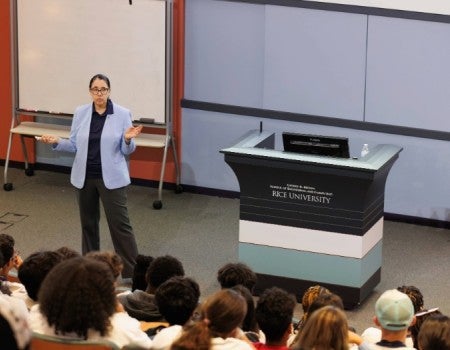
President Reginald DesRoches and Provost Amy Dittmar welcomed winners of highly prestigious and prestigious awards to the Brockman Hall for Opera to celebrate Rice faculty excellence. On Oct. 6, Rice honored those faculty who have earned prestigious and highly prestigious awards, defined as such by the Organization of the National Research Council and the Association of American Universities.
As Rice’s first community behavioral specialist, Nancy Vincent brings a wealth of experience in crisis management, social work and mental health advocacy to campus, offering a vital resource for immediate intervention and long-term support.