

For Rice University students Jessica Ji and Dafina Bajra, studying abroad once felt out of reach. Both are on the premed track, a path known for its rigid course schedules and transfer credit challenges. Yet this fall, they found themselves in Paris studying cell biology and psychology in the morning, speaking French over lunch in Le Marais and walking home along the Seine River at dusk.
“This is the first time in the history of this university that we have had a Rice faculty group teaching Rice students in an international location, and that is a remarkable step forward in our commitment to global education,” said Caroline Levander, vice president for global strategy.
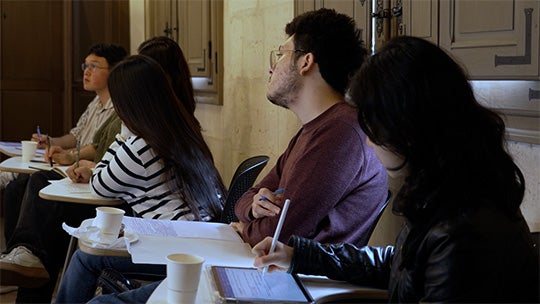
The inaugural semester of student programming at the Rice Global Paris Center is a collaboration between the Wiess School of Natural Sciences and Rice Global with support from the School of Social Sciences and School of Humanities and Arts. Eleven students are participating in the pilot, which was intentionally designed to allow life sciences majors to study abroad without delaying their degree progress.
“In the natural sciences, giving an outstanding educational experience to our students is a priority,” said Thomas Killian, dean of the Wiess School of Natural Sciences. “This was a great opportunity for us to add global experiences at a deeper level for our students in a way that can serve a large population.”
Courses this fall span the sciences, humanities and social sciences: Biochemistry, Cell Biology, Introduction to Psychology, Introduction to Social Psychology, First Year French, Contemporary French Society and two art history offerings: Architectures of Power, Resistance and Coexistence and L.A.B: On Modernism.
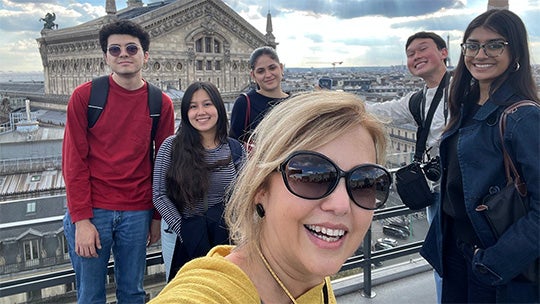
“I think this is a real transformative experience for both students and faculty,” said Fabiola López-Durán, associate professor of art history. “I’m very happy and grateful for the opportunity of being here, of introducing Rice students to a city that I know and love. Most of my classes are in the streets and museums of Paris. I strongly believe in the power of taking my students outside of the classroom to demonstrate the inherent link between knowledge and action that fosters critical thinking.”
Faculty are integrating Paris itself into the curriculum through excursions to the Curie Institute, Paris Brain Institute and the Musée de l’histoire de l’immigration. A group trip to Strasbourg included visits to the European Parliament and the Institut National du Service Public, where students examined how France trains its political elite.
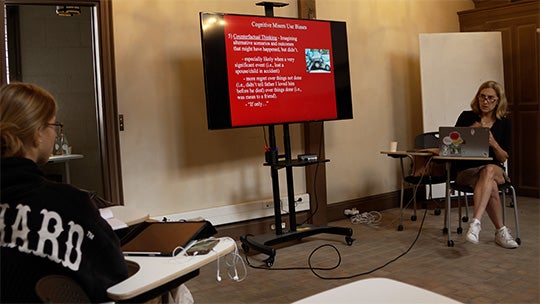
“We see concepts we are learning about in the classroom come alive when we go outside the classroom and see people in social interactions,” said Mikki Hebl, the Martha and Henry Malcolm Lovett Chair of Psychology. “In my social psychology class, we also visit the Paris Shoah Memorial (holocaust museum) and the controversial Quai Branly Museum. We discuss culture and the way in which museum pieces are obtained. And the students spend time focusing on constructs in their class depicted in these museums.”
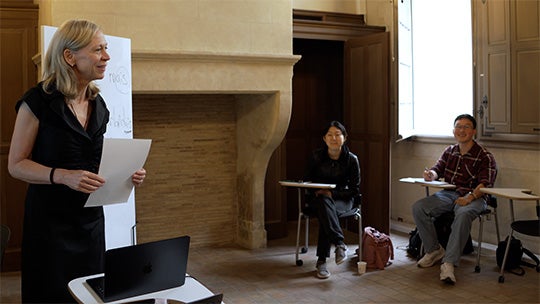
Associate professor of French studies Julie Fette built First Year French I for a cohort dominated by scientists, so they could immediately navigate daily life in Paris and observe society with nuance.
“The first thing that occurred to me when I heard about the pilot was that we need to offer these students a French language class,” Fette said, noting that students in her course on contemporary French society benefit from cultural competence and historical contextualization as well. “How fabulous that they tumble out of French class into the streets of Paris able to relate and communicate daily!”
Janet Braam, the Wiess Professor of Biosciences, said the smaller scale of the courses also redefines teaching.
“The feedback is more direct,” Braam said. “I learn a lot more about where the students are, what they’re thinking and what the challenges are. That helps to inform my class back in Houston.”
As for learning outside the classroom, Ji described afternoons exploring “hidden gems” of Paris between lab sessions, while Bajra spoke of the “one-on-one interaction” with professors rarely possible in large lecture halls.
“It’s really valuable, and I feel like it’s honestly deepened my understanding of these topics, especially with cell biology and biochemistry,” Bajra said.
Momentum now turns to scale. Rice Global and the School of Natural Sciences are using the pilot to refine the academic mix, deepen partnerships with Paris-based institutes and plan for larger fall cohorts beginning in 2026. The aim is straightforward: preserve the personalized focus of a Rice degree while making the world integral to how it is earned.
Interested students should watch for program updates and application timelines as the next phase takes shape in Paris. You can request information or sign up for the mailing list here.