
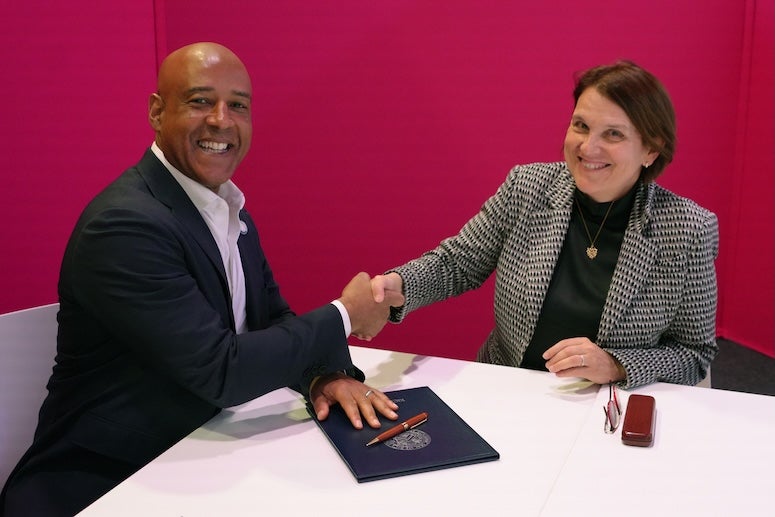
Rice University and the Max Planck Society officially launched the Quantum Materials - Rice and Max Planck Partnership (Q-RaMP) June 19, aimed at supporting the identification and development of quantum materials that will support breakthroughs in sustainability, energy efficiency and quantum and classical information processing.
“Breakthrough technologies begin with breakthrough discoveries, and those discoveries are made possible through bold partnerships,” Rice President Reginald DesRoches said. “The Rice-Max Planck Partnership in Quantum Materials brings together world-class researchers to advance the fundamental science that will power the next generation of computing, sensing and energy technologies. By combining our complementary strengths and deep commitment to innovation, we are building an international collaboration that will accelerate discovery and create lasting global impact.”

While there is a large body of theoretical work predicting useful quantum materials, identifying viable materials and understanding their physics remains a large, open challenge.
“Quantum materials drive the next generation of breakthroughs in many areas, from energy and sustainability to information technologies, but discovering the right materials with the right properties is like finding a needle in a haystack," said Emilia Morosan, trustee professor of physics and astronomy at Rice, director of the Rice Center for Quantum Materials and founding director of Q-RaMP. “By creating a space for collaboration between Rice University and the Max Planck Society, we can bring together leaders in the field to address this challenge.”
To enable this collaboration, the two partners will host workshops, hire joint faculty members, create exchange programs for graduate students and form working groups. These efforts will be supported by regular visits between Rice and Max Planck institutes.
“The greatest investment we can make is in young scientists,” said Claudia Felser, director at the Max Planck Institute for Chemical Physics of Solids and vice president of the Max Planck Society. “This partnership combines the strengths of two outstanding research systems: the long-term commitment to curiosity-driven excellence that characterizes the Max Planck Society and the dynamic tenure-track culture of leading U.S. universities. By learning from one another and bringing together world-leading institutions, we create a unique environment in which the next generation of researchers can tackle some of the most fundamental challenges in quantum materials and beyond.”
“Talented minds are one of the few things on Earth that grow when shared,” said Philip Moll, managing director for the Max Planck Institute for the Structure and Dynamics of Matter. “This partnership between the Max Planck Society and Rice University is built on exactly that conviction — that international collaboration and exchange is how we grow the next generation of scientists.”.
The work will be carried out by the Rice Center for Quantum Materials and multiple Max Planck institutes, including the Institute for the Structure and Dynamics of Matter, the Institute for Solid State Research, the Institute for Microstructure Physics, the Institute for Chemical Physics of Solids and the Institute for Physics of Complex Systems.