
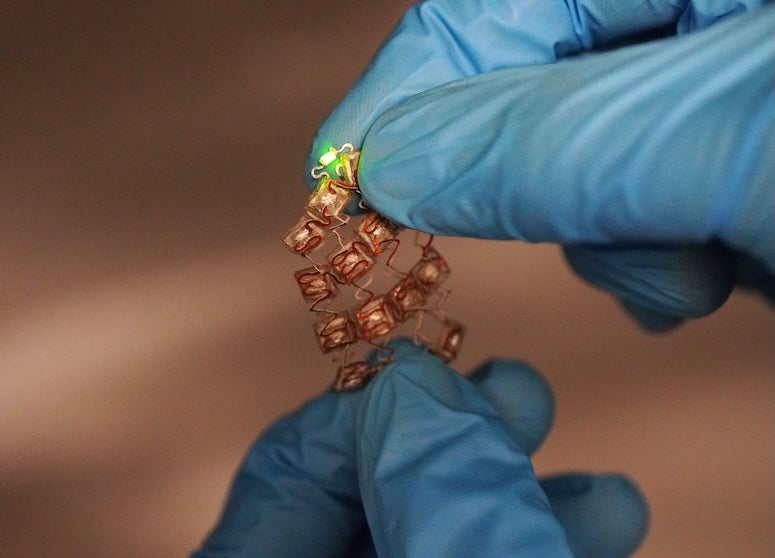
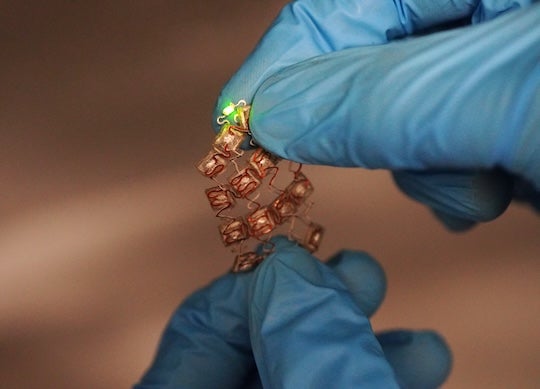
Researchers from Rice University and North Carolina State University have created a nontoxic, stretchable battery that operates by extracting moisture from the ambient environment — even in climates as dry as the desert. The batteries could be useful in Internet of Things (IoT) applications, ranging from wearables to advanced surveillance monitors with built-in kill switches.
Emerging technologies, like wearable monitors, miniature robotics and other IoT devices, require lightweight, flexible power sources. Conventional batteries, which represent the best power source options, are often too rigid and heavy to be useful, and they contain toxic materials which can leak. Energy harvesters, so-called because they capture energy from the surrounding environment and convert it into electrical power, are lighter, but their performance is limited.
The new moisture-activated battery (MAB) includes a magnesium anode and a silver/silver chloride cathode, with a cellulose membrane loaded with lithium chloride salts that serves as a separator. The separator harvests moisture from ambient air which dissolves the salts and creates the electrolyte, allowing charge to flow through the battery.
“Our battery eliminates toxic and flammable electrolytes because it’s essentially running on salt water,” said Amay Bandodkar, assistant professor of electrical and computer engineering at NC State and co-corresponding author of the research “And since it only activates once it’s exposed to ambient air, it remains inactive while within sealed packaging, giving it an extended shelf life.”
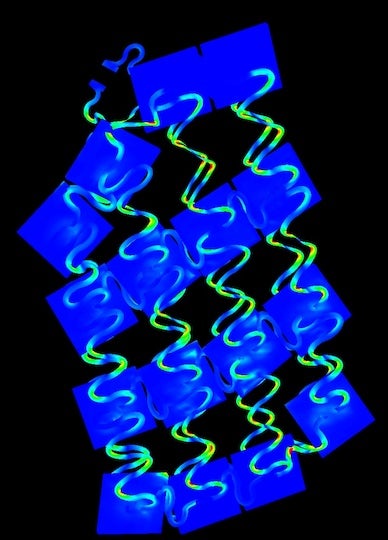
The researchers also improved upon the battery’s performance while being stretched. Most stretchable batteries utilize a series of serpentine interconnectors that still allow the current to flow when stretched. However, stretching the device creates gaps which lower energy density. The MAB’s design utilizes a pangolin-inspired structure of densely packed overlapping scales, which eliminates most of those gaps.
“Mechanics plays a central role in making these batteries both stretchable and practical,” said Raudel Avila, assistant professor of mechanical engineering at Rice University and co-corresponding author of the study, “Our modeling revealed how bioinspired stacking and stretchable interconnectors can redistribute deformation throughout the battery, preserving performance under bending, twisting and stretching while minimizing the empty space that typically reduces energy density.”

The researchers used the MAB to run a wireless Bluetooth oximeter for up to 30 hours, showing that its lifespan is comparable to that of conventional batteries.
“This battery is far more than an academic proof of concept; it is a practical energy source capable of powering everyday IoT and medical devices,” said Abraham Vázquez-Guardado, assistant professor of electrical and computer engineering at NC State and co-corresponding author of the research. “That level of performance proves this battery technology is ready to power a whole new generation of electronic devices and applications.”
“Additionally, the battery is lighter than many existing commercially available batteries and is made of biocompatible and biodegradable materials, making it a viable nontoxic alternative to lithium-ion batteries” added Rajaram Kaveti, postdoctoral researcher at NC State and first author of the study.
Finally, the research team also demonstrated a unique “kill switch” feature based on the moisture-harvesting technology, which can serve as an anti-tampering safeguard and quickly destroy a device when triggered. Such kill switches could be useful in surveillance monitoring used in covert intelligence-gathering missions.
The switch is composed of a dry mixture of aluminum and iodine powder stored within an isolated compartment inside the device housing. A moisture harvesting cellulose membrane covers the compartment. When pressure is applied to the housing — for example, by someone trying to remove or disable a surveillance device – the dry powder mix comes in direct contact with the harvested water, initiating a violent chemical reaction that engulfs the device in flames and destroys it completely.
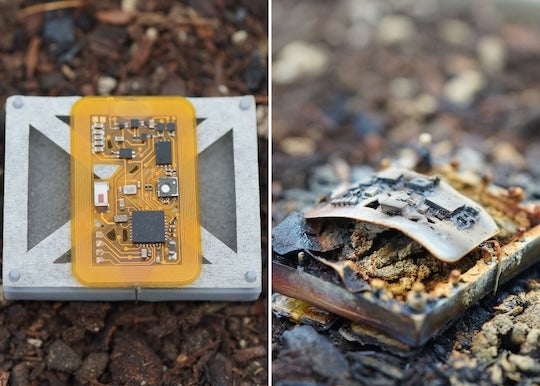
As proof-of-concept, the researchers installed the kill switch within a MAB-powered wireless gas sensor. The team showed that the wireless sensor, including the embedded CMOS electronics, was obliterated within three minutes of activation.
“These batteries open new opportunities in miniaturized, high-energy density, and nontoxic power sources suitable for next-generation IoT devices,” Bandokar said.
The research appears in Science Advances and is supported by NC State’s Advanced Self-Powered Systems of Integrated Sensors and Technologies (ASSIST) Center Industry Seed Fund and Chancellor’s Innovation Fund, as well as by Rice University’s ENRICH office. NC State graduate student Akshay Bhardwaj and postdoctoral scholar Ayemeh Bagheri Hashkavayi, as well as Rice University Ph.D. student Pei Liu, are co-first authors. Other NC State collaborators include: Bhavya Jain, Adrian Rodriguez-Kattan, Mahaboobbatcha Aleem, Baha Erim Uzunoğlu, Gurudatt N.G., Bünyamin Şahin and Veena Misra.