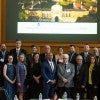
Rice President Reginald DesRoches, along with a cadre of university administrators and the Office of International Students and Scholars, hosted a Fulbright Brazil delegation of Brazilian university presidents, provosts and other leaders in the country’s higher education world March 9.
Rice U. bioengineers have developed an upgraded tumor model that houses bone cancer cells beside immune cells inside a 3D structure engineered to mimic bone and, through research using the model, found that the body’s immune response can make tumor cells more resistant to chemotherapy.
Rice University bioengineer Omid Veiseh and collaborators found that lipid deposition on the surfaces of medical implants can play a mediating role between the body and implants, knowledge that could help scientists develop biomaterials or coatings for implants that could reduce malfunction rates.
Rice U. representatives discussed the vision guiding the university’s research agenda during a panel discussion at CERAWeek, the leading annual energy conference taking place in Houston this week.
With the $1.8 million in support, Mechanical Engineering's Lillehoj looks to develop a CRISPR-Cas13-based rapid HIV-1 test and a serological test for detecting Chagas.
President Reginald DesRoches, Provost Amy Dittmar and Vice Provost for Diversity, Equity and Inclusion Alex Byrd stressed Rice’s commitment to upholding diversity, equity and inclusion in a March 8 email to the university community.
Rice University materials scientist Boris Yakobson and collaborators uncovered a property of ferroelectric 2D materials that could be exploited in future devices.
Rice materials scientist Hanyu Zhu has received a National Science Foundation CAREER Award, which includes a five-year research grant to probe quantum materials modified by terahertz quantum fluctuations.
A new study by Rice University and the Houston Health Department finds that wastewater-based monitoring is an effective way to detect viral outbreaks in schools.
Rice University is one of 14 academic institutions to join the Center for Heterogeneous Integration of Micro Electronic Systems, a $32.7 million project created by the Semiconductor Research Corporation’s Joint University Microelectronics Program 2.0.
Brandon Levin, an assistant professor of mathematics at Rice University, has won a prestigious National Science Foundation CAREER Award to pursue his research on major unsolved problems in number theory.
Engineering’s Lauren Stadler has received a CAREER Award from the National Science Foundation to improve wastewater treatment by harnessing the power of microbiomes.