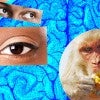
By combining behavioral and wireless eye tracking and neural monitoring, a team of Rice scientists and collaborators studied how pairs of freely moving macaques interacting in a naturalistic setting use visual cues to guide complex, cooperative behavior.
Houston Methodist and Rice recently launched the Center for Neural Systems Restoration, a joint interdisciplinary center for neuroscience research and treatment innovation that aims to advance care for neurological conditions by bringing together scientists, clinicians, engineers and surgeons to tackle medical challenges like stroke recovery and spinal cord injury.
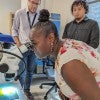
Alaura Ervin, legislative assistant for U.S. Sen. John Cornyn, toured several Rice Neuroengineering Initiative labs and the Ion Aug. 23, learning about the ways Rice is strengthening the workforce. (Photos by Nathan Cook)
Steps to regulate advanced artificial intelligence (AI) and AI-enhanced social media are needed to protect people from AI “hacking” our interpersonal relationships and collective intelligence, says Harris Eyre, fellow in brain health at the Baker Institute.
Rising Rice seniors Maria Hancu, Alex Lin, Ryan Wang and Ruofeng “Charlie” Liu are the latest Owls to win the coveted Goldwater Scholarship, one of the most prestigious honors bestowed each year upon pioneering STEM undergraduates across the country planning to pursue doctoral degrees.
Rice University postdoctoral fellow Hannah Ballard has won a three-year grant from the National Institutes of Health to investigate the link between the transition to menopause and Alzheimer’s disease.
The National Science Foundation has awarded Graduate Research Fellowships to 32 current, incoming and former Rice students, and selected another six for honorable mention.
On Feb. 24 and 25, Rice University composition professor Anthony Brandt collaborated with University of Houston professor Jose Luis Contreras-Vidal and Performing Arts Houston to premiere his newly commissioned chamber piece “Diabelli 200” at the Wortham Center.
Rice senior and electrical engineering and neuroscience student Joseph Asfouri is one of a select few American students to have been awarded the prestigious Churchill Scholarship at the University of Cambridge. Asfouri is Rice's second Churchill Scholar in nearly three decades.
Taiyun Chi, an assistant professor of electrical and computer engineering at Rice University, has won a prestigious National Science Foundation CAREER Award to research the development of a high-performance neural interface and a noninvasive deep-brain-stimulation system.
A new approach to the study of amyloid-beta, a peptide associated with Alzheimer’s disease, has led Rice University scientists to findings that could have a significant impact on the understanding and potential treatment of the disease.
Rice chemist Han Xiao and Stanford researcher Zhen Cheng have developed a tool for noninvasive brain imaging that can help illuminate hard-to-access structures and processes. Their small-molecule dye is the first of its kind that can cross the blood-brain barrier, allowing researchers to differentiate between healthy brain tissue and a glioblastoma tumor in mice.
Students at Rice University and in Malawi present device designs to deal with the COVID-19 crisis during the Rice 360˚ Institute for Global Health Intern Showcase.