

Rice’s Martí, Sarlah, Wang honored with national American Chemical Society awards
Rice’s Martí, Sarlah, Wang honored with national American Chemical Society awards.
Rice’s Martí, Sarlah, Wang honored with national American Chemical Society awards
Rice’s Martí, Sarlah, Wang honored with national American Chemical Society awards.

Wrinkles in atomically thin materials unlock ultraefficient electronics
Rice scientists have discovered that tiny creases in two-dimensional materials can control electrons’ spin with record precision, opening the path to ultracompact, energy-efficient devices.

Rice scientists pioneer transfer-free method to grow ultrathin semiconductors on electronics
A team of materials scientists at Rice has developed a new way to grow ultrathin semiconductors directly onto electronic components.

Rice’s top innovation exec headed for University of Virginia
After more than a decade of outstanding leadership at Rice, Paul Cherukuri, the university’s top innovation executive, will be leaving his post to accept a position at the University of Virginia.

A collaboration between Rice, Baylor College of Medicine and Texas Children’s Hospital’s Jan and Dan Duncan Neurological Research Institute (NRI) has produced a breakthrough in how to study and classify complex diseases.

AI can help communities prepare for, respond to climate risks during peak hurricane season
As the Gulf Coast heads into the most active stretch of the Atlantic hurricane season — August through September — forecasters warn the region could face heightened storm activity this year, fueled by warm ocean waters and a changing climate.

Rocketing to the top: Rice Eclipse claims victory at world’s largest collegiate rocketry competition
Rice’s largest engineering and student rocketry club, Rice Eclipse, soared to new heights this summer, taking top honors in the 30,000-foot Student Researched and Developed Hybrid Division at the 2025 International Rocket Engineering Competition.

Rice Emerging Scholars Program prepares first-year students for STEM success
Rice’s campus was buzzing this summer as students in the Rice Emerging Scholars Program wrapped up six weeks of challenging courses, hands-on projects and community-building. The end-of-program events and presentations marked the culmination of a summer designed to prepare incoming first-year students — particularly those from under-resourced high schools — for the pace, depth and rigor of STEM majors at Rice.

The course co-taught by Juan José Castellón and Kalil Erazo paired architecture and engineering students to study how sustainable structures are conceived and built.

Ripples of the future: Rice researchers unlock powerful form of quantum interference
Rice researchers have demonstrated a form of quantum interference two orders of magnitude greater than any previously reported.
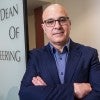
Luay Nakhleh, dean of the George R. Brown School of Engineering and Computing, has received a $1.9 million grant from the National Science Foundation to build a powerful new software infrastructure that could significantly expand how scientists study evolution.

A smarter membrane for cleaner water
A team of researchers led by Menachem Elimelech and his former postdoctoral researcher Yanghua Duan at Rice has taken a major step toward solving one of water purification’s biggest puzzles: how to best design catalytic membranes that simultaneously filter and transform contaminants in a single step.
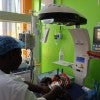
In low-resource settings, babies born with gastroschisis — a congenital condition in which the developing intestines extend outside the body through a hole in the abdominal wall — face life-threatening challenges.
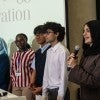
Interns innovate for impact at Rice’s Summer Experience in Engineering Design showcase
In an impressive display of creativity, collaboration and global impact, undergraduate students from around the world gathered at Rice July 24 to present the results of their seven-week Summer Experience in Engineering Design internship.
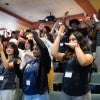
Tapia STEM Camps inspire more than 1,200 students worldwide to pursue science careers
Founded by Richard Tapia, the summer camps encourage students from all communities to pursue careers in STEM.