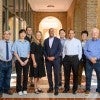
This spring, 75 students from Lone Star College, San Jacinto Community College and Houston Community College met with Rice faculty, staff and graduate students five times over three months to explore how data science can be used to solve real-world sustainability challenges.
As the world races to address the climate crisis, a coalition headquartered at Rice is taking a radically collaborative approach to one of the toughest challenges: how to decarbonize industry while at the same time boosting manufacturing, improving infrastructure and securing the supply chains for the energy and materials we rely on every day.
Impaired neuromusculoskeletal function due to conditions such as stroke, osteoarthritis, cerebral palsy, Parkinson’s disease, limb amputation, spinal cord injury, traumatic brain injury and cancer is a leading cause of disability.
In a landmark moment for Rice, renowned computer scientist Lydia E. Kavraki has been named a University Professor, the institution’s highest academic rank. She becomes only the 11th person and the third woman in the university’s 112-year history to earn this prestigious title.
Public transit operators keep cities moving, helping people get to work, attend medical appointments and access essential services. But while passenger safety is often in the spotlight, the health and well-being of drivers who spend long hours behind the wheel is frequently overlooked.
Rice bioengineer Antonios Mikos has been elected to the European Academy of Sciences, an international body that recognizes excellence in scientific research and technological innovation.
Recently, a team of scientists and engineers at Rice discovered a phenomenon on a microscopic scale, where tiny magnetic particles driven by rotating fields spontaneously move along the edges of clusters driven by invisible “edge currents” that follow the rules of an unexpected branch of physics.
Rice's Gang Bao has been selected to receive the Robert Henry Thurston Lecture Award from the American Society for Mechanical Engineers for his sustained contributions to the mechanics of composites, cell mechanics and nanomedicine.
While breastfeeding offers numerous benefits for both mother and baby, one challenge has persisted: It’s nearly impossible to know how much milk a baby is consuming.
A team of Rice engineers has developed a system that could transform desalination practices, making the process more adaptable, resilient and cheaper. The new system is powered by sunlight and uses a creative approach to heat recovery for extended water production ⎯ with and without sunshine.