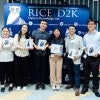
The Data-to-Knowledge (D2K) lab at Rice’s George R. Brown School of Engineering and Computing is a hub for data science solutions that conducts a semester-long program for undergraduates and master’s students to partner with governmental agencies, industry and community sponsors to solve real-world interdisciplinary challenges of scientific, local and global importance.
Queen Dube, Newborn Health Program lead at the World Health Organization, delivered the third and final lecture in the Rice360 Institute for Global Health Technologies Seminar Series Dec. 3, offering a global perspective on the future of newborn health and the urgent need to rethink how care systems are designed and delivered worldwide.
The Rice360 Institute for Global Health Technologies and its invention education partners across Africa marked a major milestone at the first Invention Education Networkwide Design Competition, a two-day event held Nov. 20-21 that brought together the most promising student-led innovations from seven university design studios across the continent.
A team of researchers at Rice, Georgetown University and the University of Trento in Italy has uncovered a surprising physical mechanism that explains how a single filament can form a knot while sinking through a fluid under strong gravitational forces.
Scenic Galveston and the SSPEED Center at Rice are launching two major initiatives designed to bolster wetland health and improve storm resilience across the Houston-Galveston region.
A new study led by researchers at Rice360 Institute for Global Health Technologies evaluated the accuracy and reliability of 11 commonly available point-of-care glucometers to determine which could safely be adapted for neonatal care in resource-constrained settings.
Rice materials scientist and neuroengineer Christina Tringides has been named a Distinguished Scientist by the Sontag Foundation, a national recognition for early career researchers advancing transformative projects in brain cancer research.
Rice bioengineers have designed an erasable serum marker that could enable clinicians to detect problems or measure any changes in how a patient responds to treatment with greater precision, using simple, minimally-invasive testing.
As artificial intelligence plays an increasingly prominent role in decoding DNA, tracking pathogens and accelerating drug discovery, the line between real capability and hype can be unclear. Rice experts can provide clear, technically grounded perspectives on how these tools are meaningfully advancing disease detection, public health preparedness and treatment design.
The Rice Center for Quantum Materials hosted a Workshop on Quantum Geometry and Winter School on Quantum Materials Synthesis, bringing together more than 100 researchers, students and scientific leaders from around the world.
A new study by Rice engineers shows that lab-grown diamond coatings could help diminish mineral scaling in industrial piping, providing an alternative to chemical additives and mechanical cleaning, both of which offer only temporary relief and carry environmental or operational downsides.
Researchers at Rice and Oak Ridge National Laboratory have unveiled a physics-based model of magnetic resonance relaxation that bridges molecular-scale dynamics with macroscopic magnetic resonance imaging (MRI) signals, promising new insight into how contrast agents interact with water molecules.
A Rice research team has developed a process that rapidly separates lithium and transition metals from spent lithium-ion batteries. The method provides an acid-free, energy-saving alternative to conventional recycling techniques,
Rice’s Severe Storm Prediction, Education and Evacuation from Disasters (SSPEED) Center convened more than 100 experts, industry leaders and attendees Nov. 6-7 for its 12th annual conference, connecting cutting-edge flood mitigation with the fast-emerging world of market-based natural carbon solutions.