
Rice scientists develop coating for enhanced thermal imaging through hot windows
A team of Rice scientists has solved a long-standing problem in thermal imaging, making it possible to capture clear images of objects through hot windows.
Rice scientists develop coating for enhanced thermal imaging through hot windows
A team of Rice scientists has solved a long-standing problem in thermal imaging, making it possible to capture clear images of objects through hot windows.

Richard Baraniuk honored with 2025 IEEE Signal Processing Medal
Richard G. Baraniuk, the C. Sidney Burrus Professor of Electrical and Computer Engineering at Rice University, has been awarded the 2025 IEEE Jack S. Kilby Signal Processing Medal.

Sandra Johnson, the first Black woman to earn a Ph.D. in electrical engineering from Rice, returned to campus for a fireside chat that celebrated her impactful career and the launch of her new book, “Soft Power for the Journey: The Life of a STEM Trailblazer.”

New insights into sleep uncover key mechanisms related to cognitive function
A new study by a team of researchers at Rice University and Houston Methodist’s Center for Neural Systems Restoration and Weill Cornell Medical College has uncovered a key mechanism by which sleep enhances neuronal and behavioral performance.
Quantum-inspired design boosts efficiency of heat-to-electricity conversion
Researchers at Rice have found a new way to improve a key element of thermophotovoltaic systems, which convert heat into electricity via light. Rice engineer Gururaj Naik and his team designed a thermal emitter that can deliver high efficiencies within practical design parameters.
Rice hosts workshop and winter school to advance quantum materials research
Rice’s Center for Quantum Materials and Smalley-Curl Institute recently held two successive events aimed at advancing the field of quantum materials research.

Researchers develop minimally invasive neural interface in revolutionary study
Researchers including Jacob Robinson have developed a technique for diagnosing, managing treating neurological disorders with minimal surgical risks.
Rice discovery taps ‘hot carriers’ for on-demand, emissions-free hydrogen and catalyst regeneration
Rice researchers have developed a new photocatalyst that could render steam methane reforming entirely emissions-free and extend catalyst lifetimes.

Rice, Texas Medical Center institutions jointly award seed grants
Rice, together with Baylor College of Medicine and the Houston Methodist Academic Institute, has awarded seed grants in support of research on health equity and digital health.

Rice has launched RBL LLC, a pioneering biotech venture creation studio designed to rapidly build companies based on lifesaving medical technologies developed out of the Rice Biotech Launch Pad.

‘A natural fit’: Rice philosophy professor explains relationship between philosophy, technology
When Robert Howell contemplates the future of artificial intelligence, he foresees a world where an app might guide your moral decisions just as Google Maps helps you navigate a road trip.

‘Out of all the unknowns in science, we have so much to discover’
Rice’s Smalley-Curl Institute held its 38th annual Summer Research Colloquium Aug. 2 at Rice’s Duncan Hall, where undergraduate and graduate students and postdoctoral researchers gave presentations covering topics in nanoscience, quantum materials and quantum information science and technology to a multidisciplinary audience.

Rice’s Ashutosh Sabharwal will lead a research project dedicated to the design and development of a modular platform for wireless networking, imaging and sensing that will significantly expand research capabilities and catalyze innovation in support of 6G wireless.

Breaking MAD: Generative AI could break the internet
Rice researchers have found that training successive generations of generative artificial intelligence models on synthetic data gives rise to self-consuming feedback loops.
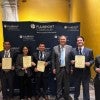
Rice is top destination for Mexican students who receive Fulbright awards
Seven master’s and Ph.D. Fulbright recipients from Mexico will study at Rice this fall, the most of any university and nearly double the number of any other university, including Rice’s Association of American Universities peers.