
Rice’s Center for Community and Public Health (CCPH) at the Kinder Institute will premiere a new series of accessible grief educational resources for adults with intellectual and developmental disabilities
Rice’s Center for Community and Public Health (CCPH) at the Kinder Institute will premiere a new series of accessible grief educational resources for adults with intellectual and developmental disabilities
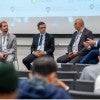
Securing tomorrow: Rice hosts key leaders for inaugural summit on quantum and national security
Rice’s Defense Research Advancement initiative and the Smalley-Curl Institute recently hosted the inaugural Quantum Frontiers Summit, a first-of-its-kind gathering that brought together leaders from industry, academia and government to build a collaborative future vision for the rapid evolution of cutting-edge quantum technologies.

Rice’s Sanchez exploring a future where fabric itself becomes the robot
Vanessa Sanchez, assistant professor of mechanical engineering at Rice, has received the Toyota Programmable System Innovation Fellowship.

From fan to storyteller: Rice senior returns to Japan to capture baseball on world stage
Rice senior from Tokyo, returns home for the World Baseball Classic this spring - a professional milestone and a homecoming.

Rice materials science brings hidden history into view at Menil Collection
Researchers from Rice collaborated to help bring the installation to life.
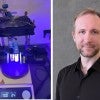
Researchers develop inexpensive, fast and environmentally friendly method for organic synthesis
Rice’s Julian West has been developing a less expensive, faster and more environmentally friendly way to catalyze carbon bonding to carbon-carbon double bonds with a breakthrough recently published in the journal Nature Catalysis.

Rice conference brings AI and health experts to Houston
The Ken Kennedy Institute will host the fifth annual AI in Health Conference.
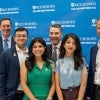
Rice Business marks new era of growth with opening of Virani Hall
Asha and Farid Virani Hall, a 112,000-square-foot building which now stands alongside McNair Hall, offering students a combined 300,000 square-feet designed to support the school’s expanding community of graduate and undergraduate students, faculty, researchers and alumni.

New method turns harmful environmental waste into useful synthetic reagent
James Tour’s lab developed a method to capture the fluoride from these waste streams and recycle it into a useful reagent, silver fluoride, that could be used in other manufacturing processes.
Rice ranks No. 16 nationally in Forbes’ America’s Top Colleges list
Rice is once again among the nation’s top universities, earning the No. 16 spot in Forbes’ annual America’s Top Colleges rankings.
Can creating music strengthen the aging brain? Rice researchers aim to find out
New $3.9 million grant will examine whether actively creating music can improve cognition and mental health-related quality of life in adults 65 and older with mild cognitive impairment, a condition associated with an increased risk of developing dementia.

Rice extends Provost Amy Dittmar’s contract through 2031 fiscal year
Rice President Reginald DesRoches has extended Amy Dittmar’s contract as the Howard R. Hughes Provost and executive vice president for academic affairs through the 2031 fiscal year with the support of the Rice Board of Trustees.

New measure captures how scientists’ identities shift across academic disciplines
Rice and Michigan State researchers have developed and validated a new way to measure the extent to which scientists remain closely connected to the core of their discipline over the course of their careers.

25 years after 9/11, Rice research traces changing landscape of religious bias
A quarter-century after the Sept. 11, 2001, terrorist attacks, religious bias in America has not disappeared, but the forces shaping it have changed.

Rice’s new Center for Space Technologies aims to accelerate Texas space innovation with $14.1M grant
Rice's new Center for Space Technologies, or CSTx, is strengthening Texas’ leadership in the space economy, supported by a $14.1 million Texas Space Commission grant.