

Study finds climate change missing from stories shaping modern culture
The findings raise pointed questions about how elite fiction reflects what study authors call the defining crisis of the present moment.
Study finds climate change missing from stories shaping modern culture
The findings raise pointed questions about how elite fiction reflects what study authors call the defining crisis of the present moment.

Rice Public Affairs wins 4 awards at PRSA Houston Excalibur Awards
Rice's Office of Public Affairs earned four honors at the 41st Public Relations Society of America Houston Excalibur Awards, including Communications Team of the Year for the Rice News and Media Relations team.

Rice President DesRoches elected to National Academy of Construction
The National Academy of Construction has elected Rice President Reginald DesRoches as one of 45 new members in its Class of 2026.

New research shows the hidden challenges facing religious scientists
A recent study from Rice’s Boniuk Institute for the Study and Advancement of Religious Tolerance titled “Religious Representation in Science: How Scientists in the United States, Mexico and South Africa Respond” explores the aspect of religious representation in science.

Rice entrepreneurship’s Summer Venture Studio selects nine ventures for 2026 cohort
Rice’s Liu Idea Lab for Innovation and Entrepreneurship has selected nine student-led ventures for the 2026 Summer Venture Studio, its flagship venture-building experience designed to help ambitious founders transform breakthrough ideas into venture-scale companies. The selected teams represent industries ranging from health care and artificial intelligence to advanced manufacturing, robotics, agriculture and defense technology.

Listening through a network: A new view of how the cochlea processes sound
Rice researchers developed a new way to model how the cochlea processes incoming sound using graph signal processing, which could shed light on what happens as hearing deteriorates with age and make possible better assistive technologies for people with hearing loss.
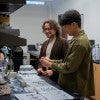
Rice researchers develop shape-shifting surface for next-generation human-machine interaction
A team of engineers at Rice and Kyung Hee University has developed a soft, shape-shifting mechanical surface that can respond to touch, sense its own movements and visually communicate changes in real time.

Braille is literacy: Rice researchers are reshaping the science of reading
As schools across the country increasingly embrace evidence-based approaches to reading instruction through the science of reading, two Rice researchers are leading an effort to ensure students who learn through braille are not left out of the research shaping literacy education.
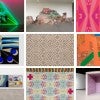
Through a framing of North, Central and South America as interconnected regions, “Radiant Geometries: Vectors of Knowledge from the Indigenous Americas” brings together contemporary Indigenous and Latin American artists whose practices illuminate knowledge as a living technology, through which the mathematical, metaphysical and artistic realms converge.

Rice-led team reveals how trios of quantum particles form checkerboard patterns
Rice's Kaden Hazzard and his team recently developed a theory on how trions in quantum particles form and behave.
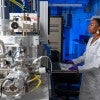
Rice researchers automate defect detection in diamond, other advanced semiconductors
Rice researchers have developed a high-throughput method to measure the quality of diamond and other wide-bandgap semiconductor materials, providing rapid feedback for improving crystal growth and device reliability.
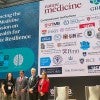
The Brain Health for Economic Resilience Commission, convened in collaboration with Nature Medicine, was announced at the Texas Brain Economy Summit June 9–10.

How do bilingual brains navigate between languages? Scientists discover ‘geometric neural map’
A new study by researchers at Rice and Baylor reveals that the brain maintains a geometric neural “map” for meaning that allows multilingual speakers to express themselves across languages.
Rice bioengineer wins federal award for Ewing sarcoma research
Rice bioengineer Julea Vlassakis has won $1.1M in federal funding for a project researching Ewing sarcoma.

Rice Business launches early career track within MBA@Rice Online Program
Rice Business today announced the launch of a new Early Career Track within its MBA@Rice Online MBA program. The new track gives high-potential professionals with less than three years of work experience a path to earn their MBA earlier in their careers. The program will launch with the October cohort and applications are open now.