Rice's new Center for Space Technologies, or CSTx, is strengthening Texas’ leadership in the space economy, supported by a $14.1 million Texas Space Commission grant.
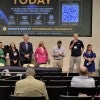
The 2026 Humans to Mars and the Moon Summit (H2M2), hosted by the nonprofit Explore Mars, was recently held at Rice’s BioScience Research Collaborative.
“NASA Stories at the Ion” is a morning series that spotlights the human side of space exploration with each session featuring personal and powerful stories from astronauts and key NASA personnel.
The initiative brings scholars across disciplines together to examine how culture, language, ethics and imagination shape space exploration, and how space exploration shapes them in return.
Rice University has joined Axiom Space’s University Alliance, comprising 26 institutes from four continents and 12 nations working as an international network dedicated to advancing microgravity research, technology development and commercial innovation in low-Earth orbit.
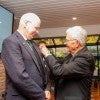
Rice’s David Alexander recently received the Ordre national du Mérite (National Order of Merit), an honor awarded by the French president for, among other things, innovation and contributions to the renown of France.
Rice University has signed an $8.1 million cooperative agreement to lead the United States Space Force University Consortium/Space Strategic Technology Institute 4 (SSTI), called the Center for Advanced Space Sensing Technologies (CASST) at Rice.
The NASA Reauthorization Act of 2026, sponsored by Texas Rep. Brian Babin (R-Woodville), moves tomorrow to consideration by the full U.S. House of Representatives following unanimous approval by the House Committee on Science, Space and Technology. As lawmakers consider the legislation, Rice experts are available to provide perspective on the bill’s implications for space science, engineering and aeronautics, artificial intelligence, public-private partnerships and the future aerospace workforce.
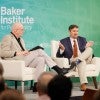
Scott Solomon, teaching professor of biosciences at Rice, headlined a lecture hosted by the Science and Technology Policy Program at Rice’s Baker Institute for Public Policy to discuss those implications.
Rice recently announced a partnership with the Astronaut Scholarship Foundation, which offers students up to $15,000, mentorship, networking and a paid trip to the ASF Innovators Symposium and Gala.
Two Rice scholars are asking what it would mean to treat that long human relationship with space as not just a footnote to engineering but as a central intellectual pursuit.