
As commercial space travel and human settlement beyond Earth near reality, questions about the human body and mind in extreme conditions are crucial. What are the short- and long-term implications for space travelers and future generations, including evolutionary changes?
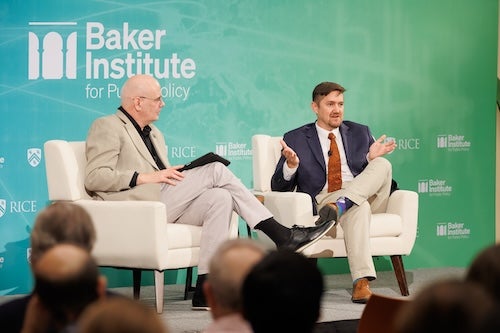
Scott Solomon, teaching professor of biosciences at Rice University, headlined a lecture hosted by the Science and Technology Policy Program at Rice’s Baker Institute for Public Policy to discuss those implications.
“Scott is one of the most talented communicators we have on campus,” said David Alexander, director of the Rice Space Institute, as he introduced Solomon on stage. “He obviously does some interesting research. He does a lot of really cool stuff, but he’s in constant demand for doing tours with our alumni because of the skill he has at bringing that science into the public domain.”
In his new book, “Becoming Martian: How Living in Space Will Change Our Bodies and Minds” (MIT Press, 2026), Solomon examines how human migration into space could reshape human evolution, drawing on biology, genetics and space science research. He framed his approach around the idea of the “civic scientist,” arguing that science communication should illuminate process as much as outcome. Rather than simply reporting conclusions, he said he immerses himself in research environments, observing scientists at work and translating their methods and experiences into narrative form.
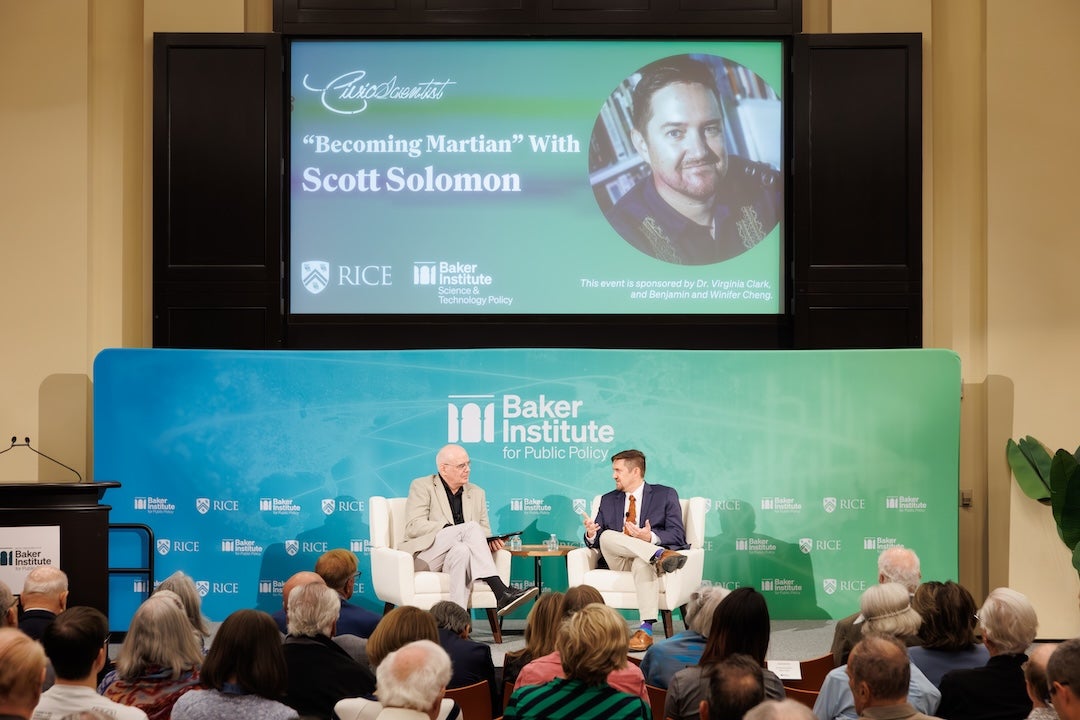
“I’m an evolutionary biologist, and so a lot of what I try to do is think about the biological, the genetic, the physiological changes that could happen to people living for long amounts of time in deep space,” he explained. “But there’s also psychological effects of being in space. And one of the ways that we have learned a lot about this is not only by studying people that are actually in space but by doing simulations.”
Solomon described an “amazing” experience he had while researching the book right on Rice’s campus. Kirsten Siebach was selected by NASA for the team working on the Mars rovers Perseverance and Curiosity and welcomed the organization’s Mars Science Team to Rice to host its sessions. Solomon was able to sit in on these meetings as an observer.
Rice and Houston are at the center of many space initiatives, he said. The Rice Space Institute, for instance, has just created a Space Humanities Initiative with Alexander and the head of Rice’s English department as leads. The team will bring the human aspect into the space exploration conversation, Alexander said.
“Absolutely fascinating work,” Alexander said. “We know a lot about the conditions (on Mars), and we know that the conditions there are quite different, actually, from the conditions in low Earth orbit, where astronauts are actually close enough to Earth that they still benefit from some of the protection of our magnetic field. So how do we make predictions about what would happen to people that are traveling deeper into space, such as to Mars?”
Currently, no one knows exactly what would happen to a person spending a prolonged amount of time in a radiation environment like Mars that also lacks the magnetic field and atmosphere that protects humans on Earth, Solomon said. Science fiction often features people living in glass domes on the surface, but Solomon argues that humans would be more protected by living underground as ants do.
“I would also just add that I think some of the most important questions that we have to be asking — especially as we start to think about the idea of living in space, settling it — are ethical questions,” he said. “I think those are things that we need to be spending time on now, because there’s serious ethical questions, for example, about raising a child in that kind of an extreme environment and the idea that a child born there might not be able to come back to Earth.
“We haven’t even gotten into the topic of should we be using genetic engineering, for example, gene editing to modify the body in order to make it sort of easier for people to live in those conditions? There’s technological, there’s biological questions, but there’s also really important ethical questions that need to be part of that conversation.”
This lecture is part of the Civic Scientist Lecture Series, sponsored by Virginia Clark with support from Benjamin and Winifer Cheng and Rice’s George R. Brown School of Engineering and Computing and Wiess School of Natural Sciences.
“Over the past 20 years, the Civic Scientist Lecture Series has hosted more than 40 speakers at Rice who shared their passion for science and challenges they face with our community,” said Kirstin Matthews, director of the Science and Technology Policy Program. “This includes Nobel lLaureates, directors of the National Science Foundation, presidential science advisors and local scientists, engineers and doctors of distinction. Rice is fortunate to have a history of distinguished civic scientists, including Dr. Lane, as well as our great Nobel Prize winners, Rick Smalley and Bob Curl. Tonight’'s speaker is another great example of a civic scientist.”