
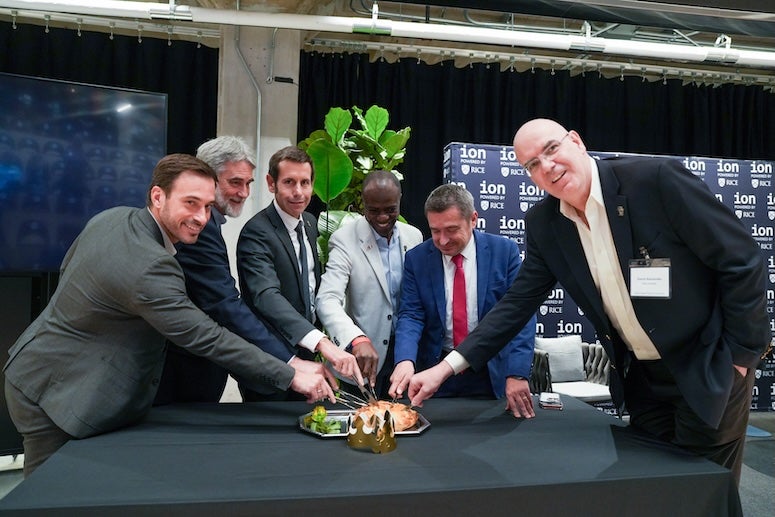
The Ion, Houston’s hub for innovation powered by Rice University, was abuzz Feb. 12 as members of the Houston and French space community met for the inaugural Houston Space Galette. This reception, named for the French king cake, was hosted by the Texas-France Space Hub, a collaboration that aims to unite academic institutes, like Rice, with private enterprises to expand the commercial space presence.
“This evening is about connection and dialogue,” said Hugues Mbezal Bogam, the senior international commercial space expert for Rice and the consulate general of France, as he welcomed the attendees, most of whom had also attended the In-Space Physical AI Workshop prior to the reception. “Space is by essence a collaborative effort. This event lays the groundwork for the next generation of Houston-France cooperation.”
Members of the Houston and French space communities, representing Rice, NASA, the French CNES space agency and the French Embassy, spoke to an excited crowd, highlighting the importance of their ongoing collaborations and their unbridled enthusiasm for the future.
“Space has always been a shared adventure between nations,” said Frank Marchetti, the consul general of France in Houston, highlighting the Feb. 13 launch of SpaceX Crew-12, which included American, French and Russian astronauts, as an example. It was good to have a French astronaut on this particular launch, he added, as Friday the 13th is considered a lucky day in France.
Marchetti also discussed the success of the Texas France Space Hub, which has “moved from exploratory work to concrete operational missions” during its first year, achieving its goals of stimulating innovation and collaboration.
Mathieu Weiss, the French space counselor and CNES representative, pointed out the benefits to infusing the Houston space ecosystem with French talent. Houston had a particular appeal for Weiss as he believed it might finally let him answer the question that plagued his childhood: Should he be an astronaut or a cowboy when he grew up?
“We have a lot more to do,” said David Alexander, professor of physics and astronomy at Rice, director of the Rice Space Institute and a Texas Aerospace Research and Space Economy Consortium member. “But together we can bring forth innovation and advances that will greatly benefit the space ecosystem.”
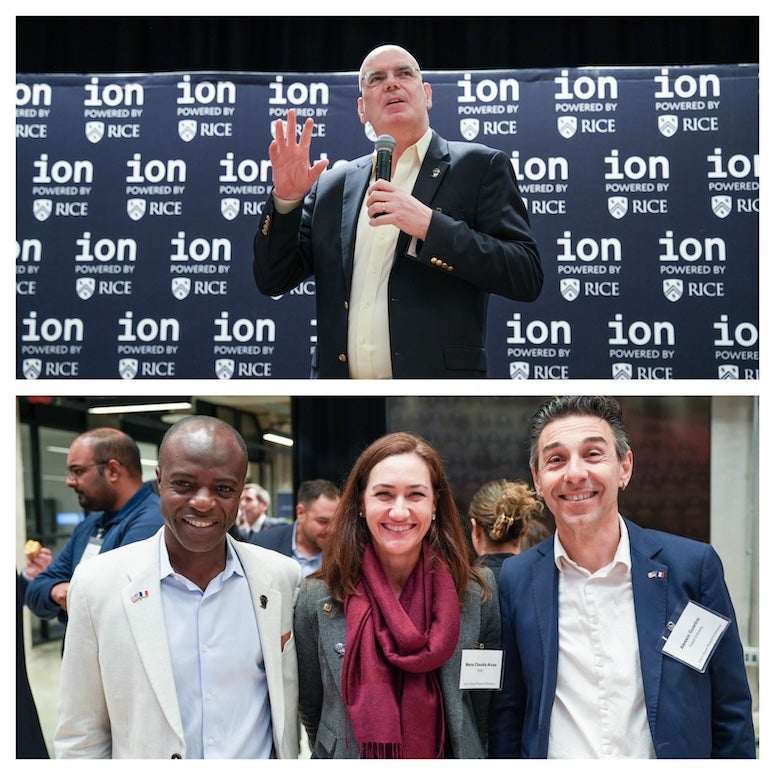
Montgomery Goforth, ’82 and ’87, chief technologist at NASA Johnson Space Center and Rice alumnus, agreed, pointing out the rich history supporting these current efforts. “Our countries [the USA and France] have 250 years of close association,” he said. “We are excited about all the opportunities before our countries, our space agencies and our industries.”
The speakers then gathered to ceremonially cut a small galette, a flaky cake made with almond paste, searching for the astronaut figurine hidden inside. The lucky attendees who found astronauts in their cake slices were awarded a golden crown to wear for the rest of the night. As cake and hors d’oeuvres were passed around the hall, the attendees returned to their conversations, excitedly sharing ideas, innovations and research findings — and the occasional admiration for a colleague’s newly acquired gold paper crown.