
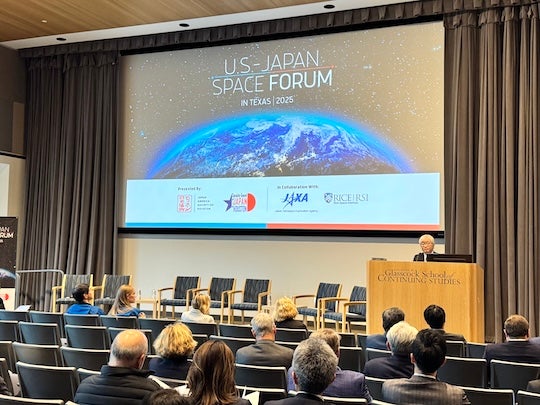
Rice University welcomed more than 120 government, industry and academic leaders Dec. 2 for the 2025 U.S.-Japan Space Forum, co-hosted with the Japan-America Society of Houston and the Consulate-General of Japan in Houston. Held at the Anderson-Clarke Center, the event focused on the future of commercial low Earth orbit destinations and the evolving U.S.-Japan partnership driving orbital innovation.

The forum, organized by Rice physicist David Alexander, came as both countries prepare for the eventual retirement of the International Space Station around 2030. Panelists and speakers emphasized how international collaboration and private sector innovation can carry forward the ISS legacy into a commercially sustainable orbital economy.
“This forum offers a glimpse into how nations working together can build a thriving orbital economy,” Alexander, professor of physics and astronomy, director of the Rice Space Institute and member of the Texas Aerospace Research and Space Economy Consortium, told Rice News. “It’s an exciting time for space development.”
Bilateral commitment
The event opened with remarks from several dignitaries who underscored the strength of the U.S.-Japan space alliance. Zentaro Naganuma, Japan’s consul general in Houston, spoke about the dual scientific and economic significance of space engagement. “Space cooperation is crucial for advancing science and technology,” he said. “Humanity has progressed by exploring cutting-edge innovations.”
Naganuma also noted the workforce and funding already devoted to the space economy. “Approximately 150,000 people are employed in space-related fields,” he said, citing the Texas Space Fund’s $126 million in awards to 22 entities since 2023.
U.S. Rep. Brian Babin (R-Woodville, Texas) offered his greetings via a prerecorded message. “Our nations signed the first space agreement in 1969, the year Americans landed on the moon,” he said. “That partnership remains strong.” He praised Japan’s contributions to NASA’s Artemis program and said he looks forward to advancing together “into the solar system.”
Donna Shafer, associate center director at NASA’s Johnson Space Center, also emphasized that collaboration is central to advancing the commercialization of low Earth orbit. “We don’t do that alone,” she said. “If you want to go fast, go alone. If you want to go far, go together.”
Astronauts reflect on global crew experience
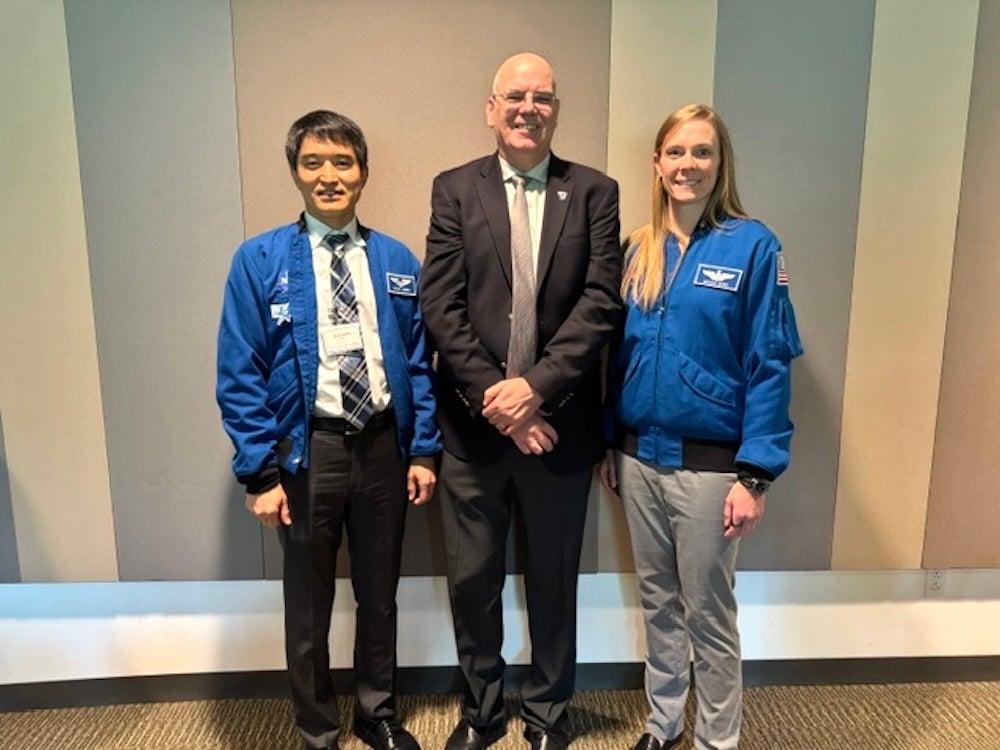
Keynote speakers included astronauts Nichole Ayers, pilot of NASA’s SpaceX Crew-10 mission and Rice alumna, and Takuya Onishi of the Japan Aerospace Exploration Agency. They shared their experiences aboard the ISS and their views on how public and private partnerships could shape future missions.
“There were astronauts and cosmonauts from six countries,” Onishi said. “They conducted scientific research, around 60 studies representing more than 30 countries.” The collaboration, he said, strengthened morale and broadened the mission’s impact.
“We look forward to private sector participation in low Earth orbit after the ISS,” Onishi added. “Hopefully we can transition to commercial LEO destinations, taking advantage of what we have learned.”
Panel explores commercial low Earth orbit opportunities
A panel discussion, led by Alexander, featured leading figures in the commercial space sector.
Panelists included Michael Baine of Axiom Space, Meghan Everett of Vast, Tim Kopra of Voyager Technologies, Randy Lillard of Blue Origin, Yudai Yamamoto of Japan LEO Shachu and Kazuya Yufu of Mitsubishi Heavy Industries. The session focused on challenges and strategies for creating viable commercial low Earth orbit destinations, known as CLDs.
They shared insights on infrastructure, operations and the need for public-private partnerships. They emphasized the urgency of planning now to ensure continuity of research and innovation once the ISS retires.
Strengthening ties for a sustainable future
The event closed with remarks from Takajiro “Tak” Ishikawa, chairman of the Japan-America Society of Houston and president of Mitsubishi Heavy Industries America. His presence highlighted the strong corporate and cultural connections between the two nations in space innovation.
Industry leaders across sectors emphasized that sustaining orbital research and development depends on building global partnerships and commercial pathways. Many participants noted that the forum served not just as a discussion but as a step toward a shared orbital economy.
“As the ISS chapter closes, we’re at a pivotal moment,” Alexander told Rice News. “The steps we take now together will define how humanity thrives in space for decades to come.”